The Daughter I Mourned Was Never Gone
Losing Eliza at birth didn’t end in a single moment. It settled into my life slowly, shaping everything that came after. There was no clear line between grief and routine—just an absence that followed me through the years as I raised her twin sister, Junie, on my own.
My husband couldn’t carry it the same way I did. At some point, the weight became too much for him, and he left. I didn’t argue. There are losses you can’t divide evenly, and I understood that, even if I didn’t agree with it.
So it became just the two of us.
Junie grew up knowing she had a sister she would never meet. I tried to speak of Eliza gently, without turning her into a shadow that hovered over everything. Life found its rhythm again—not complete, but steady enough to move forward.
Then one afternoon, everything shifted in a way I wasn’t prepared for.
Junie came home from her first day of school with a kind of excitement that didn’t match the usual stories children bring back. She talked quickly, her words overlapping, insisting that I needed to pack an extra sandwich the next day—for a girl named Lizzy.
“She looks just like me,” she said, as if that alone explained everything.
I smiled at first, the way you do when children say things that don’t quite make sense yet. But then she handed me a photograph.
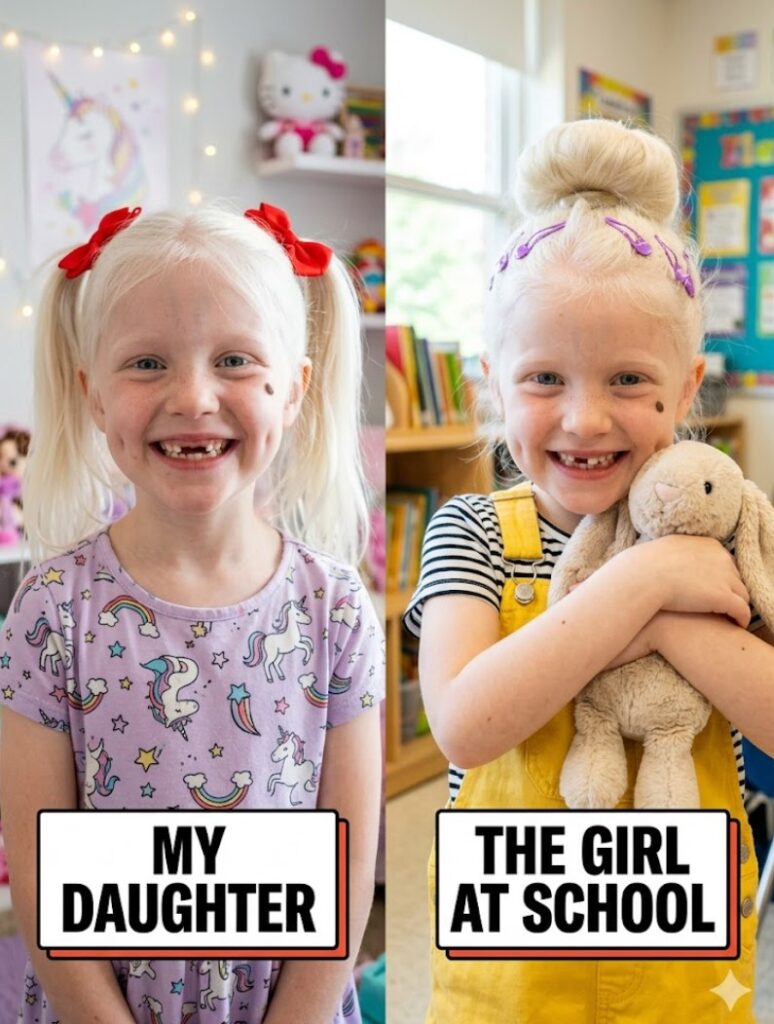
It had been taken in the classroom. A simple picture. Two girls standing side by side.
They were identical.
The same curls, the same freckles, the same expression caught mid-smile.
I didn’t react immediately. I just held the photo, letting my mind try to find a reasonable explanation—something that would bring it back into the boundaries of what I understood to be possible.
There wasn’t one.
That night, I didn’t sleep.
The image stayed with me, refusing to settle into anything I could dismiss. By morning, I wasn’t searching for explanations anymore. I needed to see for myself.
I walked Junie to school, more aware of every step than I had been in years. The parking lot was full, ordinary in every visible way. Parents talking, children moving past us, nothing that suggested anything unusual.
Then Junie pointed.
“There she is.”
I followed her gaze.
And for a moment, everything narrowed.
The girl stood a few feet away, exactly as she had appeared in the photograph. But it wasn’t just her that stopped me. It was the woman behind her.
I recognized her.
Marla.
The nurse who had been in the room the night my daughters were born.
Recognition came first. Then something colder followed.
Before I could step forward, another woman approached—Suzanne. She looked uncertain, like someone who had been waiting for a moment she wasn’t sure how to face. What followed wasn’t immediate. It came in pieces, slowly, as if each word needed to be placed carefully to avoid collapsing under its own weight.
There had been complications during the delivery.
Confusion.
Mistakes.
And then decisions made in panic—records altered, details reshaped to avoid consequences that felt too large to confront. Somewhere in that chaos, Eliza had not died.
She had been sent home.
Just not with me.
Suzanne spoke about discovering the truth later, during a medical emergency that revealed what had been hidden. She said she had known for two years. That part settled differently.
Not as shock.
As something heavier.
She hadn’t spoken because she was afraid—afraid of losing the child she had raised, the life they had built together. It wasn’t an excuse, and she didn’t offer it as one. It was simply the truth of the choice she had made.
Marla, too, spoke about her role. About how a single decision made under pressure had turned into something that couldn’t be undone easily. One lie had required another, and over time, it had become something larger than any of them knew how to correct.
For six years, I had grieved a child who had been alive.
There isn’t a clear way to describe what that realization feels like. It doesn’t arrive as a single emotion. It shifts—between disbelief, anger, confusion, and something else that doesn’t have a name.
The days that followed moved quickly.
Investigations, legal steps, questions that needed answers. The hospital became involved, then authorities. Everything that had been hidden began to surface in a way that couldn’t be contained anymore.
But within all of that, there was something else that required attention.
The girls.
Junie and Lizzy didn’t understand the full weight of what had happened. They didn’t need to. What they saw was simple—they had found each other. That connection was immediate, instinctive, something that didn’t wait for explanation.
And that became the center of every decision that followed.
Suzanne loved Lizzy. That much was clear. And no matter what I felt about the silence, I couldn’t ignore that truth. Removing her entirely would have meant creating another kind of loss, one that the girls would carry.
So we made a decision that wasn’t clean, but it was honest.
We would not separate them.
What came after wasn’t easy. Building something new out of something that had been broken for years takes time. It required boundaries, conversations, and a willingness to sit with discomfort without trying to resolve it too quickly.
The past didn’t disappear.
It stayed, in the spaces between things, in the questions that didn’t have simple answers.
But alongside it, something else began to take shape.
A new kind of normal.
Now, I watch them together—laughing, arguing, moving through the world side by side in a way that feels natural to them. The years that were lost can’t be returned. That part remains.
But the future is no longer divided.
And sometimes, that’s where healing begins—not in fixing what can’t be undone, but in choosing carefully what comes next.