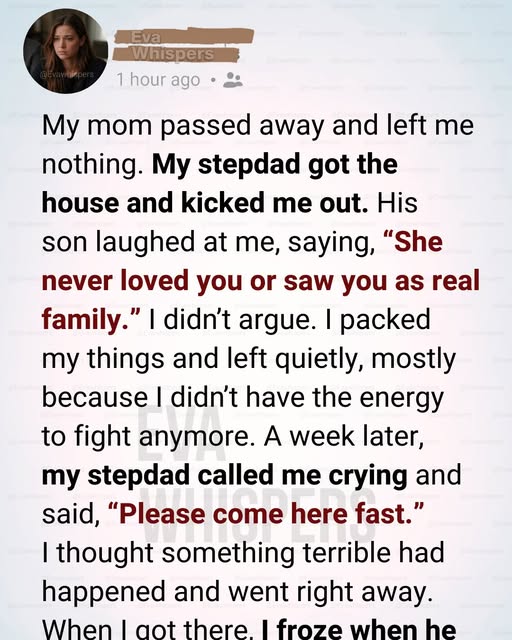
When I arrived at my old house and saw police lights washing the driveway in red and blue, fear rose before thought could catch it. I barely waited for the taxi to stop before stepping out and running toward the door.
My stepfather stood on the porch, smaller somehow, as if the night had taken years from him. His eyes were swollen from crying. He tried to speak, but no words came. He only gestured toward the living room.
There, beneath a white sheet, was the shape of his son on the sofa.
The reality settled slowly, heavily.
We sat together in silence at first. Then he broke — not dramatically, but completely — admitting that grief had turned him harsh and that anger had made him blind. He apologized for how he had treated me after my mother’s death. For allowing cruelty. For failing to protect me when I needed it most.
Not excuses.
Just ownership.
After a moment, he reached into his bag and pulled out a folder. The night before, he said, he had finally gone through my mother’s documents.
Inside was her will.
She had left the house to both of us. And she had set aside money for my education — quietly planning for a future she knew she wouldn’t see.
There was also a letter, written only to me.
She called me the greatest gift of her life. She told me to stay strong, to stay kind, to trust that I was loved even when things felt uncertain.
Reading her words lifted something I hadn’t known I was still carrying — the fear that I had somehow been forgotten.
I wasn’t.
She had thought of me carefully.
Tenderly.
Always.
I stayed with my stepfather for a few days. We grieved — not just for the son he lost, but for the years of misunderstanding and pain between us. He continued to apologize, not once, but with changed behavior. And I allowed room for that change to grow.
Healing wasn’t instant.
But it was real.
Later, I used my mother’s savings to move closer to college and focus on building my life. My stepfather and I remain in contact, learning slowly how to treat each other with honesty and respect.
The past still exists — but it no longer controls us.
What matters now is what replaced it: accountability, care, and a clearer understanding of love.
I no longer measure myself by the harsh words that once surrounded me.
I measure myself by the truth my mother left behind.
And that truth is simple, steady, and enough:
I was loved.
I was planned for.
I was never invisible.
Sometimes closure doesn’t come through answers.
It comes through being seen — even after loss.
And sometimes healing begins not when pain disappears,
but when responsibility finally meets compassion.