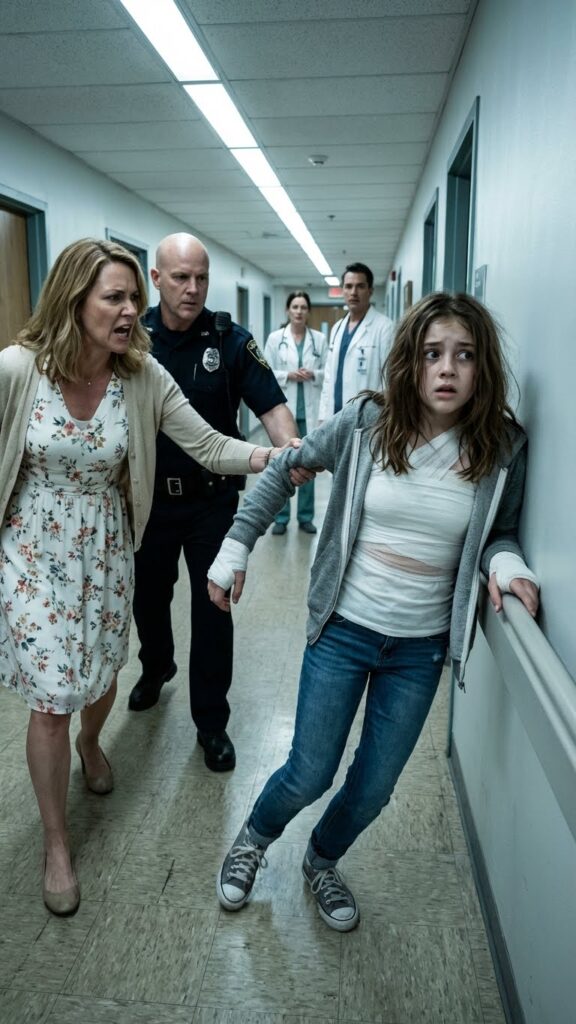
The moment everything began to change was almost invisible.
It wasn’t a dramatic reaction or a sudden outburst—just a slight shift in the nurse’s expression. A tightening in her face, a pause that lasted a second too long. But after years of living in silence, I recognized it immediately. It was concern. Real concern. And that small change made something inside me drop.
For as long as I could remember, I had lived within my mother’s version of discipline. I believed the bruises hidden under long sleeves were my fault—that I was careless, slow, or ungrateful. In our home, silence wasn’t just quiet; it was protection. Speaking the truth could make things worse, so you learned not to speak at all.
But in that exam room, surrounded by sterile walls and glowing scans, something felt different. The silence no longer protected—it exposed. For the first time, it felt like someone else could see what I had been hiding.
The next afternoon, Child Protective Services arrived.
There were no sirens, no chaos. Still, their presence felt like something fundamental shifting. My mother greeted them at the door perfectly composed—hair neat, clothes pressed, voice warm and convincing. She knew how to present a version of reality that others would believe.
Our home had always been like that—orderly, controlled, a place where appearances mattered more than truth. I stood behind her, part of the picture she carefully maintained.
When they asked to speak with me alone, I felt her grip tighten on my shoulder—a silent warning of what would come later. She laughed it off, saying I was shy. But this time, the adults didn’t step back.
The woman knelt to my level, her voice calm. She said they had seen the scans. She said they needed to understand what had happened.
I froze.
Telling the truth had always carried consequences. But something about that moment—the nurse’s expression, the quiet persistence of these strangers—made me hesitate in a different way.
I realized I was tired.
Tired of the fear. Tired of holding my breath. Tired of pretending everything was normal.
When I spoke, my voice barely sounded like mine.
I told them.
At first it came slowly, then all at once—details I had buried, words I had never allowed myself to say out loud. I explained how I got hurt, what happened behind closed doors, how things changed when no one else was watching.
That night, they took me away.
I packed what little I had into a single backpack—some clothes, a couple of books, and a sketchpad I had kept hidden. As we drove away, I looked back. My mother stood still on the porch, not upset in the way others might expect, but rigid, controlled.
It was the first time I had spoken, and everything had changed.
Foster care didn’t feel safe right away. It took time to understand that quiet could exist without fear. That making a mistake didn’t lead to consequences.
One moment stays with me more than anything else.
A bowl slipped from my hands and shattered on the floor. Instinct took over—I curled up, bracing myself, waiting.
But nothing happened.
Instead, someone knelt beside me and gently asked if I was okay.
When I begged not to be hurt, they reassured me softly. It was just an accident. Nothing more.
That moment felt unfamiliar, almost overwhelming. Not because of what happened—but because of what didn’t.
Months later, the case went to court.
I was terrified. My voice shook. But I spoke again, this time in a room full of people. I told my story as clearly as I could. The medical evidence supported what I said. It wasn’t dismissed or explained away.
When it was over, everything felt quiet again—but different.
Outside the courtroom, the nurse found me. She handed me a scarf and asked how I was doing.
I told her she had saved me.
She shook her head gently and said something I didn’t fully understand at the time:
She had only noticed.
I was the one who spoke.
For the first time, I started to believe that was true.