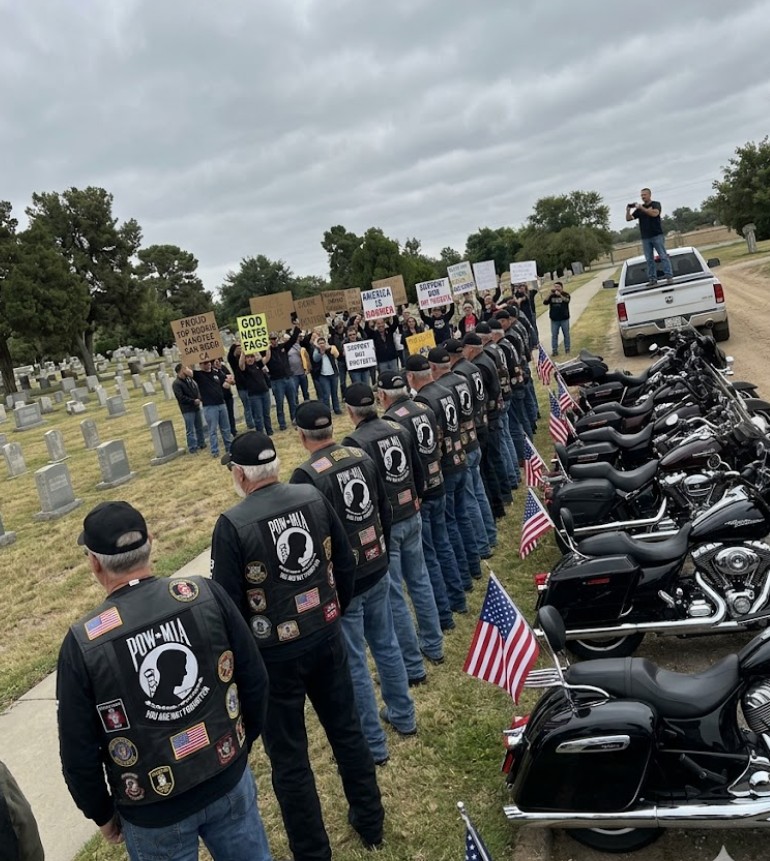
I was kneeling beside my son Daniel’s casket on a quiet Tuesday, trying to hold myself together in a moment no parent is prepared for. He was twenty-four. My husband Earl stood nearby, and our chaplain spoke gently, but even those small anchors felt distant. Grief has a way of narrowing everything.
Then the noise began.
Across the road, a group of protesters gathered, their voices cutting through the stillness. My husband and the chaplain tried to shield me from it, but some things reach you anyway. I closed my eyes and wondered how even this moment—one that should have been left in peace—could be disturbed.
Before it could go further, the sound of engines filled the air. About fifty bikers entered the cemetery and positioned themselves in a line, forming a barrier between us and the shouting. They didn’t rush, didn’t posture. They simply took their place, steady and present.
When one protester climbed up to continue, an older man from the group walked toward the fence. He didn’t raise his voice. He spoke clearly, saying he had buried his own son years earlier, and that no grieving parent should have to endure this. There was no threat in his tone—just a boundary that didn’t invite argument. The shouting faded. The group left.
The service continued as it should have from the beginning. The bikers stood quietly, hands over their hearts during the bugle call. When I received Daniel’s folded flag, the same man—his patch read “Doc”—gave me a small nod. Nothing dramatic. Just acknowledgment.
Afterward, they escorted us to the reception. People stood along the streets, offering their presence in silence. Doc explained that they had come because others had once stood for him in the same way, when he buried his own son. Before leaving, he handed me an envelope and said to open it when I was ready.
I waited a few days. Sitting in Daniel’s room, I opened it. Inside was a list of all fifty riders, each with the name of someone they had lost or honored. At the bottom, Doc had written that Daniel’s name had been added—that he would be carried with them from now on.
It didn’t remove the grief. Nothing does. But it shifted something in how alone I felt within it.
Months later, Doc invited me to join them for another funeral. A young Marine, Anthony Morales, had been lost. I went. Not because I felt strong, but because I understood what it meant to have someone stand between you and the worst of the world when you’re already carrying enough.
I met his mother, Elena. I held her hands and told her the truth as simply as I could—that she didn’t have to face the day unprotected, and that the people outside were there to make sure of it. I didn’t offer words to fix anything. There aren’t any. Just presence.
Grief doesn’t disappear. It changes shape, and sometimes it becomes something you can carry for someone else, even briefly. And in those moments, something quiet but real passes between people who understand without needing much explanation.