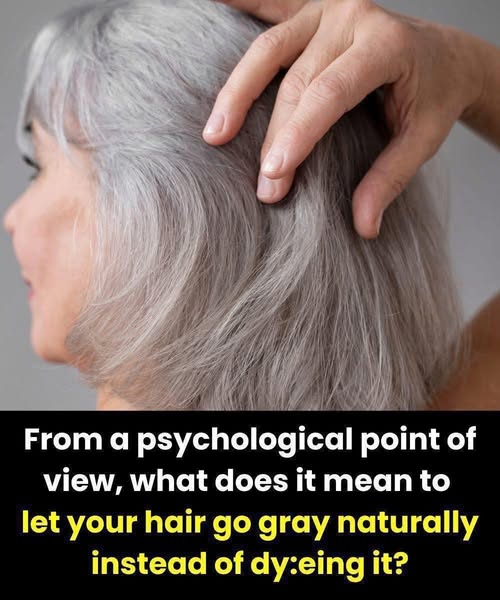
The sight of a woman embracing her natural gray hair is often treated as something unusual, though it need not be. It is not simply a change in appearance—it quietly challenges expectations that many have accepted without question. In a culture that places strong emphasis on preserving youth, choosing not to conceal the passage of time can feel out of place. Not because it is wrong, but because it steps outside what is commonly practiced.
The reactions it draws are not always about appearance itself. More often, they reflect discomfort with what gray hair represents. It makes visible something that is usually managed quietly—change, aging, the limits of control over one’s own body. Many are accustomed to softening these realities through routine and presentation. When someone chooses not to do so, it can feel unfamiliar, even unsettling, not because it lacks beauty, but because it removes a layer people rely on.
There is also a long-standing expectation placed more heavily on women—that appearance should remain refined and resistant to time for as long as possible. These expectations are rarely stated directly, yet they are widely understood. Choosing to step outside them is not necessarily an act of defiance, but it does signal a shift in focus. It moves attention away from meeting external standards and toward a more internal sense of alignment.
For many, this decision comes with a change in how they carry themselves. Not in a dramatic way, but in a quieter confidence. When the need to meet certain expectations lessens, there is more room for consistency—being as one is, rather than adjusting constantly to fit what is preferred by others. That steadiness is often what people notice, even if they do not name it directly.
Gray hair, in this sense, becomes less about appearance and more about acknowledgment. It reflects time lived, experiences carried, and changes accepted rather than concealed. It does not ask for approval, nor does it require rejection of those who choose differently. It simply stands as it is.
As more people become comfortable with this, reactions begin to shift. What once felt unfamiliar becomes more understood. Not celebrated loudly, but recognized with less resistance.
In the end, it is not about choosing one path over another, but about choosing with awareness.
And allowing that choice to remain without the need to defend it.
{"post":98383,"page":1,"next":[{"id":98361,"title":"From a Family of Educators: The 1980s Star Who Still Treasures His Privacy Today","url":"https:\/\/new24.info\/98361"},{"id":98357,"title":"Heartfelt News from the Parton Family","url":"https:\/\/new24.info\/98357"},{"id":98354,"title":"Robert Irwin\u2019s Alleged New Romance Draws Fan Attention","url":"https:\/\/new24.info\/98354"},{"id":98351,"title":"If You\u2019ve Noticed Ridges in Your Fingernails, This Is What It Really Means","url":"https:\/\/new24.info\/98351"},{"id":98346,"title":"30 Minutes ago in California, Kevin Costner was confirmed as..","url":"https:\/\/new24.info\/98346"},{"id":98342,"title":"Startling Midnight Police Visit Uncovers A Hidden Secret About My Sister","url":"https:\/\/new24.info\/98342"},{"id":98339,"title":"Discover How Celine Dion Fights Her Toughest Battle After A Legendary Career","url":"https:\/\/new24.info\/98339"},{"id":98336,"title":"Beloved TV Star and His Wife Share a Heartwarming Moment Caught on Camera","url":"https:\/\/new24.info\/98336"},{"id":98331,"title":"A Life Beyond the Spotlight: Choosing Purpose, Simplicity, and Meaning","url":"https:\/\/new24.info\/98331"},{"id":98328,"title":"My Husband Faked His Wedding Day Death To Steal Family Wealth","url":"https:\/\/new24.info\/98328"},{"id":98310,"title":"How A Four Dollar Gas Station Gift Changed My Entire Life","url":"https:\/\/new24.info\/98310"},{"id":98321,"title":"Shania Twain\u2019s Latest Performance Outfit Sparks Online Reactions","url":"https:\/\/new24.info\/98321"},{"id":98318,"title":"Spanish woman, 25, to be euthanized later today \u2013 her heartbreaking decision explained","url":"https:\/\/new24.info\/98318"},{"id":98315,"title":"Heartbreaking 3-Word Message From 25-Year-Old Woman Before Being Euthanized Today","url":"https:\/\/new24.info\/98315"}]}