
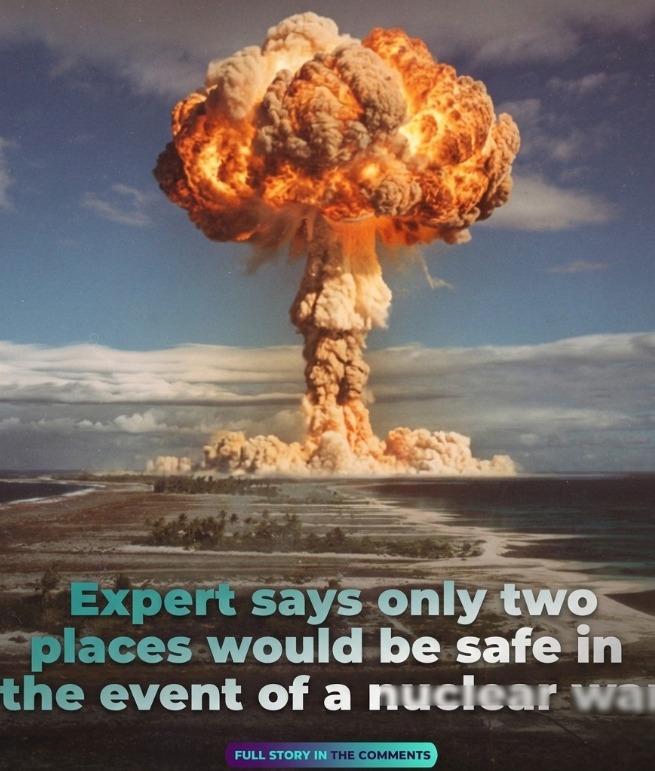
Rising geopolitical tensions periodically revive an unsettling question: if a large-scale nuclear conflict were to occur, where would survival be most likely?
Experts consistently stress that no location would be entirely insulated from the global consequences of a nuclear war. However, researchers who study nuclear winter scenarios, atmospheric science, and food systems have examined which regions might fare comparatively better under worst-case conditions.
Geography and Distance From Primary Targets
Most of the world’s nuclear arsenals are concentrated in the Northern Hemisphere. Strategic military installations, missile silos, and major political centers are also primarily located there. Because of that, analysts often note that countries in the Southern Hemisphere — particularly New Zealand and Australia — are geographically distant from likely primary targets.
Distance does not guarantee safety. Long-range missiles, shifting alliances, and global fallout patterns complicate predictions. But relative isolation reduces the probability of being an immediate first-wave strike zone in many modeled scenarios.
The Nuclear Winter Factor
The more complex threat is not the blast itself, but the aftermath.
Research on “nuclear winter” — a scenario in which smoke from widespread fires enters the upper atmosphere and blocks sunlight — suggests that global temperatures could drop significantly. Shorter growing seasons and reduced sunlight would severely disrupt agriculture, particularly in already temperate or colder regions.
Studies led by atmospheric scientist Owen Toon and others indicate that even a limited regional nuclear exchange could disrupt global food production for years. In a full-scale conflict, the resulting agricultural collapse could trigger widespread famine affecting billions.
Southern Hemisphere nations with strong agricultural sectors, diversified food systems, and relatively mild climates could be better positioned to maintain some level of food production under reduced sunlight conditions.
Agriculture as the Critical Variable
Modern civilization depends heavily on globalized supply chains. Even regions untouched by direct strikes would face disruptions in fuel distribution, fertilizer production, trade networks, and refrigeration systems.
Countries with:
- Large areas of arable land
- Strong domestic food production
- Low population density relative to food output
- Stable freshwater resources
would likely have better odds of sustaining survivors.
New Zealand, for example, has high agricultural output relative to its population size. Australia also has vast agricultural regions, though parts of the country are climate-sensitive and water-dependent.
Radiation and Long-Term Risks
Even distant nations would not be immune to:
- Atmospheric radiation transport
- Ozone layer damage
- Economic collapse
- Migration pressures
- Infrastructure strain
Fallout patterns depend heavily on wind systems and the scale of detonations. Global interconnectedness means that no country would function normally in the aftermath of a major nuclear war.
Within the United States
In U.S.-focused discussions, analysts often point out that states hosting strategic missile silos — such as Montana, North Dakota, Wyoming, Nebraska, and Colorado — would likely be high-priority targets in a large-scale exchange.
Regions without major military infrastructure might avoid immediate strikes. However, long-term food shortages, radiation drift, and infrastructure breakdown would still present serious challenges nationwide.
A Sobering Conclusion
While some geographic regions may offer comparatively better survival conditions, the overarching reality remains sobering: a large-scale nuclear conflict would produce global humanitarian, ecological, and economic consequences.
Preparedness discussions tend to converge on three major survival factors:
- Distance from primary targets
- Agricultural resilience
- Stable governance and infrastructure
Countries like New Zealand and Australia are often cited in theoretical modeling because they combine geographic isolation with agricultural capacity. That does not make them “safe” — only potentially less immediately catastrophic compared to densely targeted regions.
Ultimately, the conversation underscores a deeper truth: prevention, diplomacy, and nuclear risk reduction remain far more viable strategies than survival planning.
The best-case scenario is not finding the safest corner of the world — it is ensuring such a scenario never unfolds at all.