
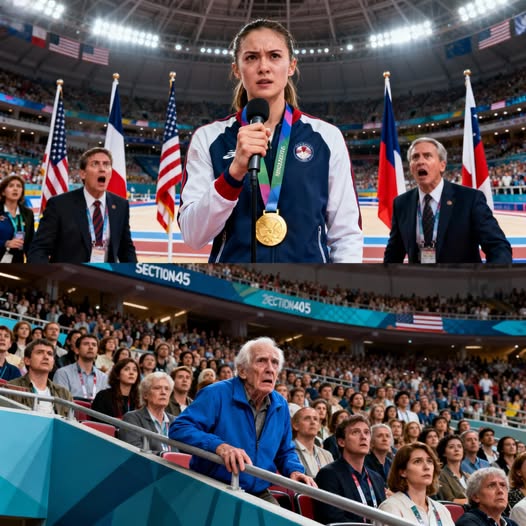
The live global broadcast of the 2026 Olympic Gymnastics Finals was expected to end with an anthem and applause. Instead, it ended in stillness.
Maya Porter, newly crowned gold medalist, stood on the podium beneath bright arena lights. Her floor routine had been flawless—disciplined power carried by quiet confidence. As officials prepared for the ceremony, she reached for the microphone.
“I’m not leaving this podium,” she said, steady but composed, “until security brings me the man in Section 405, Row 12, Seat 4.”
Fifteen thousand spectators turned toward the upper tiers. High above sat an elderly man in a worn blue jacket: Earl Whitmore. He had come alone. He had expected to leave the same way.
A Dream That Changed Form
In 1976, Earl had missed making the U.S. Olympic team by two places. Soon after, an ankle injury ended his competitive career. For years, that near-miss lingered like an unfinished sentence.
He chose not to abandon the sport. Instead, he coached at a small-town recreation center in Greyfield. When budget cuts closed the facility, he salvaged what equipment he could and continued mentoring wherever space allowed.
Loss did not embitter him. It redirected him.
The Parking Lot
On the final day before the center shut down, Earl noticed a nine-year-old girl practicing cartwheels in a parking lot. Her movements were controlled, intentional—beyond imitation.
Her name was Maya Porter.
Her mother, Grace, worked long hours as a waitress. Formal training was out of reach. Maya learned from library videos and instinct.
Earl offered to coach her at no cost. Grace hesitated—careful with her daughter’s future—but after hearing his story, she agreed. Trust was placed quietly, not blindly.
Training began on weekends, using repaired beams and worn mats. Earl paid for leotards from his retirement savings. He did not speak of sacrifice; he treated it as responsibility.
Strain and Encouragement
At home, the picture was more complicated. Earl’s son, Dany, had grown up feeling secondary to the gym. Years of unspoken resentment created distance that neither fully bridged.
Around the time a national scout discovered Maya at a regional competition—earning her a scholarship to a national training center—Earl’s wife, Linda, received a terminal diagnosis.
Even as her strength faded, Linda urged him to keep mentoring. “Some dreams aren’t meant to be worn,” she told him once. “They’re meant to be carried forward.”
She passed away before Maya entered Olympic training camp.
Grief remained. So did purpose.
The Final
Years later, Maya stood in the Olympic arena as one of the sport’s brightest talents. Commentators praised her composure. Viewers saw precision. Few knew the long road beneath it.
Earl bought a single ticket and chose a seat far from the cameras. He did not want to distract her. He came to witness, not to claim.
When Maya secured the gold medal, he wept—not loudly, but with the weight of decades settling into one moment.
Then security reached him.
Behind him stood Dany. He had received a letter from his late mother, urging him to see what his father had built. They descended together.
A Medal Repositioned
On the podium, Maya stepped down from her place. The cameras followed, confused at first. She approached Earl and lifted the medal from her neck, placing it over his shoulders.
“You once told me you missed the Olympic team by two spots,” she said. “You didn’t miss it. You were building something bigger.”
The arena fell silent.
It was not a rejection of her achievement. It was a recognition of its roots.
What Endures
Great victories are rarely solitary. Talent may belong to one person; formation rarely does. Behind discipline stands instruction. Behind confidence stands someone who believed early, when belief carried no spotlight.
Earl once thought his Olympic story ended in disappointment. In truth, it matured into legacy. Not all dreams are fulfilled in the form we expect. Some are fulfilled in the lives we help shape.
The broadcast concluded without spectacle. Viewers witnessed not only athletic excellence, but reconciliation—a father and son standing side by side, a student honoring her teacher, grief and purpose intertwined without drama.
The moment did not diminish Maya’s gold. It clarified it.
Success shines brightest when it remembers its foundations.