
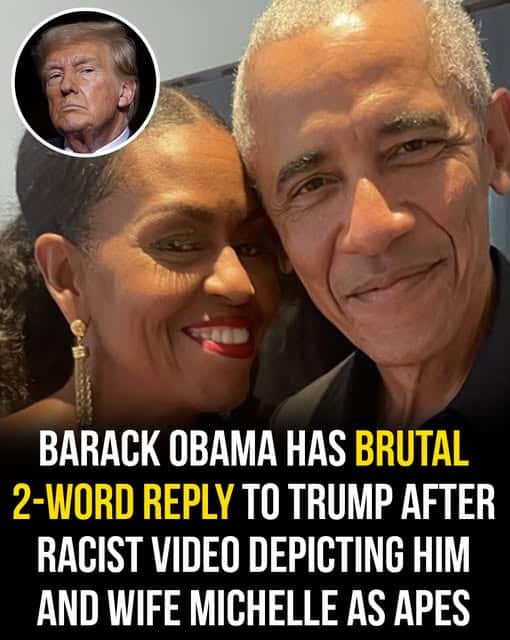
🇺🇸 A Viral Post, a National Reckoning: How One Video Sparked a Wider Debate
In early February 2026, a brief video posted on Donald Trump’s account on Truth Social ignited a wave of controversy that quickly spread across the country.
The clip included a segment in which Barack Obama and Michelle Obama appeared with their faces superimposed onto animated ape bodies. Though the broader video focused on disputed claims about the 2020 election, this moment revived one of the most harmful racist tropes in American history.
The post remained online for roughly 12 hours before being removed amid widespread criticism.
What followed was not just outrage over a single clip, but a larger conversation about race, leadership, and responsibility in the digital age.
📱 The Post and the Immediate Backlash
The video appeared late on February 5 and quickly circulated beyond Trump’s core supporters. Within hours, journalists, civil rights organizations, and public officials condemned the imagery as offensive and dehumanizing.
One of the most notable responses came from Tim Scott, who publicly criticized the post and called for its removal, describing it as deeply inappropriate. His remarks stood out as a rare instance of a senior Republican rebuking Trump on racial grounds.
On the Democratic side, Gavin Newsom labeled the imagery a “racist trope” and urged leaders from both parties to reject it.
Social media platforms filled with debate, with some defending the post as satire and others calling it a dangerous normalization of racist symbolism.
🏛️ The White House Response
Initially, the White House attempted to downplay the controversy.
Press Secretary Karoline Leavitt dismissed the criticism as “fake outrage,” describing the clip as part of a broader meme portraying Trump as the “King of the Jungle.” In comments to media outlets, she urged critics to focus on policy issues instead.
As pressure mounted, aides removed the video and said it had been posted in error by a staff member.
Trump himself did not apologize. He maintained that the focus should remain on the video’s political message and minimized the significance of the offensive segment.
For many observers, this refusal to acknowledge harm became as controversial as the post itself.
🎙️ Barack Obama Responds
For several days, the Obama family remained silent. That changed on February 14, when Barack Obama addressed the issue in an interview with political commentator Brian Tyler Cohen.
Rather than focusing narrowly on the insult, Obama framed the incident as part of a broader decline in political norms.
He described the imagery as “deeply troubling” and warned that sensationalism and provocation were replacing decency in public life.
He emphasized that, in his experience traveling around the country, most Americans still value courtesy, kindness, and mutual respect — even when political disagreements are intense.
“There doesn’t seem to be any shame about this anymore,” he said, reflecting on how standards of public conduct have eroded.
🧭 From One Clip to a Broader Critique
In the same interview, Obama also expressed concern about federal enforcement practices under the Trump administration, particularly involving U.S. Immigration and Customs Enforcement.
While his remarks echoed long-standing critiques from civil liberties groups, he was careful to frame his comments around principles of dignity, fairness, and rule of law rather than partisan attacks.
His central argument was consistent: leadership should model restraint, respect, and responsibility — especially in moments of tension.
📰 Media Coverage and Political Impact
Major outlets, including Associated Press and PBS NewsHour, highlighted the historical context of comparing Black people to animals and why the imagery resonated so painfully.
Analysts noted that this context made the backlash swift and bipartisan.
The episode also renewed scrutiny of how presidents use social media. Platforms that allow direct communication can strengthen democratic engagement, but they can also amplify harmful content when used carelessly.
Many commentators argued that this incident demonstrated the risks of unfiltered presidential messaging.
⚖️ Supporters, Critics, and Divided Reactions
Trump’s supporters responded in different ways. Some dismissed the controversy as exaggerated. Others emphasized the White House’s claim that the post was shared accidentally.
Still, civil rights advocates and many ordinary citizens found those explanations unsatisfying.
To them, the incident raised deeper concerns about how political leaders influence social norms and what kinds of language and imagery become acceptable when used from positions of power.
🌱 Why This Moment Matters
This controversy was not only about a single offensive image. It reflected larger questions about:
-
The boundaries of political speech
-
Respect in a multiracial democracy
-
The role of social media in shaping national culture
-
Accountability for those in power
When a sitting president circulates racially charged imagery, it becomes a test of how seriously society takes its commitment to equality and dignity.
Obama’s response, measured but firm, sought to redirect attention toward shared civic values rather than personal grievance.
🔮 Looking Ahead: Leadership in the Digital Age
As political communication continues to evolve, incidents like this highlight the growing responsibility of public figures in online spaces.
Presidents and political leaders are no longer just policymakers. They are cultural influencers whose posts can shape attitudes, normalize behaviors, and inflame or calm divisions.
Public reaction to this episode showed that many Americans — across parties — still expect limits grounded in basic human respect.
📌 Conclusion: A Flashpoint With Lasting Meaning
The Truth Social video may have been brief, but its impact was lasting.
It exposed how quickly digital content can become a national crisis.
It revealed deep anxieties about race and leadership.
It reignited debates about accountability and decorum.
More importantly, it reminded the country that democratic debate, however fierce, loses its legitimacy when it crosses into dehumanization.
In calling for decency, restraint, and kindness, Barack Obama gave voice to a sentiment shared by many Americans: political disagreement is inevitable — but respect is not optional.
Ultimately, the direction of political culture will be shaped not only by leaders, but by voters who decide what behavior they reward, tolerate, or reject.