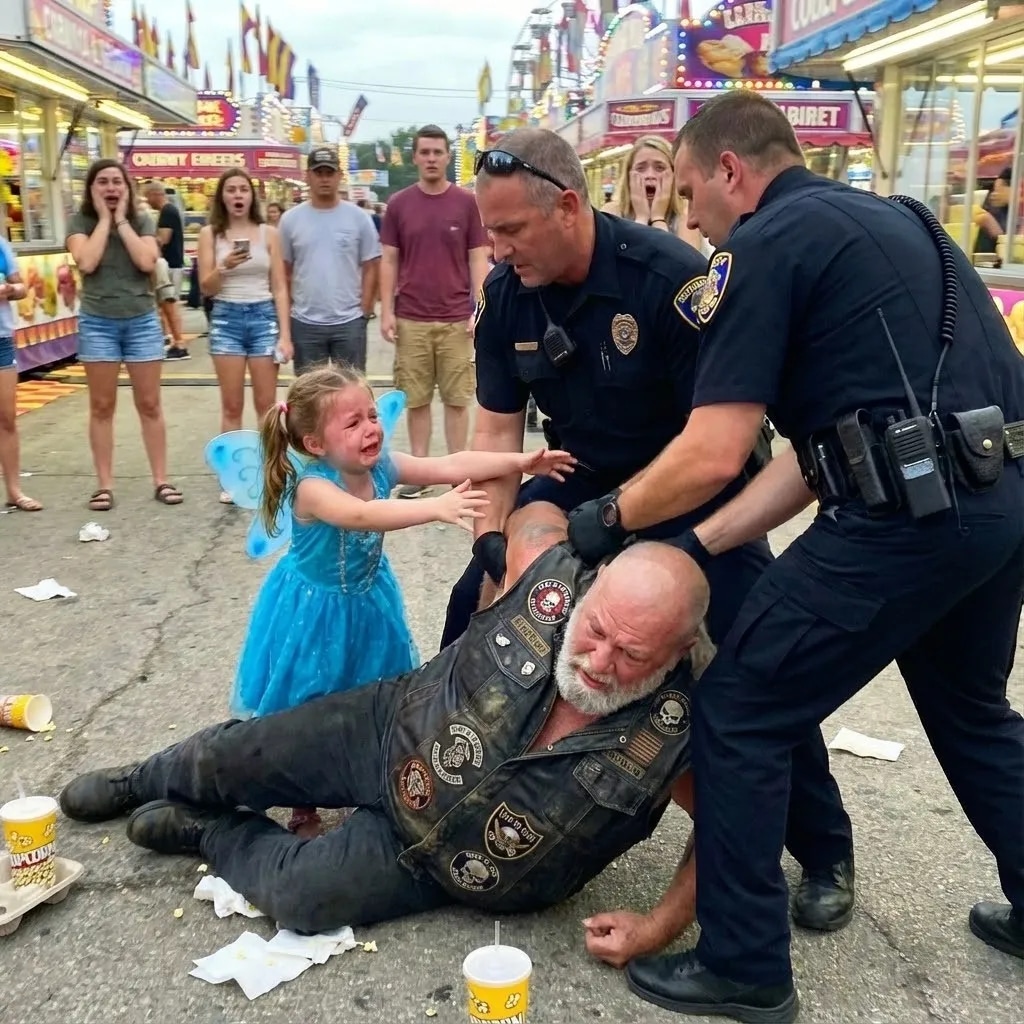
My daughter’s scream rose above the hum of the county fair — not loud with mischief, but sharp with fear.
“That’s my grandpa,” she cried, her small hands pushing against the arms of the officers holding my father on the ground.
She was five, dressed in a pink fairy costume he had just bought her. A child trying to protect the man who had spent his life protecting others.
I wasn’t there that day. I was recovering from surgery, trusting my father — a quiet, sixty-seven-year-old veteran who fixes things, keeps his promises, and plans small joys carefully — to give Lily a happy afternoon.
He had done everything right.
The dress. The treats. The patient tying of her shoes.
What he hadn’t planned for was being seen as a danger.
Someone had called the police about a “dirty old biker.”
And that description was enough.
The officers didn’t ask what he was doing.
They didn’t look at the little girl holding his hand.
They acted fast, the way fear moves when it thinks it recognizes a threat.
My father was pulled back, pressed to the asphalt, treated like a problem to control instead of a person to understand.
The injury to his knee healed.
The deeper wound took longer.
A man who had built half the buildings in our town — who had raised children, served his country, and never raised a hand in harm — suddenly felt unsafe simply being visible.
He stopped visiting Lily. Not out of anger. Out of fear that his presence might bring trouble to her again.
And Lily waited.
Every afternoon she sat by the window, listening for the motorcycle that no longer came.
She asked if she had done something wrong.
She asked if Grandpa was mad at her.
There are moments when injustice doesn’t just hurt — it rearranges how safe the world feels.
Healing didn’t arrive loudly.
It came through a hard conversation with the woman who had made the call — someone who learned, face to face, what her assumption had done.
It came through support from strangers who reminded my father that dignity doesn’t disappear because of a stereotype.
It came slowly, through courage returning in small steps.
One day, Grandpa came back.
Lily ran to him with tears and fierce relief, wrapping her arms around his waist like she could anchor him to the earth. She told him she would always protect him now.
The county apologized.
The officers received training.
Not everything was undone — but something was corrected.
My father walked Lily into kindergarten wearing his leather vest, standing straighter than he had in months.
People still look sometimes.
And Lily still answers them, calmly and proudly:
“That’s my grandpa. He’s a hero.”
Not loudly.
Not angrily.
Just truthfully.
And somehow, that simple truth carries more strength than all the fear that tried to rewrite it.