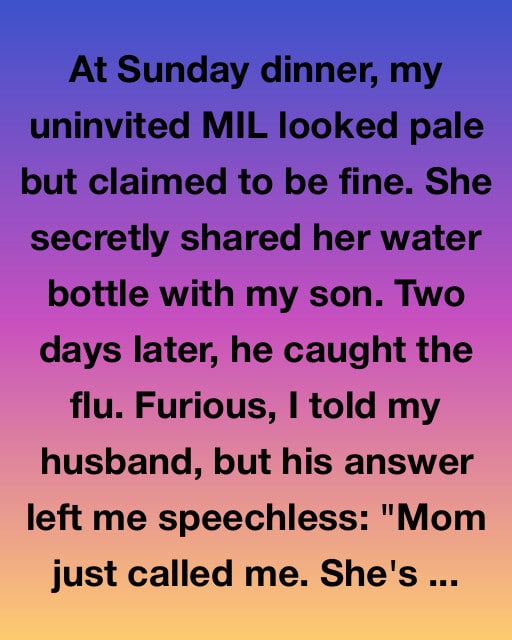
Two Sundays ago, Silvia showed up at our place looking washed-out but stubbornly cheerful—the way people do when they’re trying to outrun a cold by smiling at it. She wasn’t invited; she never is, exactly. She just appears with a pie and opinions. We made room, because that’s what we always do.
Dinner was ordinary until it wasn’t. In the middle of the chatter, I glanced over just in time to see her pass her water bottle to my son, Noah. He took two happy gulps before I could move. I felt heat rush to my face.
“Silvia, he has his own cup,” I said as evenly as I could.
She waved it off. “Oh please, it’s just water. I’m fine.”
By Tuesday, Noah was not fine. Burning cheeks, glassy eyes, restless sleep. My fear braided itself into anger—tight and hot—and I told my husband, Nick, exactly what I thought of “just water.”
He listened, jaw tense, and then his phone rang. He stared at the screen longer than usual before answering. “Mom?” A beat. His face drained. “We’re coming.”
He hung up slowly. “She’s in the hospital.”
My breath snagged. “Why?”
“She collapsed. It’s the flu,” he said, voice rough. “But… there’s more. She has lupus. She never told anyone. Her immune system’s a mess.”
The anger that had felt so righteous a minute ago broke apart in my hands. Lupus. A year of unsolicited advice, sudden visits, brittle smiles—and under it all, a story we didn’t know.
“I’ll stay with Noah,” I said softly. “Go.”
That night, I held our feverish son and replayed every barb, every boundary Silvia crossed, every time I bit my tongue and wished I hadn’t. Then, under those, the questions: Why didn’t she tell us? Why did she risk coming if she felt this bad? Why share water with my child—unless she was trying to pretend her body wasn’t betraying her?
Two days later, Nick came home late, red-eyed and wrecked. “She wants to talk to you,” he said. “Alone.”
“Me?”
He nodded. “She said she has something to confess. And to ask.”
I didn’t have forgiveness in me, but I had curiosity—and a thin thread of something like compassion I couldn’t quite name. I agreed.
Silvia looked smaller under the hospital sheets, as if the bed had taken a bite out of her. Her skin had gone almost translucent, her hands trembling with each breath. The monitor kept time.
“I owe you the truth,” she said, voice sandpapered down to a rasp. “And probably an apology.”
I sat, choosing neutral. “I’m listening.”
“I’ve been in a flare for weeks,” she said. “I should have canceled dinner. But I didn’t come for the meal. I came for you. I wanted to make peace.” Her mouth quivered. “I brought a letter. It’s… in my bag.”
Me. Peace. I thought of the day she told me my lasagna tasted like “regret and oregano” and had to fight the urge to laugh.
“When I saw Noah sip my water,” she continued, “I panicked. I didn’t want to make a scene. I told myself it was just a sniffle. I didn’t mean to put him at risk. I wanted one night that felt normal.”
“Kids bounce back,” I said, more gently than I expected.
She gave a crooked smile. “I don’t.”
We sat with that. Then she pulled out a thick, folded letter and handed it over with shaking fingers. My name was written on the front in careful loops.
“Why didn’t you tell us about the lupus?” I asked.
“Pride,” she said simply. “And shame. I’m the fixer, not the one who needs fixing. At least, that’s the lie I kept telling myself.”
That night, after Noah finally slept, I read her letter at our kitchen table. Seven pages. She admitted everything I had suspected—and more I hadn’t. She’d judged me long before she’d met me. She’d been jealous of the place I took in her son’s life, and terrified of being replaced. She’d learned cruelty at the knee of her own mother-in-law and confused “honesty” with the habit of hurting people first. She’d been diagnosed with lupus a year before our wedding and told no one because she didn’t want to be a burden, or a story that made people look at her with pity.
On the last page, in handwriting that tilted into vulnerability, she wrote: If anything happens to me, please don’t let Noah think I didn’t love him. And if you can… forgive me.
I cried in the quiet kitchen while the dishwasher hummed as if it were trying to comfort me.
The next morning, I made chicken soup and packed crayons. Noah and I walked into her hospital room, and she looked more shocked than pleased at first, like grace was a language she’d forgotten how to translate.
“I thought you’d be too angry,” she whispered.
“I was,” I admitted. “Now I’m mostly sad.”
She opened her arms. Noah went to her like he’d known the ending of this story all along.
Something shifted after that. We visited daily. Noah drew dragons with terrible wings. I brought meals in Tupperware labeled with reheating instructions. Silvia talked about real things: the years she’d spent performing strength, the loneliness tucked under her perfect hair, the gnawing fear that if she needed help, she’d be less herself.
One afternoon, while sunlight climbed the blanket at the foot of her bed, she told me about the daughter she lost in childbirth before Nick was born. I didn’t know. Grief rearranged her face as she said it.
“I’ve been terrified of losing the people I love ever since,” she whispered. “So I held on too tight. I confused control with care.”
I finally understood the constant drop-ins, the critiques disguised as kindness, the water bottle at dinner like a dare to her own body. Not excuse—explanation.
By the time she was discharged, we weren’t friends. We were honest. It felt like a sturdier bridge.
A week later, she invited us for dinner—her cooking, her table, her pace. The table was set with cloth napkins and the good plates. Halfway through the meal, she put down her fork with ceremony.
“I’m moving into assisted living,” she said.
Nick stared. “Mom—what?”
“I need help,” she said simply. “I’m done pretending I don’t. I want the time I have left to be lived, not survived.”
Then she turned to me. “You showed me what accepting care looks like without shame. Watching you with Noah, and the way you cared for me even when you were angry… it changed me.”
I didn’t have words, so I reached for her hand. Sometimes touch is the only sentence that lands.
In the months that followed, she adjusted. The place was small and warm, ten minutes from our house. She joined a book club. She painted clumsy tulips. She learned the names of everyone who pushed a walker past her door. And her best standing date became Noah.
Every Saturday, they’d play Go Fish and she’d cheat outrageously, tucking a card up her sleeve and winking at him. They shared secrets in whispers. She became his favorite storyteller.
“Did Grandma always love me this much?” he asked one night, chocolate on his lip.
“Yes,” I said. “She just didn’t always know how to show it.”
Three years later, on a July night soft as a lullaby, she slipped away in her sleep. At her memorial, I read a paragraph from her letter—the part where she apologized for the harm control can do when it tries to wear compassion’s clothes. People cried, and then they laughed at a story about her insisting “oregano is a feeling, not a spice,” and it felt like the truest celebration we could give her: the whole woman, not just the hardest parts.
Afterward, one of her neighbors took my hand. “She called you the daughter she never got to raise,” she said.
It knocked the breath out of me. Because she had hurt me. And yet—she had, finally, healed something in me too: the place that believes people never change, the place that thinks a story can only end how it begins.
I still think about that Sunday dinner—my anger at the water bottle, my fear for Noah, the fight that bloomed in my throat and then withered when Nick said “hospital.” But the memory doesn’t end there anymore. It ends with soup in a thermos, a letter folded and refolded, card games on a Saturday afternoon, and a woman brave enough to trade pride for help.
Sometimes the door to forgiveness is made out of paperwork you never meant to sign: discharge forms, assisted-living contracts, seven handwritten pages addressed to you. Sometimes the foolish thing—a shared sip of water—becomes the hinge the whole family turns on.
If there’s a lesson, it’s small and simple: you can be right and still choose mercy. You can be hurt and still make soup. And if you’re lucky, someone on the other end will meet you halfway with the truth, a trembling apology, and a seat at a table that finally feels safe.
{"post":89114,"page":1,"next":[{"id":89093,"title":"We announce the passing","url":"https:\/\/new24.info\/89093"},{"id":89090,"title":"Rest in peace: Died after father took his\u2026See more","url":"https:\/\/new24.info\/89090"},{"id":89086,"title":"These are the signs that he is cr\u2026 See more","url":"https:\/\/new24.info\/89086"},{"id":89083,"title":"Breaking News: Kelly Ripa confirmed\u2026 See more","url":"https:\/\/new24.info\/89083"},{"id":89080,"title":"Never heard of this...","url":"https:\/\/new24.info\/89080"},{"id":89077,"title":"Our Daughter Expected Us to Watch Her Kids on Our 40th Anniversary Trip \u2014 But This Time, We Said No and Left Her to Handle the Consequences","url":"https:\/\/new24.info\/89077"},{"id":89073,"title":"How I Dealt with My Neighbor Stealing from My Garden","url":"https:\/\/new24.info\/89073"},{"id":89070,"title":"I Bought $15 Shoes for a Struggling Mom \u2013 Two Weeks Later, There Was a Knock on My Door","url":"https:\/\/new24.info\/89070"},{"id":89067,"title":"The Surprising Gen Z Habit Everyone\u2019s Talking About","url":"https:\/\/new24.info\/89067"},{"id":89064,"title":"Donald Trump has signed the order","url":"https:\/\/new24.info\/89064"},{"id":89061,"title":"10 Minutes ago in Washington, D.C.,Jill Biden was confirmed as\u2026See more","url":"https:\/\/new24.info\/89061"},{"id":89056,"title":"Remembering the Dallas Air Show Mid-Air Collision: Honoring Aviation Heritage and Lessons for the Future","url":"https:\/\/new24.info\/89056"},{"id":89052,"title":"Why Drivers Are Putting Salt in a Glass Inside Their Cars\u2014The Reason May Surprise You","url":"https:\/\/new24.info\/89052"},{"id":89050,"title":"20 Minutes ago in Los Angeles, Pat Sajak was confirmed as\u2026See more","url":"https:\/\/new24.info\/89050"}]}