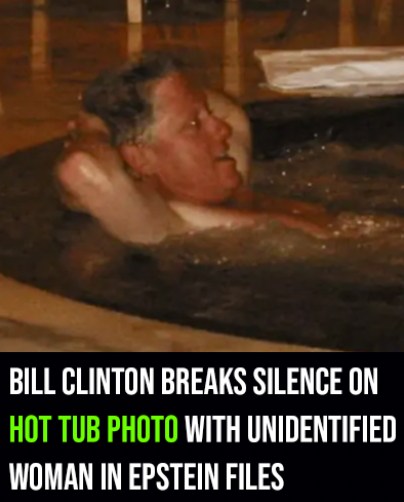
Former U.S. President Bill Clinton has publicly addressed questions tied to a photograph referenced in documents connected to Jeffrey Epstein.
His remarks were delivered during a closed-door deposition before members of the House Oversight Committee in New York, where he testified for roughly six hours, according to reporting by BBC News.
Release of Epstein-Related Records
On January 20, the United States Department of Justice released more than three million pages of documents related to investigations involving Epstein, who died in a New York jail in 2019 while awaiting trial on federal sex trafficking charges.
The release renewed public attention toward individuals who had past associations with him. Clinton has not been charged with or accused of criminal wrongdoing.
Focus of the Testimony
Clinton’s appearance followed testimony by Hillary Clinton, who stated she had no knowledge of Epstein’s criminal activities and denied traveling on his aircraft or visiting his private properties.
During Bill Clinton’s deposition, lawmakers reportedly asked about photographs referenced in the files. Among them were images described as showing him swimming with Ghislaine Maxwell and an unidentified woman, as well as a separate image involving a hot tub scene.
According to cited reports, Clinton denied any inappropriate relationship with the unidentified woman and stated that he did not know her identity.
Clinton’s Position
Addressing the broader issue, Clinton told committee members that he had no awareness of Epstein’s criminal conduct during the period of their association.
“I saw nothing, and I did nothing wrong,” he reportedly stated, adding that even in hindsight, he had not witnessed behavior that raised suspicion.
He also commented on Epstein’s capacity to conceal illegal activities, suggesting that secrecy played a role in the length of time before accountability occurred. Clinton noted that he had ended contact with Epstein prior to Epstein’s 2008 guilty plea in state court.
In addition, Clinton criticized the decision to subpoena his wife, maintaining that she had no involvement in Epstein’s affairs.
Continuing Scrutiny
The deposition forms part of an ongoing congressional review following the large-scale release of federal documents. While numerous public figures have appeared in filings connected to Epstein over the years, legal experts continue to emphasize that inclusion in records does not equate to criminal liability.
The renewed attention reflects broader public concern around transparency, oversight, and accountability in high-profile investigations. As additional material is reviewed and questions continue, the process is likely to remain under sustained media and political scrutiny.
In matters of public trust, clarity takes time. Allegations warrant examination, and reputations warrant fairness. The work now lies in distinguishing evidence from assumption, and fact from implication, with steadiness rather than spectacle.