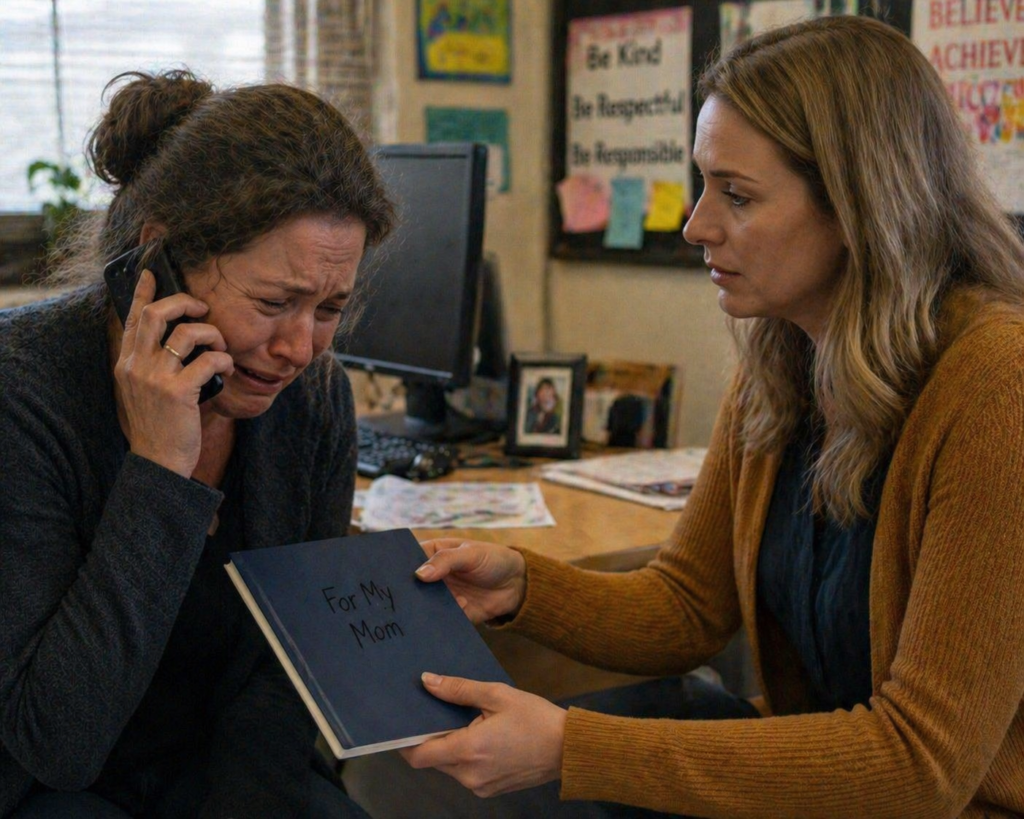
I was sitting on my late son’s bed with his blue camp shirt pressed to my face when the phone rang.
It still smelled faintly like him.
That was what grief had turned me into—a mother sitting in a room full of sneakers, schoolbooks, baseball cards, and silence, trying to breathe in whatever was left of her child.
Owen had been gone for weeks, but his room still looked like he might come back any second. His hoodie was thrown over the chair. His math notebook sat open on the desk. One of his wooden shop-class projects hung crookedly near the window.
Some mornings, I still saw him in the kitchen, flipping pancakes too high and laughing when they landed half on the stove. That was the last morning I saw him alive.
He had been fighting cancer for two years, but we believed he was going to beat it. We had built our whole future around that belief.
Then the lake took him.
He had gone with my husband, Charlie, and a few friends to the lake house. A storm rolled in too fast. The current pulled him under. Search teams looked for days and found nothing.
No body.
No goodbye.
Just the cruel kind of grief that never feels finished.
The phone kept ringing until I finally looked at the screen.
Mrs. Dilmore.
Owen’s math teacher.
“Hello?” I answered, my voice barely there.
“Meryl,” she said, sounding shaken, “I’m so sorry to call like this, but I found something in my desk drawer today. I think you need to come to the school.”
My grip tightened around Owen’s shirt. “What is it?”
“It’s an envelope,” she said. “It has your name on it. It’s from Owen.”
The room seemed to tilt.
“From Owen?”
“Yes. It’s in his handwriting.”
I don’t remember hanging up. I only remember standing too fast, my heart pounding in my throat.
My mother found me in the kitchen.
“What’s wrong?”
“His teacher found something,” I whispered. “Owen left me something.”
Her face changed at once. Only another mother could understand that kind of hope and terror arriving in the same breath.
Charlie was at work. Since the funeral, work had become his hiding place. He left early, came home late, and said almost nothing. He didn’t even let me hug him anymore. At first, I told myself it was grief.
Lately, it felt like a door closing.
The school looked exactly the same when I arrived, and somehow that hurt.
Mrs. Dilmore met me near the front office, pale and careful. She held out a plain white envelope.
“I found it in the back corner of my desk drawer,” she said. “I don’t know how I missed it.”
On the front, in Owen’s handwriting, were two words:
For Mom.
My knees nearly gave out.
She took me to a small empty room. I sat at the table, staring at the envelope, afraid of what it might give me and what it might take away.
Finally, I opened it.
The second I saw his handwriting, my chest ached.
“Mom, I knew this letter would reach you if something happened to me. You need to know the truth. The truth about Dad and what has been going on these past few years…”
I stopped breathing.
The letter told me not to confront Charlie first. It told me to follow him. To see something with my own eyes. Then, afterward, to go home and check beneath the loose tile under the small table in Owen’s room.
No explanation.
Just a path.
For the first time since the funeral, doubt entered the room wearing my son’s handwriting.
I drove to Charlie’s office and parked across the street.
Then I texted him.
“What do you want for dinner?”
Three minutes later, he replied.
“Late meeting. Don’t wait up. I’ll grab something out.”
My stomach twisted.
Twenty minutes later, Charlie walked out of the office carrying only his keys. I followed him.
The drive took nearly forty minutes. Then he pulled into the parking lot of the children’s hospital—the same hospital where Owen had received treatment.
Charlie opened his trunk, took out bags and boxes, and went inside.
I followed at a distance.
He moved through the halls like someone who knew exactly where he was going. A nurse smiled when she saw him. He slipped into a supply room and closed the door.
Through the small window, I watched my husband change into bright suspenders, a ridiculous checkered coat, and a red clown nose.
I stared.
Then he picked up the bags and walked into the pediatric ward.
Children smiled before he even reached them.
He handed out toys, coloring books, tiny stuffed animals. He pretended to trip over his own feet, and a little girl in a hospital bed laughed so hard she clapped.
A nurse passed him and grinned.
“You’re late, Professor Giggles.”
Charlie smiled back.
I stood there, frozen.
Nothing about this matched the suspicion Owen’s letter had created. Nothing about it looked like betrayal.
It looked like grief wearing a costume so children could laugh.
I stepped forward before I could stop myself.
“Charlie.”
He turned mid-joke.
The smile vanished from his face.
He pulled me into a quiet corner and tore off the clown nose.
“Meryl,” he whispered. “What are you doing here?”
“I should ask you that.”
I pulled Owen’s letter from my bag.
Charlie saw the handwriting, and all the strength seemed to leave him.
“Owen wrote to me,” I said. “He told me to follow you.”
Charlie covered his mouth for a second.
“I should’ve told you.”
“Then tell me now.”
He looked toward the ward, his eyes wet.
“I’ve been doing this for two years,” he said. “After work. I come here, dress like an idiot, bring toys, and try to make the kids laugh for a little while.”
“Why?”
“Because of Owen.”
The words hit me hard.
“During one of his treatments, he told me the worst part wasn’t the pain,” Charlie said. “It was seeing other kids scared and trying not to cry in front of their parents. He said he wished someone would just make them smile for one hour.”
I looked through the glass at the children waiting for him.
“So I started coming,” Charlie continued. “I never told Owen. I wanted it to be for him, not because of him. But I guess he found out.”
“And you hid it from me.”
“I know,” he whispered. “After the lake, I didn’t know how to tell you anything. Everything felt too late. Too broken.”
“You let me think you were disappearing from me.”
“I wasn’t disappearing,” he said. “I was drowning in private.”
I handed him the letter.
He read it right there in the hallway, still half dressed as a clown, tears falling onto the paper.
For the first time since Owen died, I understood. His distance hadn’t been rejection. It had been grief, shame, and a secret too tender to carry properly.
Charlie pressed the letter to his mouth.
“I need to finish in there,” he said.
So he did.
I watched him make those children laugh for twenty more minutes with red eyes and a broken heart.
They didn’t care that he had been crying.
They cared that he showed up.
Afterward, we went home together.
Straight to Owen’s room.
Charlie knelt beside the little table and pried up the loose tile with a butter knife. Beneath it was a small gift box.
Inside was a wooden sculpture.
Three figures.
A man, a woman, and a boy standing between them.
It was rough in places, smooth in others, unmistakably made by Owen’s hands.
Under it was another note.
“I’m sorry I didn’t tell you the truth straight out, Mom. I wanted you to see Dad’s heart for yourself before a letter did the talking for me. I know both of you have been trying, even when it was messy and hard. I also need you to know that I was lucky. Not every kid gets parents who love the way you and Dad do. I love you both more than you know.”
I read it twice before I could cry.
Then I broke.
Charlie broke too.
We sat on Owen’s floor and held each other for the first time since the funeral. This time, when I reached for him, he didn’t pull away. He held on like a man who had finally run out of places to hide.
After a while, he drew back.
“There’s something else,” he said.
He unbuttoned his shirt.
Over his heart was a tattoo of Owen’s face. Small. Detailed. Tender.
“I got it after the funeral,” he said. “I didn’t let you hug me because it was still healing. And I didn’t show you because you hate tattoos, and I couldn’t handle one more thing being wrong.”
I laughed through my tears.
My first real laugh since before the lake.
“It’s the only tattoo I’ll ever love,” I told him.
It didn’t fix everything.
Grief doesn’t work that way.
But our son had left us a path back to each other. One letter. One secret. One final act of love from a boy who had spent his life thinking about other people’s pain, even while carrying his own.
And for thirteen years old, that was one more miracle from a child who had already given us everything.