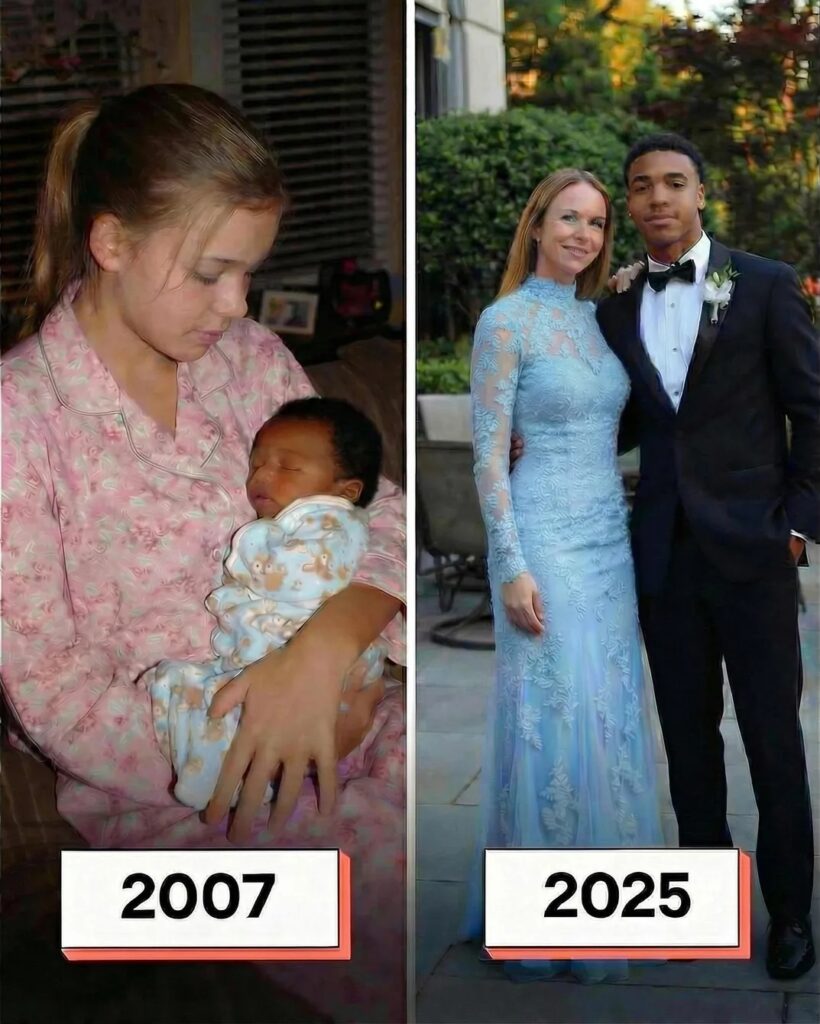
The Prom She Never Had
For most people, prom is just a night. A dress, a dance, a few photos, and then it’s over. But for my mom, Emma, it was something she never got to have at all.
She became a mother at seventeen. While everyone else was planning outfits and talking about college, she was figuring out how to survive. The baby’s father disappeared, and overnight, her world shifted from possibilities to responsibilities. She worked nights, wore secondhand clothes, skipped meals when money was tight—whatever it took to make sure I never felt the cost of the life she gave up. She never complained. She never asked for recognition. She just showed up, every single day, and carried everything quietly.
By the time I reached my own senior year, I started to understand what that meant. Not in a vague, “I appreciate you” kind of way—but in a real, uncomfortable way. I realized that every opportunity I had was built on something she didn’t get to experience herself. And suddenly, “thank you” didn’t feel like enough anymore.
So I asked her to prom.
At first, she thought I was joking. Then she laughed. Then she cried. Not because of the dance—but because someone had finally seen what she had given up.
Not everyone saw it that way.
My stepsister Brianna made sure of that. She didn’t just disapprove—she made it her mission to tear the whole thing down. She called it pathetic, embarrassing, said my mom was trying to relive something she had no business being part of. The comments didn’t stop there. Every chance she got, she found a new way to mock it—what my mom might wear, how people would react, how “sad” it all looked.
I wanted to confront her. More than once, I was ready to. But I didn’t. Because I realized something: Brianna fed on attention, especially the kind that came from conflict. If I reacted, I’d be playing her game.
So I didn’t argue.
Instead, I planned.
I spoke to the school principal. I talked to the prom organizers. I told them my mom’s story—not as a spectacle, but as the truth. I didn’t know how it would play out. I just knew I wanted that night to be about what she deserved, not what someone else wanted to tear down.
Prom night came, and the tension was exactly what I expected.
We were standing in the courtyard when Brianna made her move. Loud enough for everyone to hear, she laughed and asked if this was “prom or family visiting hours.” Her friends joined in. People turned to look. For a moment, everything felt like it was about to collapse.
My mom didn’t respond. She just stood there, holding herself together.
And then everything shifted.
Midway through the night, the music stopped. The principal stepped onto the stage and took the microphone. He didn’t call out Brianna. He didn’t mention the comments. Instead, he told a story.
He told my mom’s story.
He spoke about a seventeen-year-old girl who gave up everything to raise her child alone. About years of sacrifice no one saw. About strength that didn’t need an audience to exist. And then he said her name.
For a second, there was silence.
Then the entire room stood up.
Students. Teachers. Everyone.
They started clapping. Then cheering. Then chanting her name. It wasn’t forced. It wasn’t polite. It was real. And in the middle of it all, my mom just stood there, overwhelmed, finally being seen in a way she never had been before.
I looked over at Brianna.
She wasn’t laughing anymore.
She just stood there, completely still, watching the same crowd she tried to impress turn toward something she couldn’t control—respect.
That night didn’t end with drama. It ended with clarity.
When we got home, her father—Mike—handled it in a way that said more than any argument ever could. No yelling. No chaos. Just consequences. The car was gone for the summer. Social plans—gone. And one requirement: a handwritten apology.
His words were simple: she ruined her own night by choosing cruelty.
And that was it.
But the real ending wasn’t about Brianna.
It was about my mom.
For years, she carried her story like something quiet, something ordinary, something that didn’t deserve attention. But that night changed how she saw herself. Not as someone who missed out—but as someone who made something possible.
The photos from that night still sit in our living room.
Not as a memory of prom.
But as proof of something much bigger—that the woman who thought she lost everything had, in reality, built something worth standing up for.