The Porch Next Door
I’ve lived next door to Harold Peterson for over thirty years.
Long enough to remember when he built that porch himself—measuring twice, cutting once, moving with the confidence of someone who knew exactly what he was doing. Back then, he was strong, steady. A carpenter people respected.
Now he’s ninety-one, in a wheelchair, and alone more often than not.
His wife passed years ago. His kids… well, they didn’t exactly disappear overnight. It happened slowly. Fewer visits. Shorter calls. Then silence.
The house followed the same pattern.
The porch started to give way first. Boards softened, then cracked. The railing disappeared at some point. The ramp—if you could still call it that—was patched together with scrap wood that didn’t quite line up. It wasn’t just worn out.
It was dangerous.
When the city finally stepped in and warned that the house could be condemned, Harold did what anyone in his position would do.
He called his children.
I didn’t hear the conversation, but I saw the result.
Later that day, he was sitting inside by the window, holding a photo of his wife. He looked… smaller than I’d ever seen him. Not physically. Just… something in him had dropped.
He told me what they said.
That it wasn’t worth fixing.
That it would make more sense to leave things as they were.
That the house could be dealt with “later.”
After he was gone.
That night, I couldn’t sit with it.
A few blocks away, there’s a motorcycle club. The kind people talk about but don’t really approach. I’d never had a reason to go there before.
Until then.
I walked in, explained the situation as simply as I could. No exaggeration. Just the truth: an old man, a broken porch, and a family that had decided not to show up.
Something changed in the room when I mentioned his name.
Their leader recognized it.
Said Harold had once helped his father—built a ramp for him when he was struggling to get in and out of the house. Charged almost nothing for it.
“Just said it was the right thing to do,” he told me.
That was enough.
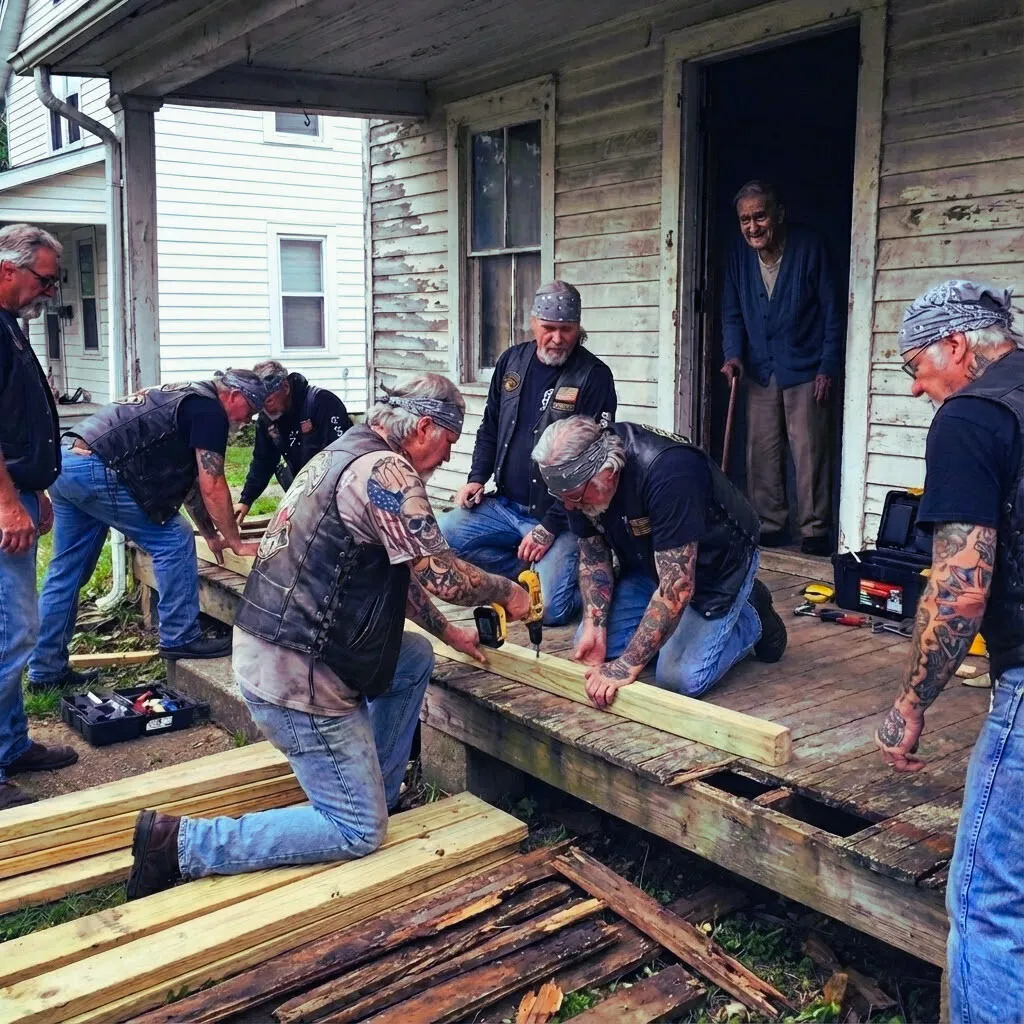
The next morning, they showed up.
Not loud. Not aggressive. Just… present.
Pickup trucks. Tools. Lumber.
Work started almost immediately.
Over the next three days, they rebuilt everything from the ground up. Not just patching it—but doing it properly. A solid ramp. Strong railings. Clean steps. Even lighting along the side so he wouldn’t have to worry at night.
It wasn’t rushed, but it wasn’t slow either. Just steady, focused work.
Harold stayed outside most of the time, watching.
Sometimes talking. Sometimes quiet.
His kids found out, of course. There were calls. Complaints. Even threats about involving authorities. None of it changed anything.
The work kept going.
At one point, I saw one of the bikers kneel beside Harold’s chair and speak to him quietly. I didn’t hear everything, but I caught one sentence:
“You helped someone when you didn’t have to. This is just that coming back.”
Harold didn’t say much after that.
He just nodded, eyes wet.
When it was finished, the difference wasn’t just physical.
Yes, the porch was safe. Strong. Better than it had been in years.
But Harold changed too.
He started coming outside again. Sitting there in the mornings. Waving at people walking by. Talking more. Smiling more.
Like something had been returned to him.
A few weeks later, his granddaughter showed up.
She’d heard about what happened—from someone who saw it, not from the family. She stayed longer than anyone had in years.
That porch didn’t just fix access to his home.
It changed who showed up for him.
Now, every morning, Harold wheels himself out there like it’s part of his routine again. Like it matters.
And it does.
Because in the end, it wasn’t about wood or nails.
It was about being seen.
About someone deciding you’re still worth the effort.