The Winter I Stopped Paying for Belonging
I drove back to Boston in the middle of a snowstorm, but the weather wasn’t what made the road feel long.
It was the clarity.
Fifteen years of habit had just come undone in a single moment—quietly, without confrontation, but in a way that couldn’t be reversed.
It happened earlier that evening, in my parents’ dining room. I had just carried in dessert, moving through the familiar space without thinking much about it. Then I heard my mother speaking to my aunt.
She wasn’t angry. She wasn’t even careful.
She said I didn’t deserve gratitude for the latest transfer—four thousand dollars I had sent just days before. She described it as something I owed them. Payment for being raised. A responsibility that simply continued.
There was no hesitation in her voice.
That was the part that stayed with me.
I stood there for a moment, still holding the plate, realizing something I hadn’t allowed myself to see clearly before. What I had been giving wasn’t being received as care. It had become expected. Routine. Almost invisible.
I didn’t say anything that night.
Some truths don’t need to be argued. They need to be recognized.
I went to my old room, the one that had slowly turned into a guest space over the years. I sat on the bed and opened my bank account. The January transfer was already scheduled, as it had been every year.
I canceled it.
Not dramatically. Just one decision, made without hesitation.
I had started helping them when I was twenty-three. My father had been injured, and they were close to losing their home. It made sense then. Temporary support, something to stabilize things until they recovered.
But time has a way of changing temporary things into permanent ones.
The mortgage became mine to handle. Then came other expenses. Eventually, even their vacations—things that had nothing to do with survival, but somehow still became part of what I was expected to carry.
I didn’t question it often.
It felt easier to keep things running than to step back and ask what it was costing me.
When I got back to Boston, I asked my financial advisor to review everything.
I wanted clarity, not assumptions.
The number came back larger than I expected, even after all those years.
Eight hundred sixty thousand dollars.
It wasn’t just the amount. It was what it represented. The years of income, the choices deferred, the security I had slowly given away without ever pausing to measure it.
At the same time, my own situation had been shifting quietly.
After losing my corporate job, I adjusted without telling them. I moved into a basement studio. I took on two jobs. I kept everything running on their side, even as mine became smaller and more fragile.
They never asked.
Not out of cruelty, but out of distance. The kind that forms when one person carries too much for too long without saying it out loud.
When the January transfer didn’t arrive, their response was immediate.
Messages about errors. About delays. Not about how I was, or whether something had changed. Just the assumption that something needed to be corrected.
That was when I answered.
I told them the transfers had ended.
Not temporarily. Not conditionally. Just ended.
I sent them the full financial record. Not to accuse, but to show. Numbers, dates, totals—things that didn’t need interpretation.
Then I invited them to Boston.
Not to argue. To see.
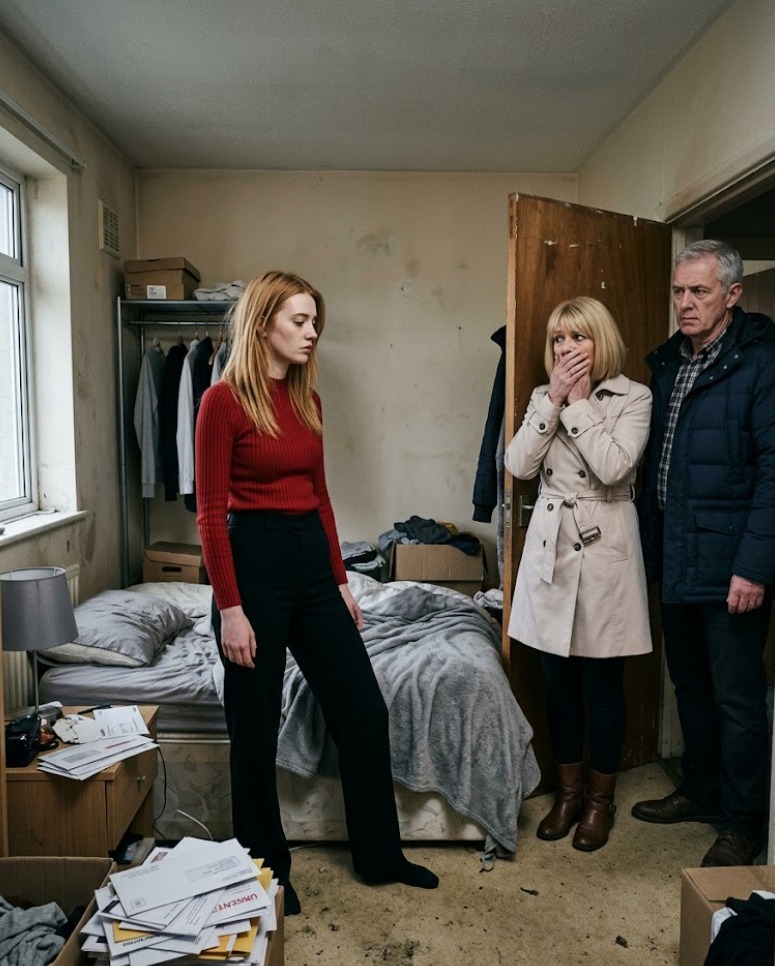
They arrived on New Year’s Eve expecting something different. I could see it in the way they looked around when they stepped inside. The room was small, unfinished in places, a mattress on the floor instead of a bed.
There was no attempt to explain it before they saw the documents.
I laid everything out on the table.
The savings accounts that were gone. The retirement funds that had been emptied. The debt that had replaced them. All of it, in one place.
My father didn’t speak at first.
He just looked at the total.
Then he said something simple—that he hadn’t understood what it had cost me.
It wasn’t an apology.
But it was the first moment of recognition.
After they left, things didn’t resolve all at once.
But they shifted.
My father called a few days later. He told me they were selling their car and cutting back on expenses. He didn’t ask for anything. He asked if I needed help moving.
It was a different kind of conversation.
Months later, my mother wrote to me. Her message was shorter than I expected. She admitted she had been wrong to see what I gave as something owed. That she had confused support with obligation.
It didn’t erase the past.
But it changed how we stood in the present.
And for me, something else settled.
I sat in that same small room, surrounded by less than I had before, and realized something I hadn’t felt in years.
I wasn’t responsible for holding everything together anymore.
There was no transfer scheduled. No expectation waiting at the start of the next month. No quiet pressure shaping my decisions before I even made them.
For the first time since my early twenties, what I earned stayed with me.
Not as excess. Not as comfort.
As ownership.
Starting over with less is not easy.
But it is different when what you build belongs to you.
And sometimes, the hardest part is not giving.
It’s knowing when to stop.