What My Grandmother Really Left Me
I walked into the pawn shop thinking I was about to give up the last piece of my grandmother I had left.
There was no drama in my mind, no sense of meaning attached to it. Just a transaction. At that point, most things in my life had been reduced to numbers—rent, bills, hospital costs, overdue notices. When everything becomes urgent, sentiment starts to feel like something you can’t afford to carry.
My name is Meredith. I’m twenty-nine, and I’m raising three children on my own.
Two years ago, my husband left. There wasn’t a long explanation, just a shift that happened quickly and didn’t reverse. One day we were managing together, imperfectly but together. The next, I was doing everything alone.
You don’t stop. You adjust.
School runs, grocery lists, fevers in the middle of the night—you learn to keep moving because there isn’t another option. I told myself I was strong, but in truth, I was simply continuing.
Then my youngest got sick.
The bills didn’t come gradually. They arrived all at once, layered on top of each other until it became difficult to see where one ended and the next began. I took loans just to keep things steady, thinking I would sort it out later.
Later never came.
When I lost my job, the conversation was brief. “Downsizing,” they said. A clean word for something that leaves a mess behind. After that call, something in me didn’t break—it just went quiet.
That night, I opened a shoebox I hadn’t touched in years.
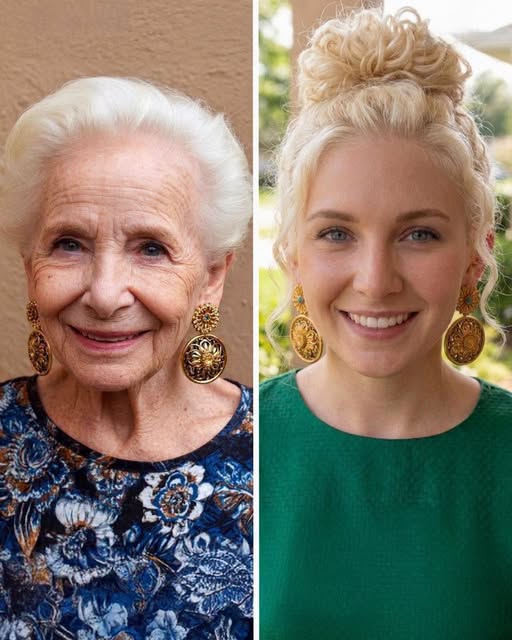
Inside were my grandmother’s earrings.
Simple, 18-karat gold. She had given them to me when I was younger, pressing the box into my hand and telling me, “One day, these will help you.” At the time, I thought she meant comfort, something emotional. I didn’t imagine it would come to this.
The pawn shop smelled like old wood and metal. The man behind the counter asked what I needed, and I placed the box in front of him.
“I need to sell these,” I said.
He opened it casually at first.
Then he stopped.
It wasn’t a dramatic reaction. Just a pause that stretched longer than expected. He picked up one earring, turned it toward the light, and something in his expression changed. He reached for a magnifier, studying it more closely.
“What’s wrong?” I asked.
He didn’t answer immediately.
“Where did you get these?”
“My grandmother.”
“What was her name?”
When I told him, the room seemed to shift in a way I didn’t understand. He stepped back slightly, then reached into a drawer and pulled out an old photograph.
He placed it on the counter.
It was her.
Younger, but unmistakably the same. And standing beside her was the man in front of me.
“Who are you?” I asked.
“My name is Walter,” he said. Then, after a pause, “I made those earrings.”
He turned one of them gently, showing me a small engraving I had never noticed—a faint “W.”
“She kept them,” he said, almost to himself.
I asked if he had known her.
He nodded. “We were close. A long time ago.”
There was no need for more detail. The way he said it was enough.
“They chose a different path for her,” he continued. “And she lived that life. But she came back once. Years later. Still wearing those.”
I realized then how little of her life I had truly known.
“She never told us,” I said.
“I know,” he replied. Not with regret. Just with acceptance.
Then he handed me a folded paper.
“She left this with me.”
I opened it carefully.
It was her handwriting.
“If one of mine ever comes to you hurting, don’t turn them away.”
For a moment, I couldn’t speak.
Then, without planning to, I told him everything. The bills. The illness. The job loss. The pressure that had been building quietly until it felt like there was no space left to stand.
He listened without interrupting.
When I finished, he closed the box and pushed it back toward me.
“I’m not buying them,” he said.
My first reaction was panic. “I need the money.”
“I understand,” he said. “But this doesn’t have to be your only option.”
There was a part of me that almost stopped listening right there. When you’ve been carrying things alone for too long, help can feel unfamiliar.
Then he said something simple.
“I have some savings. And I know someone who can help you sort through this properly.”
I asked him why.
His answer didn’t change.
“Because I loved your grandmother. And because she asked me to look out for her family.”
What followed wasn’t sudden relief.
It was steady work.
Phone calls. Paperwork. Conversations that replaced confusion with steps I could actually follow. A lawyer who spoke clearly instead of urgently. Walter sitting with me, going through bills I had been too overwhelmed to even read properly.
Slowly, things shifted.
The foreclosure paused. Medical payments were adjusted. I found part-time work through someone he knew. Nothing disappeared, but everything became more manageable.
The ground stopped moving.
Months later, life is still difficult. My son is still in treatment. Money is still tight. But we are still here, and there is space to breathe again.
Sometimes I visit Walter’s shop.
We talk about my grandmother. He shows me photographs I had never seen, small pieces of her life that feel like something being returned rather than discovered.
One evening, I opened the box again.
The earrings caught the light in the same quiet way they always had.
I thought about what I had believed their value was.
And realized I had been mistaken.
She didn’t leave me something to sell.
She left me something that would lead me to help when I needed it most.
Not everything valuable is meant to be exchanged.
Some things are meant to carry you until you reach the right place.
And sometimes, what we think is the end of something is only the point where we finally understand what it was meant to do.