“Don’t Look at Them…”: A Twin Birth That Revealed More Than Anyone Expected
If you’d asked me what the best day of my life would look like, I would’ve said joy. Relief. That quiet, overwhelming moment when you finally meet your children.
I wouldn’t have imagined confusion. Or fear. Or a truth that would ask us to stand steady when everything around us felt uncertain.
But that’s what happened the day my wife, Anna, gave birth to our twins—and asked me, in a trembling voice, not to look.
A Long Road to Parenthood
We didn’t arrive here easily.
There were years of waiting. Doctor visits. Three miscarriages that left us grieving in ways we couldn’t explain properly to anyone else.
Each loss took something from us—especially from Anna. She became quieter, more careful with hope. As if even feeling it too strongly might break it.
So when the doctors finally said, “Everything looks stable,” it didn’t just bring happiness.
It brought a kind of cautious relief.
We allowed ourselves, slowly, to believe again.
The Moment That Didn’t Feel Right
The day of the delivery came fast.
Bright lights. Quick movements. Voices that sounded controlled, but urgent.
Then suddenly, I was alone in a hallway.
Time stretched in a way that doesn’t feel real—long enough for every possible fear to take shape.
When I was finally brought back in, I knew something was off before I even saw her face.
Anna was holding both babies close—too close—like she was trying to protect them from something.
“Please,” she whispered, not looking at me. “Don’t look at them.”
Two Children. One Question.
I stepped closer anyway, gently.
And then I saw.
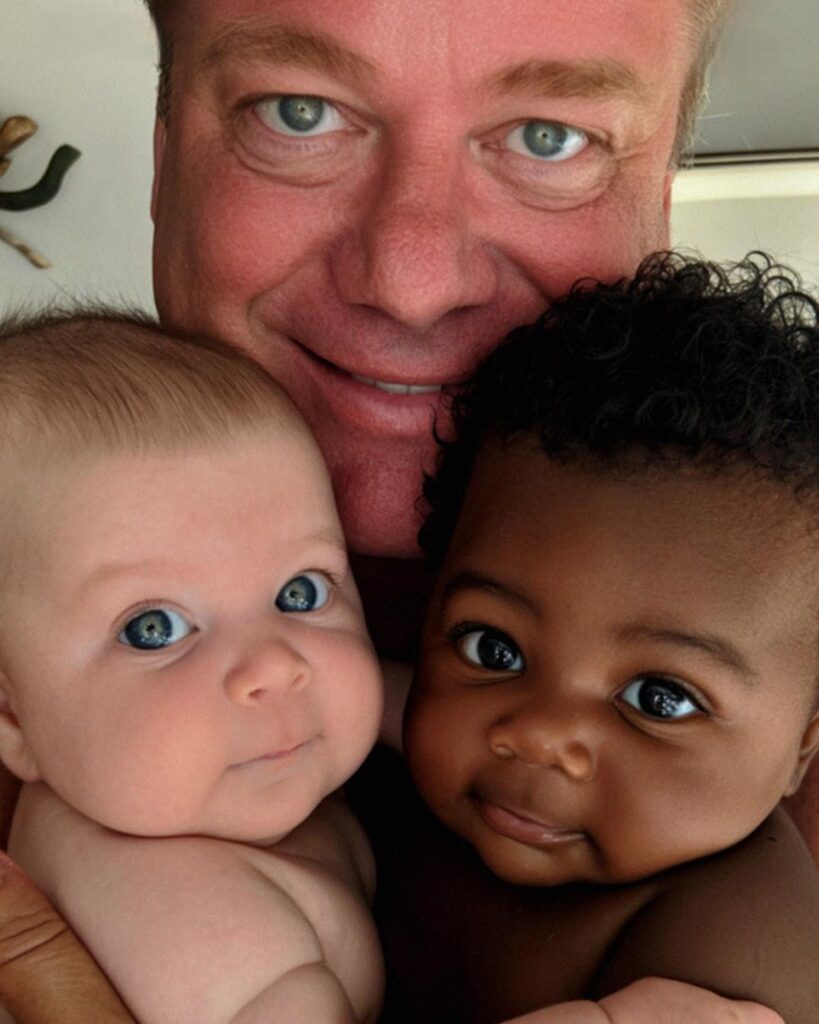
One of our sons had features that looked immediately familiar—like something I recognized without thinking.
The other looked different. Not wrong. Not unfamiliar in a deeper sense. Just… different enough to raise questions.
Anna broke down.
“I didn’t do anything,” she said through tears. “I didn’t betray you. I don’t know how to explain it, but I didn’t.”
In that moment, there were many directions I could have gone.
Doubt. Anger. Distance.
Instead, I chose something simpler.
“I believe you,” I told her.
Not because I had all the answers—but because trust isn’t built in moments of certainty. It’s proven in moments like that.
When Facts Don’t Quiet Assumptions
Tests confirmed what mattered: both boys were mine.
The explanation was medical. Rare, but real. Genetics doesn’t always follow what people expect to see on the surface.
That should have been enough.
But truth doesn’t always silence judgment.
The looks came anyway. The questions. The pauses that carried more meaning than words.
Anna felt it more than I did.
Not because she was weaker—but because the judgment was directed at her.
The Weight of What Was Hidden
One night, she handed me her phone.
Messages from her family. Careful, cold, focused on one thing: silence.
They weren’t asking her to explain.
They were asking her to carry a misunderstanding rather than reveal something they had hidden for years.
Then she told me the truth.
Her grandmother had been mixed-race. It had been concealed—treated as something to erase, not acknowledge.
Her family had built a version of themselves around that silence.
And when our children were born, that silence became pressure.
Not to protect Anna—but to protect an image.
Choosing What to Carry
We could have continued explaining ourselves. Trying to make others comfortable.
We chose not to.
At one gathering, when the question finally came directly, I didn’t argue or defend.
“They’re our sons,” I said. “That’s enough.”
And it was.
Not for everyone—but for us.
What Stayed After
What this revealed wasn’t something new.
It was something that had always been there—just unspoken.
Our children didn’t create the tension.
They brought it into the open.
And once something is seen clearly, you have a choice:
Carry it quietly—or stand in it honestly.
Final Thought
People often rush to explain what they don’t understand.
Sometimes with questions. Sometimes with assumptions.
But not everything needs to be justified to the outside world.
Some truths are meant to be lived, not argued.
And some families become stronger the moment they stop trying to fit into someone else’s version of what they should look like.
💬 Have you ever had to stand firm in something others didn’t understand?
{"post":98672,"page":1,"next":[{"id":98641,"title":"Paris Jackson Shares Emotional Tribute to Michael Jackson and His Lasting Legacy -","url":"https:\/\/new24.info\/98641"},{"id":98635,"title":"Donald Trump Jr. makes a private decision regarding Vanessa after Tiger Woods crash","url":"https:\/\/new24.info\/98635"},{"id":98631,"title":"Trump and Obama Clash Live on Air: A Historic Moment in Political Discourse","url":"https:\/\/new24.info\/98631"},{"id":98626,"title":"Israel\u2019s Secret Operation Sparks Chaos \u2014 Families Left in Shock","url":"https:\/\/new24.info\/98626"},{"id":98623,"title":"UNEXPECTED MOMENT WITH A FORMER PRESIDENT","url":"https:\/\/new24.info\/98623"},{"id":98619,"title":"Donald Trump Points to a Country That Could Be Next on the Global Stage","url":"https:\/\/new24.info\/98619"},{"id":98616,"title":"From Dream Wedding to Tragedy What Happened That Shook a Whole Community","url":"https:\/\/new24.info\/98616"},{"id":98612,"title":"I Married a Waitress in Spite of My Demanding Parents","url":"https:\/\/new24.info\/98612"},{"id":98609,"title":"Food Stamp Program Changes You Need to Know About This.","url":"https:\/\/new24.info\/98609"},{"id":98606,"title":"Heartbreaking School Bus Incident Leaves 32 Children Lost, Country in Mourning","url":"https:\/\/new24.info\/98606"},{"id":98603,"title":"Trump and Obama Exchange Heated Words During Live Appearance","url":"https:\/\/new24.info\/98603"},{"id":98600,"title":"The Long Road Home: How Recovery After 60 Is Changing What We Know About Healing-","url":"https:\/\/new24.info\/98600"},{"id":98590,"title":"Willow Smith Breaks Silence \u2014 Emotional Family Announcement on Will and Jada","url":"https:\/\/new24.info\/98590"},{"id":98584,"title":"Aging Biker Discovers His Missing Daughter When She Arrests Him Unexpectedly","url":"https:\/\/new24.info\/98584"}]}