
The structure of a mother’s grief is rarely built on clear answers. More often it rests on the fragile threads of questions that never found their end. When Christopher died in 2012, Kim did not only lose her son. She also lost the quiet certainty that helps the heart accept a death. In the confusion that followed, decisions were made quickly—most painfully, a rapid cremation arranged without the kind of understanding or consent she felt she deserved. The absence of a final goodbye left something unsettled within her. Photographs taken by investigators showed bruising she could not fully explain, and although authorities later concluded there was no evidence of foul play, the lack of physical remains left her with an emptiness where proof might have stood. For a mother, an official conclusion may close a case, but it does not always quiet the questions of the heart.
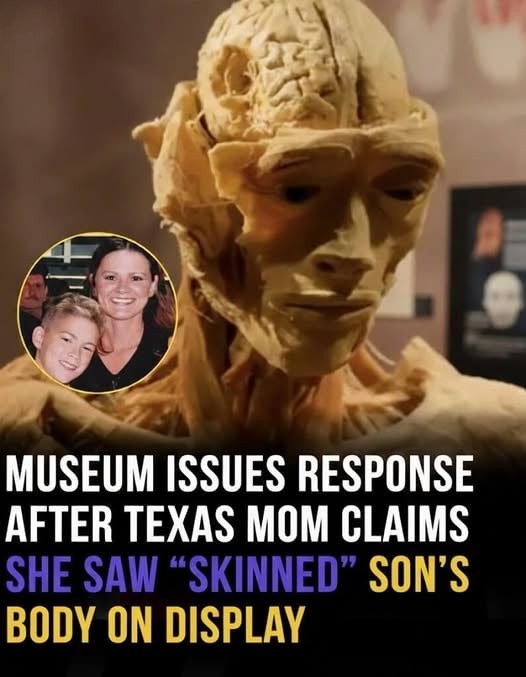
Years passed with that quiet ache unresolved. Then, while visiting a traveling exhibition displaying plastinated human bodies for educational purposes, Kim found herself standing before a figure labeled “The Thinker.” In that moment the museum setting faded, replaced by a deeply personal shock. To her eyes, the body seemed familiar in ways she could not dismiss—the frame, the structure of the muscles, even marks that reminded her of injuries she believed Christopher had once suffered. What others saw as an anatomical specimen, she experienced as something painfully close to home. The exhibit that aimed to teach about the human body suddenly became, for her, a place where grief spoke louder than reason.
The exhibition organizers responded with documentation showing that the specimen had been prepared years before Christopher’s death. According to their records, the timeline alone made Kim’s belief impossible. On paper, the explanation was clear. Yet grief does not move according to paperwork. When a parent feels they were denied the chance to see, hold, and bury their child properly, the mind continues searching for some physical trace of the life that was lost. In such moments, facts may exist, but the heart still struggles to accept them.
Psychologically, this kind of search is not uncommon in deep bereavement. When the reality of death feels incomplete—when a body was never seen or a farewell never fully lived—the mind sometimes seeks a place to anchor the loss. A face in a crowd, a voice in a recording, or even a figure in a museum can become that anchor. For Kim, “The Thinker” became a focus for years of unresolved pain. If she could prove it was Christopher, then perhaps the missing piece of the story would finally return to her.
Officials and legal experts maintain that the matter is settled. The documentation surrounding the exhibition’s specimens supports their origin and timeline. To them, the situation represents a tragic crossing of two worlds: a public display meant for education and a private grief still searching for peace. Yet Kim’s persistence does not appear driven by a desire for spectacle or accusation. At its core, her struggle seems rooted in a simpler human need—to know that her son’s story ended with dignity and clarity.
The controversy also raises broader questions about how human remains are displayed and remembered. When bodies are transformed into anonymous educational models, their individual histories disappear. For most visitors this anonymity allows them to view the exhibit with scientific curiosity. But for someone carrying unresolved grief, that same anonymity leaves space for the imagination to fill in what is missing.
Today the exhibition continues to travel, drawing crowds interested in the complexity of the human body. For most people it remains an educational experience. For Kim, however, the figure she encountered still represents something far more personal. Her search is less about proving a theory than about finding a place where the story of her son feels complete.
In the end, her struggle reminds us that systems designed to manage death—investigations, records, cremations, official conclusions—do not always meet the deeper needs of those who remain behind. When closure is absent, the human heart keeps searching. And sometimes that search leads to unexpected places, driven not by defiance of truth, but by the quiet hope that somewhere the missing piece of love and memory might still be found.