The silence after I turned off my phone felt heavier than any argument I had ever had with my family.
For years, I had lived in a strange fog where cruelty was always explained away. Miranda was “going through a hard time.” My parents were “doing their best.” Every slight, every missed birthday, every dismissive comment about my marriage, my home, even my daughter, had been folded into that same tired excuse: family is complicated. Family requires sacrifice. Family forgives.
But there is a difference between forgiveness and surrender. There is a difference between helping people and feeding the very hands that wound your child.
That morning, after I dropped Lily at school, I sat in my parked car for almost twenty minutes with both hands on the steering wheel, breathing through the ache in my chest. I was grieving something, though I could not yet name it. Not just what they had done, but what I had finally accepted: the parents I had been trying to earn all these years did not exist. The loving grandparents I kept hoping would emerge for Lily were never going to arrive. I had been pouring loyalty into an empty well, praying it would one day give back water.
By noon, my phone was lit with missed calls and messages once I turned it back on.
My father’s texts came first.
You are overreacting.
There was no room in the car.
Your mother said Lily could wait five minutes under the gate.
Why are you being cruel after everything we’ve done for you?
Then Miranda’s messages came in a long stream of indignation.
Are you seriously cutting off my kids because of a misunderstanding?
Mom is crying.
Dad says the mortgage bounced.
Private school tuition is due Friday.
How could you punish innocent children?
I stared at the screen for a long time, amazed by the complete absence of remorse. Not one message asked how Lily was. Not one asked whether she had gotten sick, whether she had been frightened, whether she was still crying when I picked her up. Their first instinct was not sorrow. It was panic over money.
And somehow, even that hurt less than it clarified.
I handed the phone to David when he came home for lunch. He read everything quietly, then set it down on the table.
“They’re telling on themselves,” he said.
I looked at him, exhausted. “I know.”
“You don’t need to prove anything anymore.”
His words settled into me with the kind of truth that does not shout. All my life, I had been performing for love. The dependable daughter. The successful sister. The one who fixed things. The one who paid, and forgave, and showed up, and kept the peace. I had confused usefulness with belonging. I had called it duty because that sounded noble. But if your love is only welcomed when it arrives carrying a checkbook, it is not really love they are attached to. It is access.
That evening, my parents came to the house.
David saw them first through the front window. My mother stood with her arms folded tightly across her chest, my father beside her looking annoyed rather than ashamed. Miranda sat in the passenger seat of the idling car, glaring toward the house like she was preparing for war.
My stomach knotted, but David touched my shoulder. “You don’t have to do this alone.”
I stepped onto the porch and closed the door behind me so Lily wouldn’t hear.
“What do you want?” I asked.
My mother’s face hardened instantly, as if my lack of invitation offended her. “We came because this childish behavior has gone far enough.”
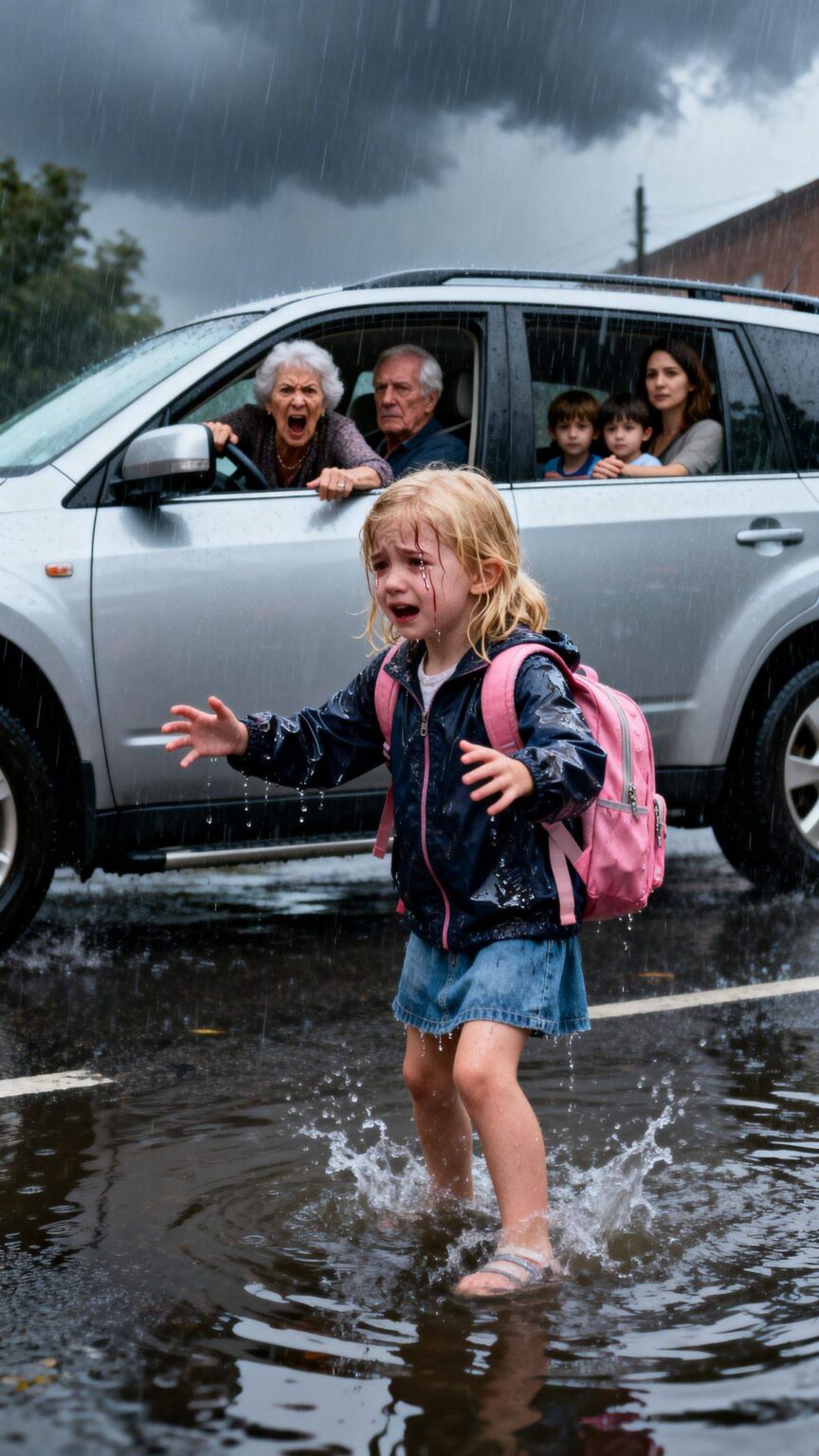
I almost laughed. Childish. As if the word belonged to me and not to the adults who had abandoned a six-year-old in a storm.
My father held up a printed bank notice. “The mortgage payment failed.”
“Yes,” I said. “I canceled it.”
My mother blinked. “You can’t just do that.”
“I already did.”
My father’s voice rose. “After all we’ve sacrificed for you?”
I stared at him in disbelief. “You left my daughter in the rain.”
My mother lifted her chin. “There were too many children in the car.”
“There was room for Miranda.”
“That’s different.”
There it was. Plain, unvarnished, and at last too visible to deny.
I stepped down from the porch and looked at both of them carefully, as if I were seeing strangers. “Say it clearly. Different how?”
My mother faltered. My father answered instead. “Miranda needs more support.”
“No,” I said softly. “Miranda gets more support because you choose her over everyone else. You chose her when we were kids. You chose her when we were adults. And yesterday, you chose her children over mine while my daughter stood there begging you not to leave.”
My mother’s eyes flickered, but not with guilt. With irritation. “You always were dramatic.”
That sentence should have shattered me. Instead, it set me free.
Because suddenly I understood that no explanation would ever reach people committed to seeing only themselves. I could line up every memory, every bank statement, every wound. I could describe Lily’s shaking body, her soaked shoes, her little voice asking whether Grandma and Grandpa were mad at us. And they would still search for a way to make themselves the injured party. Some hearts, when they refuse truth long enough, become allergic to it.
So I stopped trying.
“I’m not discussing this anymore,” I said. “The payments will not resume. You will make your own arrangements. And you will not come here again.”
My father stepped toward me. “You owe us.”
David opened the door behind me then, not aggressively, just enough for them to see he was there. Steady. Calm. Unmovable.
I met my father’s eyes. “No. I owed protection to my daughter. I’m finally paying that debt.”
For the first time, no one had an answer.
They left angry, muttering, wounded in the shallow way people are wounded when comfort is removed. Miranda sped off before my parents had even fully closed their car doors. I watched them disappear down the street and felt, beneath the sadness, the first clean breath of peace I had taken in years.
The weeks that followed were ugly before they were beautiful.
There were more messages from extended family. Aunts telling me I should forgive. Cousins saying I must have misunderstood. One uncle suggested that keeping parents financially afloat was simply what a “good daughter” did. I did not argue. I did not send evidence. I did not campaign for sympathy. Truth does not always need a committee. Sometimes it simply needs a boundary.
I blocked numbers. I informed the school that only David, Mrs. Patterson, or I could pick Lily up. I began therapy, which felt less like falling apart and more like finally cleaning out a house full of old smoke. David and I redirected the money into savings, Lily’s future, and things that actually nourished our home. We took a small weekend trip by the lake. We ate dinner without my phone buzzing with another family emergency designed to drain more from us. The peace felt unfamiliar at first, then sacred.
Lily changed too.
A month later, the rain came again one afternoon during pickup. I watched her face carefully as thunder rolled in the distance. She took my hand and squeezed it, but she did not look afraid. She looked up at me and smiled.
“You came,” she said simply.
Something inside me broke and healed in the same breath.
“Always,” I told her.
And I meant more than that moment. I meant always, in the deep sense children need. Always before appearances. Always before guilt. Always before old family scripts. The world will try to teach women that goodness means endless endurance, that mercy means letting yourself be emptied, that keeping peace is holier than telling the truth. But real love is not spineless. Real love protects what is entrusted to it. Real love can close a door without hatred. It can walk away without revenge. It can grieve and still refuse to return to what harms.
My parents had spent years teaching me that love must be earned by overgiving. Lily taught me otherwise with one trembling question in a parking lot.
Were Grandma and Grandpa mad at us?
No, my sweet girl. It was never about us being unworthy.
Some people simply choose blindness over gratitude, entitlement over tenderness, favoritism over justice. And when they do, the kindest thing you can do is stop helping them sin against your peace.
That season, I lost the family I had spent years trying to save.
But in losing them, I finally saved my own.