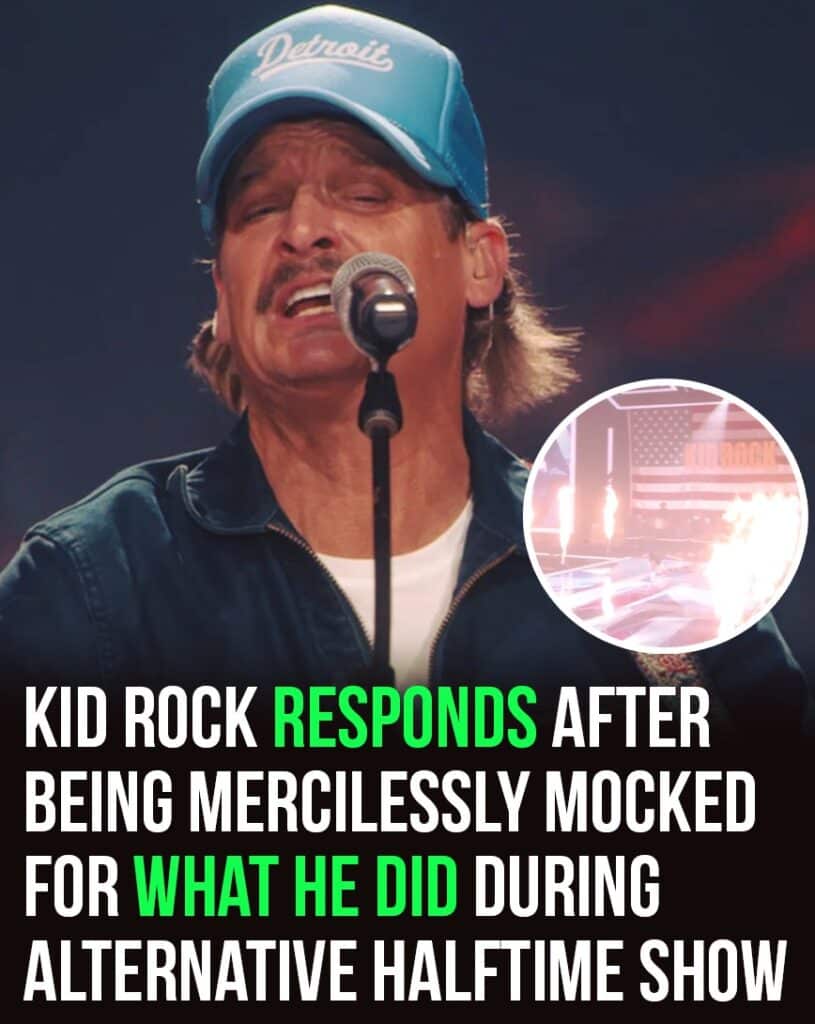
Public attention often moves faster than understanding, and nowhere is that clearer than in moments where music, politics, and social media collide. When Kid Rock appeared at Turning Point USA’s alternative halftime event on February 8, the performance itself quickly became secondary to the online reaction that followed.
The show spread rapidly across platforms — not only clips of the music, but waves of jokes, comparisons, and ridicule. Some viewers framed it as low-budget or unserious, turning the moment into a meme cycle almost instantly. Others tuned in out of curiosity or support, pushing the livestream numbers into the millions.
In contrast to the official Super Bowl halftime performance headlined by Bad Bunny, this alternative broadcast leaned into a different cultural lane — one that blended music, ideology, and tribute.
At the center of Kid Rock’s set was a memorial segment dedicated to Charlie Kirk, introduced by host Jack Posobiec. The performance shifted from familiar hits into a quieter, reflective tone, weaving faith and remembrance into the music. For some, it felt sincere and moving. For others, it felt staged or awkward. Accusations of lip-syncing spread quickly, and the internet did what it often does — turning a moment into spectacle.
Kid Rock’s response was brief and unbothered. He announced a studio version of the performance would be released, choosing momentum over defensiveness. That, too, became fuel for debate rather than closure.
Support came from certain public figures, including Pete Hegseth and Megyn Kelly, who praised the tribute and its message. On the other side, artists like Kacey Musgraves offered sharp, sarcastic commentary that captured the frustration of critics.
What emerged wasn’t really about musical quality.
It was about identity.
For some viewers, the event represented sincerity, faith, and resistance to mainstream culture. For others, it symbolized performative politics wrapped in entertainment. The same performance became two completely different experiences depending on who was watching.
And that is the quiet truth beneath the noise.
Online outrage and online praise often say more about the audience than the moment itself. In today’s digital landscape, visibility rarely means unity. It usually means division amplified.
The alternative halftime show succeeded in one undeniable way — it was seen. Millions watched, argued, shared, and reshaped it into whatever narrative fit their worldview.
Yet beyond the memes and mockery, there was also a man honoring someone he believed mattered, fans who felt moved, and critics who felt alienated. All of it existing at once.
This is how modern culture works now:
not as a shared experience, but as parallel realities.
Kid Rock didn’t just perform a set.
He stepped into a symbolic space where entertainment becomes statement — and where reaction often overshadows intention.
In the end, the moment wasn’t really about winning applause.
It was about how quickly society turns art into battleground — and how attention, whether warm or hostile, has become the loudest currency of all.
Sometimes what goes viral isn’t excellence or failure.
It’s simply division finding a stage.
And in that sense, the halftime show did exactly what the internet does best — not bringing people together, but revealing how far apart they already are.