
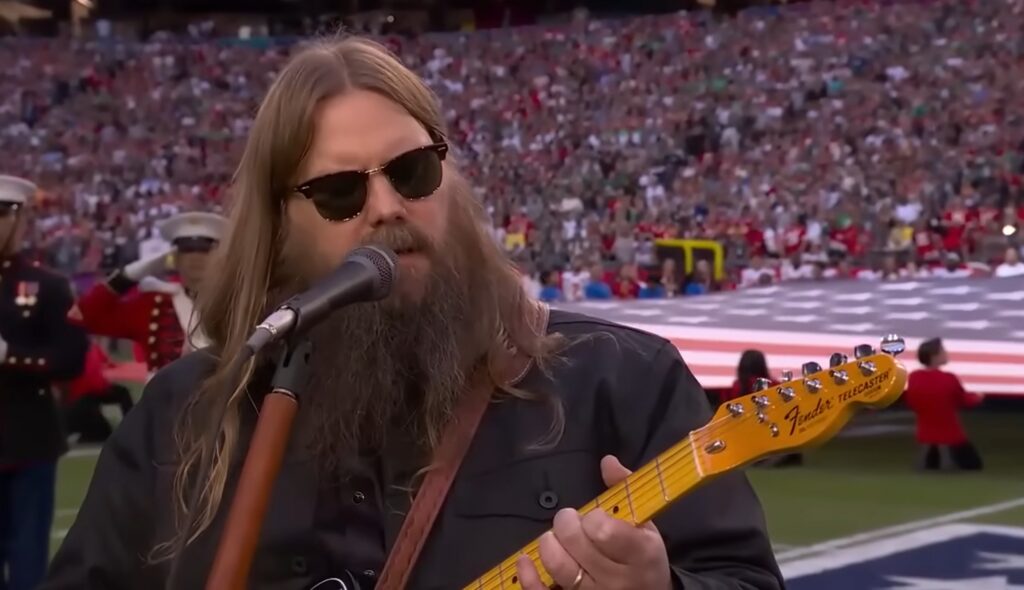
Don’t expect to see Chris Stapleton standing on the 50-yard line this February — or ever again, for that matter.
With Super Bowl LX fast approaching, fans are already buzzing about the annual national anthem performance. Gamblers, especially, are once again obsessing over one timeless question: how long is it going to be? This year, Charlie Puth has been tapped to sing The Star-Spangled Banner. He’s undeniably talented — but he’s not Chris Stapleton. And he’s definitely not Whitney Houston.
Stapleton’s 2023 rendition, a performance so powerful it left then–Eagles head coach Nick Sirianni visibly emotional, still stands as the most-watched Super Bowl anthem of the decade. It was one of those rare moments that made everyone ask the same question: Why doesn’t he do this every year?
Turns out — he never will again.
Stapleton has officially retired from singing the anthem.
And honestly? That makes perfect sense. There may be more pressure on the person singing the national anthem at the Super Bowl than on the halftime performer. Halftime shows are subjective — if you like the artist, you’ll probably enjoy it. The anthem is different. It’s sacred ground.
Mess it up, and you’re immortalized for all the wrong reasons. Nail it, and congratulations — you did exactly what you were supposed to do.
Country singer Eric Church, who once avoided singing the anthem for most of his career, summed it up perfectly when he said, “There’s more to lose than to gain.” He wasn’t wrong.
Stapleton Calls It a Career
Stapleton recently opened up about the performance on Dirty Mo Media, speaking with Dale Earnhardt Jr. about why he’s officially done with anthem duty.
He admitted that while he doesn’t usually get nervous performing, this one was different — so different that he prepared more than he ever has.
Stapleton explained that he used to joke about turning down anthem requests by saying he’d only do it once — when the Super Bowl finally came calling. And once it did, that was it.
He also credited the broadcast team for elevating the moment even further, acknowledging that the camera work, pacing, and production helped make the performance feel as massive and meaningful as it did.
Importantly, there was no safety net. No pre-recorded vocals. No second takes. It was live — live live — and that was part of what made it so intense.
Stapleton emphasized that the goal wasn’t to show off or “crush it,” but simply to execute cleanly and respectfully.
His focus was singular: don’t miss a word, don’t flub a guitar note, don’t disrespect the song.
And once it was over? Relief.
He said his team was thrilled, which let him finally relax, drop his shoulders, and settle in to actually watch the game.
Everyone Else Loved It Too
Calling it “well received” would be a massive understatement.
Luke Combs later revealed that he was sitting next to Adele during the performance — and that she completely lost it watching Stapleton sing.
Pink was reportedly stunned. Travis Kelce has admitted he still listens to the performance when he’s feeling down — just to let it hit him emotionally.
That’s the kind of cultural impact you can’t replicate.
Stapleton walked onto the biggest stage in sports, delivered one of the greatest national anthem performances of all time, and walked away forever.
One song. One night. No encore.
Go out at the absolute peak — with nothing left to prove.