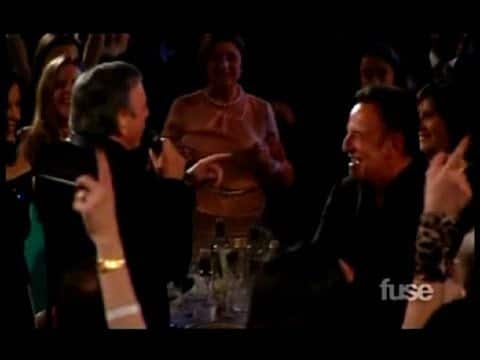
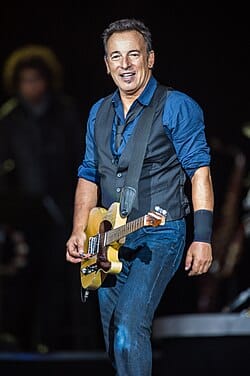
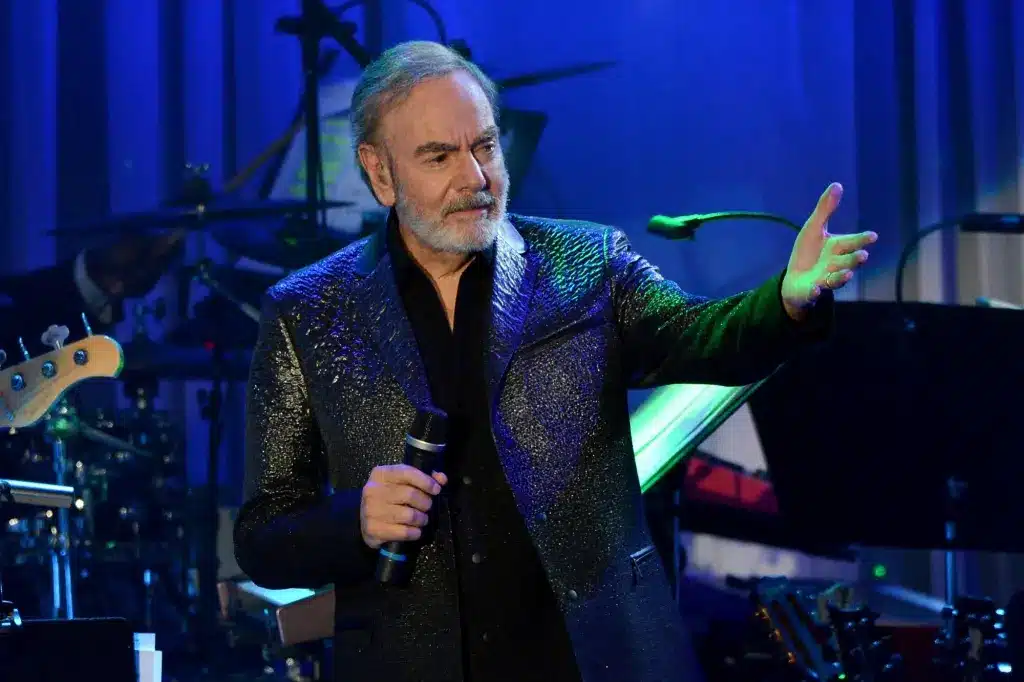
“I Don’t Remember The Words… But I Remember Why I Started.” That Trembling Line — Half-laughed, Half-broken — Is What Fans Swear They Heard When Bruce Springsteen Stepped Into Neil Diamond’s Spotlight And Turned Madison Square Garden Into A Living Heartbeat. The Crowd Was Already Electric When Bruce Barreled In Mid-verse, Guitar Slung Low, Crashing Neil’s Tribute With That Wild Jersey Grin That Says Music Isn’t Planned — It’s Lived. Two Icons Met Center Stage, Brooklyn’s Storyteller And Jersey’s Working-class Poet, And Suddenly The Song Felt Bigger Than Both Of Them. But Then It Happened — Bruce Stumbled, Stopped, The Lyrics Slipping Right Out Of His Mind. For A Second He Looked Young Again, Vulnerable, Searching. Neil Walked Over, Touched His Shoulder, And Whispered Through The Mic Like A Prayer The Whole Arena Felt In Their Bones: “Just Sing What’s True.” And Bruce Did — Not The Perfect Words, But The Real Ones — Pouring Pure Belief Into Every Note Until The Room Shook Like A Hymn. The Ending Wasn’t Polished. It Wasn’t Rehearsed. It Was Historic — Two Legends Proving That The Soul Of Music Lives In The Moments That Fall Apart… And Then Rise Higher Than Anyone Imagined.
The crowd inside Madison Square Garden was already on its feet when the lights dropped and the brass section blasted the opening notes of Brother Love’s Traveling Salvation Show. The sound was thunderous—equal parts gospel revival, raw grit, and theatrical flair. The kind of moment only Neil Diamond could turn into something that felt like church.
Neil was deep into the verse when movement stirred in the shadows offstage. A man stepped into the light—denim jacket, sweat catching the glow, a Telecaster hanging low. For a heartbeat, the audience thought it was scripted.
Then the camera zoomed in.
Bruce Springsteen.
The arena detonated.
Neil broke into a grin—half disbelief, half delight—the look of someone who’s seen everything and still loves a surprise. He leaned into the mic.
“Didn’t know you were coming, Boss.”
Bruce laughed, his voice slicing through the roar.
“Neither did security.”
The band snapped into gear. The drummer doubled down. The horns screamed. And suddenly, two giants of American music—one a preacher of everyday miracles, the other a prophet of the open road—stood shoulder to shoulder, tearing into a song about chaos, redemption, and love that refuses to quit.
Then, halfway through the chorus, something unexpected happened.
Bruce stopped.
He stared ahead, mouth slightly open, hunting for the next line—and coming up empty. For a fleeting second, panic flashed across his face. A rare, human moment when the legend forgot the words.
Neil caught it instantly.
Without missing a beat, he stepped closer, placed a hand on Bruce’s shoulder, and leaned in—close enough that only the microphones and a handful of front-row fans could catch it.
“It’s not about remembering,” Neil murmured. “It’s about believing.”
Bruce laughed, shook his head, and jumped back in—louder now, freer. The lyrics no longer mattered. The feeling did.
They sang like two men who had carried the same flame through different decades—one forged from New Jersey steel, the other from Brooklyn soul—passing it back and forth in front of a crowd that knew it was witnessing something that couldn’t be recreated.
When the final note rang out, the band let it hang in the air.
Neil raised his hand.
Bruce raised his too.
The applause was overwhelming.
Bruce turned toward him, breathless.
“Man, I just hijacked your revival.”
Neil chuckled, that familiar gravelly warmth echoing through the room.
“Good revivals never end, brother.”
Then he pulled Bruce into a hug—not for the cameras, but the kind shared between men who’ve carried generations on their backs and somehow kept standing.
Later, backstage, a sound tech caught a quiet exchange. Bruce sat on a road case, guitar resting across his knees, still catching his breath. Neil walked past and gave him a playful pat on the back.
“You forgot the words,” Neil teased.
Bruce smiled, eyes still glowing.
“Yeah. But I remembered how it’s supposed to feel.”
Neil nodded.
“That’s all the words were ever for.”
In the days that followed, the clip spread everywhere. Fans called it “the night rock and soul shared a hymn.” Musicians had another word for it: real.
One critic wrote, “They didn’t perform that song—they brought it back to life.”
And maybe that’s why people kept replaying it weeks later. Not because Bruce Springsteen stumbled—but because, for once, perfection didn’t matter.
What mattered was belief.
In music.
In brotherhood.
In the kind of magic that ignores setlists.
A month later, Bruce was asked about the moment. He paused before answering.
“I’ve sung millions of words,” he said softly. “But that night, Neil reminded me of the only one that counts—believe.”
When pressed, Bruce smiled.
“You can forget every lyric you ever wrote. Just don’t forget why you started singing.”
Somewhere, maybe in a quiet house in Colorado, Neil Diamond likely smiled at that.
Because that night, the preacher of “Brother Love’s Traveling Salvation Show” didn’t just rescue a song—
he reminded The Boss that even legends sometimes need saving too.
{"post":94518,"page":1,"next":[{"id":94490,"title":"Opening With The Shattering Line, \u201cIf My Voice Breaks\u2026 Just Let It. I\u2019ve Held This In For Too Long,\u201d Kelly Clarkson Delivered A Raw, Soul-baring Performance That Left The Entire Arena Frozen. Revisiting A Song She Once Vowed Never To Sing Again, Kelly Transformed It Into A Healing Confession \u2014 Breaking Down As She Declared, \u201cI Take Care Of Me\u2026 Because I Love Me.\u201d Jelly Roll Watched In Stunned Silence From Side Stage, Overcome With Emotion, While Thousands In The Audience Wiped Away Tears, Clinging To Every Trembling Note. When The Music Faded, Kelly Stood Still, Offering No Bow \u2014 Only A Quiet, Holy Moment Of Release. A Performance Not Of Applause, But Of Pure, Life-changing Healing.","url":"https:\/\/new24.info\/94490"},{"id":94487,"title":"Adam Lambert\u2019s Royal Moment Became Pure Magic Inside Westminster Abbey, As The Former Idol Hopeful Returned Not As A Contestant \u2014 But As A Full-Fledged Icon. Personally Welcomed By Duchess Kate In A Warm, Tear-stirring Gesture, Adam Joined Beverley Knight For A Breathtaking Duet Of \u201cThe Christmas Song\u201d That Left Guests trembling And Whispering They Were \u201cWitnessing History.\u201d Every Note Filled The Abbey With Sacred Emotion, And When The Last Chord Faded, The Standing Ovation Crowned Adam\u2019s Unshakable Rise To Greatness","url":"https:\/\/new24.info\/94487"},{"id":94483,"title":"They Didn\u2019t Even Have A Chance To Brace Themselves \u2014 Because The Moment Adam Lambert Stepped Back Onto That Stage, The Entire Room Felt Like It Had Been Struck By Lightning. Gone Was The Nervous Teen America First Met; Standing In His Place Was A Fire-forged Icon, Dressed Like A Storm And Moving Like He Owned Every Atom Of The Spotlight. \u201cI Can\u2019t Believe This Is The Same Man\u2026 He\u2019s On Another Level,\u201d one fan whispered through tears as Adam unleashed his soul-shaking version of Ann Peebles\u2019 \u201cI Can\u2019t Stand The Rain,\u201d each note cracking open the crowd with raw emotion. People weren\u2019t just cheering \u2014 they were rising, trembling, letting the music pull them out of their seats. Even Katy Perry, usually collected and playful, froze wide-eyed before lifting both hands to her heart in a gesture of pure awe \u2014 something she had never done on that stage. \u201cMy God\u2026 he\u2019s unstoppable,\u201d she mouthed, stunned. Every riff, every breath, every look Adam gave felt like he was reclaiming the universe that once slipped through his fingers. By the time the final note shattered into the rafters, fans were gasping, clutching each other, whispering, \u201cI\u2019ve never seen anyone command a room like that.\u201d When the lights dimmed, the echo of his voice still lingered \u2014 not a performance, but an eruption, a declaration, a reminder that without Adam Lambert\u2026 the show simply doesn\u2019t exist","url":"https:\/\/new24.info\/94483"},{"id":94479,"title":"Raul Malo Spent His Final Moments Not As A Music Icon, But As A Husband, Quietly Saying Goodbye After An 18-month Battle With Cancer. Holding His Wife\u2019s Hand, He Admitted His Fear Wasn\u2019t Death \u2014 It Was Leaving Her Alone. Surrounded By Family And Love, His Last Words Were Filled With Gratitude, Devotion, And Peace, Slipping Away As Gently As The Final Note Of A Song. His Voice May Have Fallen Silent, But The Love He Left Behind Continues To Echo.","url":"https:\/\/new24.info\/94479"},{"id":94474,"title":"Blake Shelton And His Mom Share A Christmas Song That Quietly Became A Holiday Phenomenon","url":"https:\/\/new24.info\/94474"},{"id":94469,"title":"Country Star Brett Kissel Confirms Marriage Is Over After Quiet Yearlong Separation","url":"https:\/\/new24.info\/94469"},{"id":94464,"title":"SEASON 29 IS COMING \u2014 and The Voice is about to look very different. Four fan-favorite coaches are quietly stepping away, while three champion-making legends storm back into those iconic red chairs, instantly raising the stakes. But that\u2019s not the twist shaking viewers the most. For the first time ever, a brand-new voting block will decide who moves forward \u2014 a change so drastic it could flip outcomes overnight and leave some fans feeling completely shut out. Insiders say this season won\u2019t just test the singers\u2026 it will test the audience, too. Love it or hate it, Season 29 is setting up a shake-up no one saw coming \u2014 and once it starts, there\u2019s no turning back.","url":"https:\/\/new24.info\/94464"},{"id":94461,"title":"Lauren Alaina Laughs Off A Mismatched Boot Mishap Before Ohio Concert","url":"https:\/\/new24.info\/94461"},{"id":94458,"title":"Brandon Coleman\u2019s Quiet Focus And His Wife\u2019s Explosive Joy Create The Most Talked-About Moment Of The Night","url":"https:\/\/new24.info\/94458"},{"id":94454,"title":"\u201cI Sure Will Miss Him\u201d: Reba\u2019s Emotional Tribute Reveals A Side Of Rob Reiner Fans Rarely Saw","url":"https:\/\/new24.info\/94454"},{"id":94451,"title":"Tim Mcgraw And Faith Hill\u2019s Youngest Daughter Quietly Steals The Spotlight With Her Acting Debut In Landman","url":"https:\/\/new24.info\/94451"},{"id":94448,"title":"Riley Green Finally Meets Sam Elliott At The Cmas And Gets A Response No One Could Ever Make Up","url":"https:\/\/new24.info\/94448"},{"id":94445,"title":"After A Year Of Loss And Fear, Miss Kay Robertson\u2019s Health Update Leaves Duck Dynasty Fans Emotional","url":"https:\/\/new24.info\/94445"},{"id":94442,"title":"Carrie Underwood\u2019s Live Performance Of \u201cO Come All Ye Faithful\u201d Feels Like A Sacred Christmas Moment","url":"https:\/\/new24.info\/94442"}]}