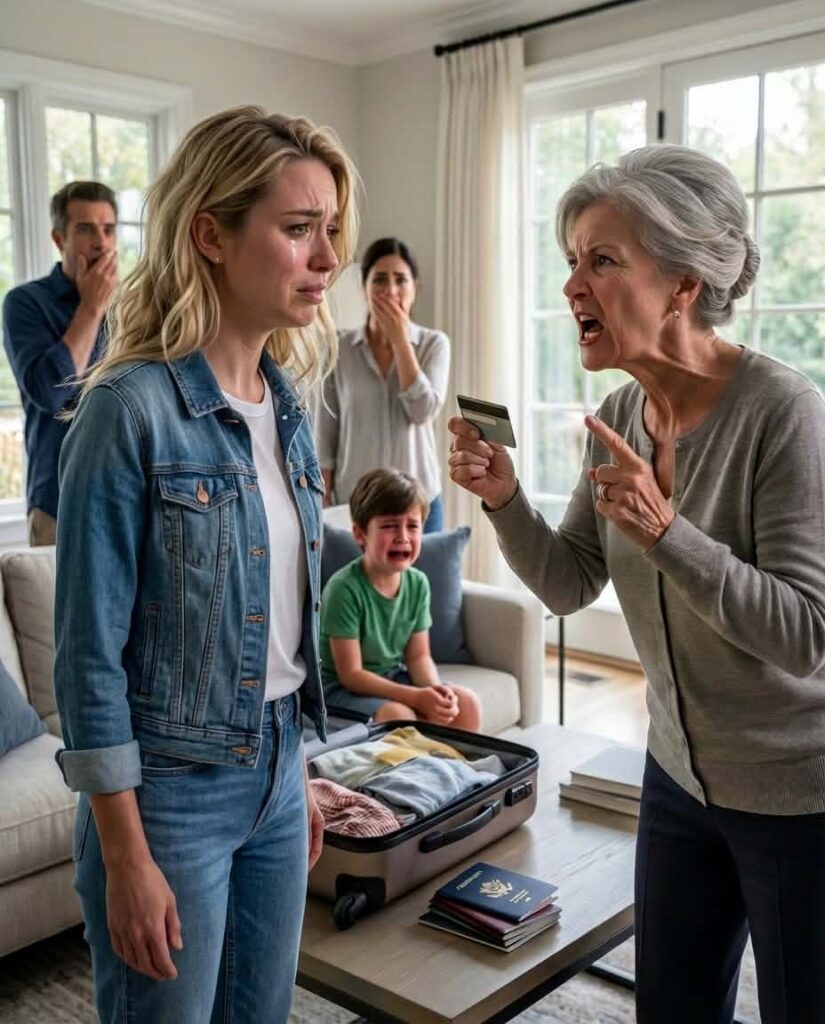
Three days before our flight to Bali, my son Mason was sitting cross-legged on the living room floor, carefully zipping up the same little blue suitcase he had packed and unpacked all week.
He was eight, and he had been counting down the days like it was the most important event of his life.
To him, this wasn’t just a vacation. It was something bigger. A “real family trip,” the kind where everyone stays, no one argues, and no one leaves early. He had memorized where Bali was on the map and proudly corrected anyone who called it “just somewhere tropical.”
I had paid for everything.
Flights for six. A private villa in Seminyak. Activities for the kids. Even a day trip to Ubud because my sister’s twins wanted to see monkeys. I knew, deep down, I was being valued more for what I could provide than for who I was—but I told myself it was for Mason.
That was enough.
Then the doorbell rang.
When I opened it, my mother stood there, already composed, already decided. My sister Monica was beside her, arms crossed, expression cool and rehearsed.
And in my mother’s hand—
my bank card.
For a second, I just stared.
“Why do you have that?” I asked.
She stepped inside without waiting. “We need to talk.”
Mason came running, smiling. “Grandma! Did you bring the Bali bracelets you said—”
She barely acknowledged him.
Monica shut the door. “Go to your room for a minute, sweetheart.”
Mason hesitated, looking at me. I nodded, even though something in my chest had already tightened.
When he disappeared down the hallway, my mother held up the card like it was proof of something.
“We decided you won’t be coming.”
I laughed.
I actually laughed—because the sentence didn’t make sense.
“What?”
My mother didn’t flinch. “Your sister’s kids don’t want to see you.”
Monica added casually, “They feel uncomfortable around… everything.”
Everything.
That word again. The one they used when they didn’t want to say the truth out loud. Since my divorce, since I stopped being agreeable, since I stopped shrinking to keep peace—“everything” had become their polite version of rejection.
I looked at the card again. “You took this from my purse?”
“Watch your tone,” my mother snapped. “I took it because I needed to make changes before you did something dramatic.”
“My son has been waiting for this trip for weeks.”
Monica shrugged. “Then you should explain that life changes.”
From the hallway, Mason’s voice drifted out, small and hopeful.
“Mom? Are we still going?”
No one answered him.
And something in me—something that had been quiet for years—finally stood up.
I looked at both of them, really looked, and then I said the one thing that drained all the color from their faces.
“Good,” I said quietly. “Because I canceled everything an hour ago.”
Silence.
Real silence. The kind that doesn’t just fill a room—it empties it.
My mother blinked. “What did you say?”
“I said I canceled it.”
Monica laughed too quickly. “Stop.”
But I didn’t move. I didn’t soften. I walked to the table, picked up my phone, and showed them.
Canceled flights. Voided villa booking. Transfers gone. Activities refunded. Everything undone—cleanly, completely, and within policy.
Monica stepped closer, her voice tightening. “You can’t be serious.”
“You came into my home,” I said evenly, “took my card, and planned to tell my eight-year-old he wasn’t wanted on a trip I paid for. I became serious before you rang the bell.”
My mother’s voice rose. “Do you realize what you’ve done?”
“Yes,” I said. “I stopped you from humiliating my child in another country.”
Mason had come halfway down the hallway now, holding the strap of his suitcase.
“Are we not going to Bali?” he asked.
My mother tried to step in, suddenly soft again. “Honey, plans just changed a little—”
I stopped her with a look.
Then I crouched in front of Mason.
“We’re not going on that trip,” I said gently.
His eyes filled instantly. “Because they don’t want us?”
The silence answered him.
And that was the moment that mattered.
Not the trip. Not the money. Not even the betrayal.
That moment.
I put my hands on his shoulders. “This is not because of you. This is because some adults made a very bad decision, and I’m not going to let that hurt you more than it already has.”
He nodded, trying to be brave.
Behind me, my mother kept going. “You’re overreacting. Family doesn’t do this.”
I stood up slowly.
“Exactly,” I said.
Monica grabbed her phone, dialing frantically. “I’m calling the airline.”
“Go ahead,” I replied. “You’ll need my details to fix anything. You don’t have them.”
That’s when the panic really started.
Not emotional panic.
Practical panic.
Because control—real control—was never theirs.
After twenty minutes of arguing, blaming, and failing to reverse what had already been undone, they left. My mother crying. Monica furious. Neither one apologizing to Mason.
The house went quiet.
Mason sat at the table, tracing circles with his finger. “Did Grandma lie?”
I sat beside him. “They made a hurtful choice. And sometimes people call that ‘peace’ so they don’t have to admit what it really is.”
He was quiet for a while.
Then he asked, “Are we still going somewhere?”
That question stayed with me long after he fell asleep.
Because disappointment wasn’t the lesson I wanted him to carry.
So that night, I rebuilt everything.
Not Bali.
Something else.
Smaller. Better. Ours.
By midnight, I had booked two tickets to Maui.
Oceanfront. Five days. No relatives.
Just us.
The next morning, while making waffles, the bank called.
They wanted to confirm recent activity on my account—attempts to modify bookings, timestamps matching exactly when my mother had been in my house.
I stood there, spatula in hand, listening.
In the past, I would have protected them. Softened it. Explained it away.
This time, I didn’t.
“I did not authorize my card to be taken or used,” I said.
Facts.
Simple. Clean. Unavoidable.
And facts have consequences.
By the time we boarded our flight, the fallout had already started—accounts flagged, questions asked, money traced.
My mother left a voicemail just before takeoff, her voice smaller than I had ever heard it.
“You’ve made this into something terrible.”
I deleted it.
Maui wasn’t what Mason had imagined.
It was better.
No tension. No quiet ranking of who mattered more. No performance disguised as family.
Just ocean water, warm evenings, and a child slowly remembering that belonging shouldn’t hurt.
On our second night, he leaned against me and asked, “Did you know they were going to be mean?”
“I thought they might be,” I said. “I didn’t think they’d do it in front of you.”
He nodded, thinking. Then said softly, “I’m glad you canceled it.”
That stayed with me.
Because that was the real moment everything changed.
Not when they showed up.
Not when I canceled the trip.
But when my son understood something most adults learn too late:
You don’t stay where people decide your worth based on convenience.
You don’t fight to belong where love comes with conditions.
And sometimes, the strongest thing you can do—
is walk away before they get the chance to push you out.