
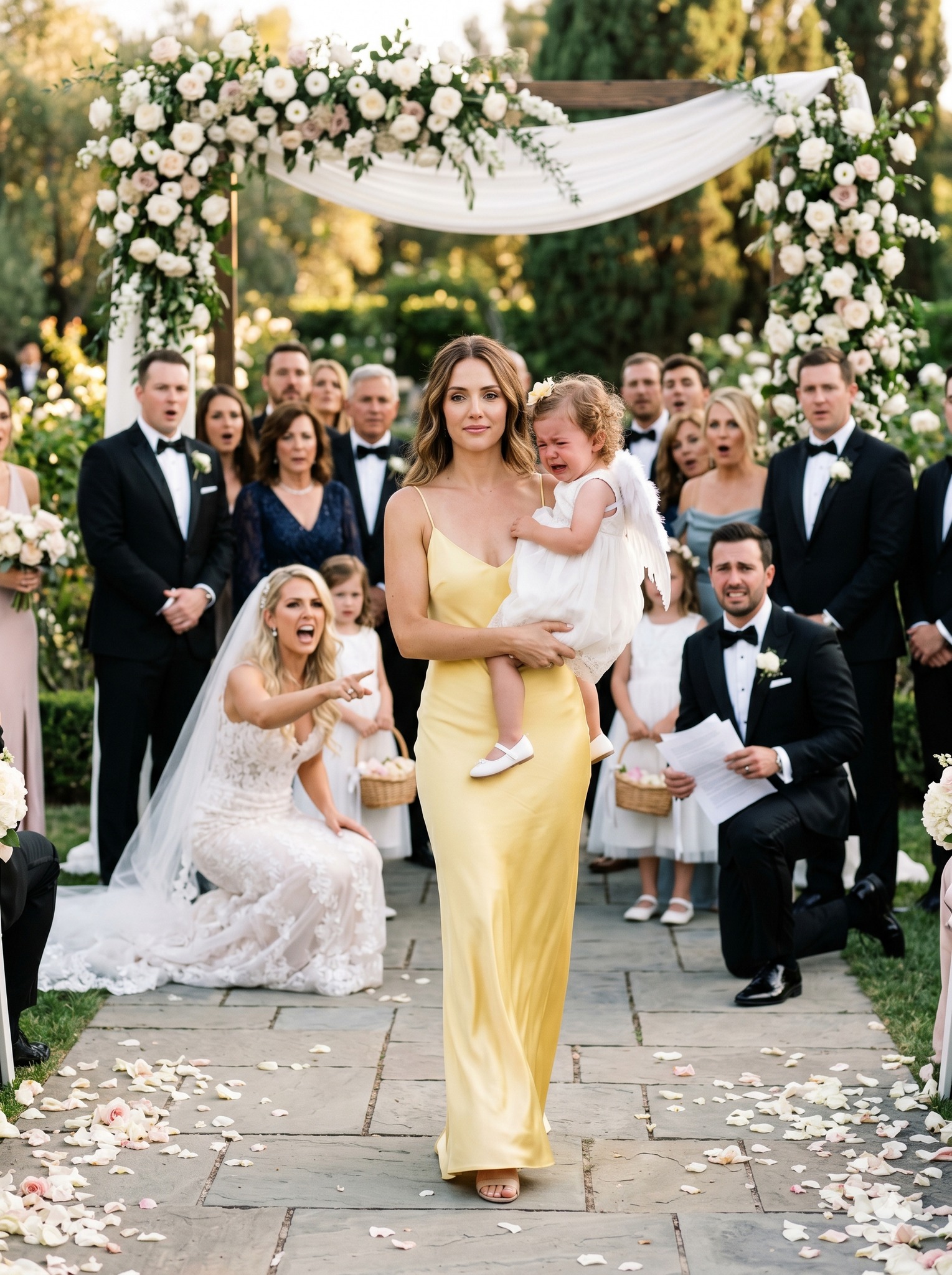
The Moment I Chose My Daughter Over the Room
On the morning of my brother Ryan’s rehearsal dinner, I sat on the bathroom floor with my six-year-old daughter, Emma.
She was carefully placing small white daisy clips into her hair, asking me every few minutes if they looked “just right.” For four months, she had practiced her walk down our hallway, holding an invisible basket, taking each step seriously—as if the moment already mattered.
To her, it did.
My husband Derek moved quietly through the house, making sure everything was ready. There was a sense of order, of anticipation. On the drive to the Hargrove Inn, Emma talked without pause about how excited she was for her uncle to see her walk down the aisle.
It was a simple kind of happiness.
The kind you don’t think needs protecting.
When we arrived, my phone buzzed before I even stepped out of the car.
A message from my mother. She asked me to meet her privately in the garden before bringing Emma inside.
There was something in the tone that made me pause.
I told Derek I’d be back in a moment and walked toward the rose garden, where she was already waiting. She stood still, composed in a way that didn’t match the day.
She didn’t ease into it.
She told me, plainly, that the flower girl had been changed. That Madison had chosen her own niece, Brooke, instead of Emma. The decision had been made weeks earlier. No one had said anything.
She added that it was for the sake of the wedding’s “cohesiveness.”
Then she asked me to stay calm. To be gracious. To not upset anyone.
The words settled heavily, not because they were loud, but because of what they revealed. Not just the change itself, but the choice to keep it from us. To allow a child to arrive expecting something that had already been taken away.
I didn’t argue.
Some moments don’t need more conversation. They need clarity.
I walked back to the car.
Emma was still smiling when I opened the door. That made it harder, not easier. I knelt beside her on the gravel and told her the truth in the simplest way I could—that the plans had changed, and another little girl would be carrying the basket.
She didn’t cry immediately.
She just went quiet.
It was the kind of quiet that shows you a child is trying to understand something that doesn’t make sense yet. Derek reached for her hand, and we stayed there for a moment, giving her space to feel it without rushing her through it.
Then we went inside.
We took our seats. We didn’t draw attention. We didn’t disrupt anything. There is a difference between creating a scene and standing with dignity, and in that moment, it felt right to remain steady.
Still, something had already shifted.
A few minutes later, my phone buzzed again.
This time, it was my father.
He asked me to come outside.
When I stepped onto the porch, I could see immediately that he knew. There was no confusion in his expression, only a quiet anger that had already settled into something firm.
He didn’t speak for long.
He simply said that this wasn’t right, and that it shouldn’t be carried quietly as if it were.
Then he walked back inside.
What followed wasn’t loud in the way people might expect, but it was clear. He addressed the room—not to create embarrassment, but to name what had happened. He spoke about the decision, about the silence around it, and about the cost of protecting appearances at the expense of a child’s trust.
There was no exaggeration in his words.
Just truth.
No one interrupted him.
Some looked away. Some stayed still. My brother and my mother said nothing, not because they had nothing to say, but because the moment didn’t belong to explanation anymore.
It belonged to accountability.
I didn’t stay to see how it resolved.
Derek and I gathered our things, and we left with Emma. Not in anger, not in haste. Just with the understanding that our place, in that moment, was no longer in that room.
Outside, the air felt different.
Emma was still quiet, but she held my hand more tightly. That mattered more than anything else that had happened inside.
Later, I thought about what had unfolded.
Not just the decision, but the way it had been handled. The assumption that we would accept it quietly, that we would protect the comfort of others while asking a child to absorb disappointment without warning.
That was the part that couldn’t be carried forward.
My father didn’t fix what happened.
But he did something important.
He made it clear that some lines are not meant to be crossed in silence. That respect, especially for those who trust us most, is not optional. And that protecting a child’s dignity is never an inconvenience.
That evening, I didn’t feel pride in leaving.
I felt clarity.
And sometimes, that is what steadies you more than anything else.