
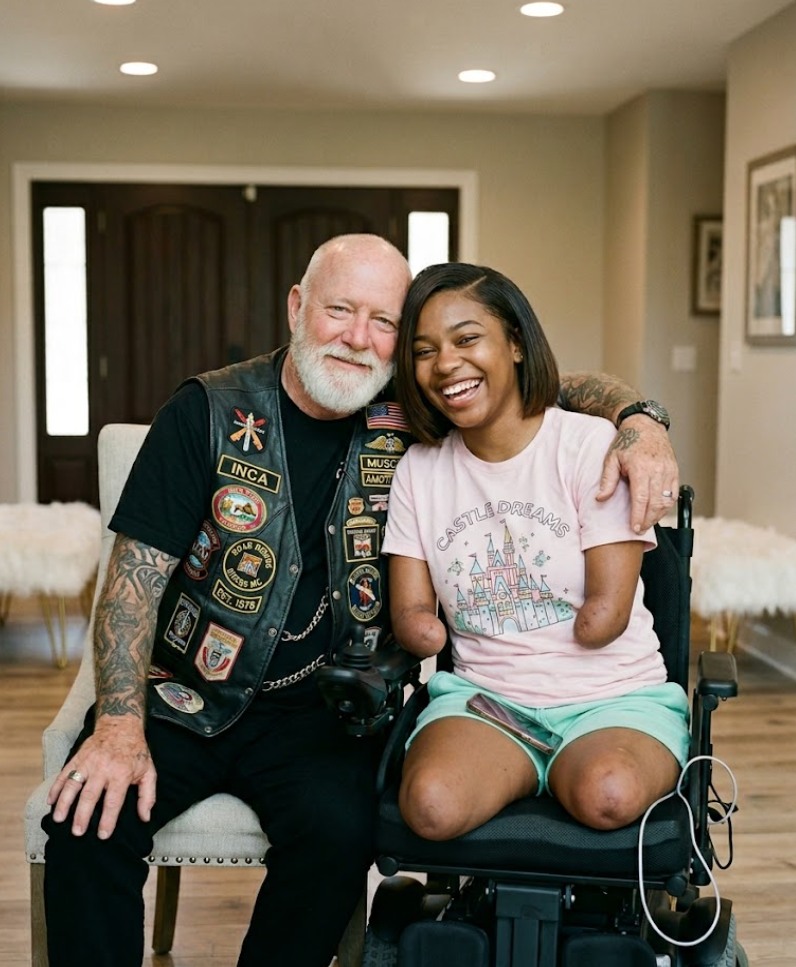
The Day Someone Chose Me
My name is Destiny, and for most of my life, I believed family was something that happened to other people.
I lost my legs in a car accident when I was three years old. My mother died in that crash, and my father went to prison not long after. I don’t remember much from that time, but I grew up carrying the consequences of it in ways that followed me everywhere.
Over the next twelve years, I moved through four different foster homes.
Each one began with cautious hope. Each one ended the same way—politely, quietly, sometimes with explanations, sometimes without. My wheelchair, the medical care, the extra attention I needed—it was always more than they were willing to hold for long.
By fourteen, I had learned not to expect permanence.
My social worker tried to be honest with me. She said I would likely age out of the system. No promises, no illusions. Just a path forward that meant learning how to stand alone, even without legs to stand on.
I accepted it.
Not because it didn’t hurt, but because it was easier than hoping again.
Then one afternoon, everything shifted in a way I didn’t recognize at first.
I saw him through the window before I met him.
A tall man with a gray beard, stepping off a motorcycle, wearing a worn leather vest that didn’t quite fit the setting. He didn’t look like the kind of person who usually walked into places like ours. There was something steady about him, though—not loud, not performative. Just present.
I wheeled myself into the meeting room, already preparing for another version of the same conversation.
He introduced himself as Robert Miller.
Then he said something I wasn’t ready for.
He told me he knew about my grades, about the way I played guitar, about how I spoke up for other kids in the system. He spoke as if those things mattered. As if they were the reason he was there.
And then he said, simply, that he wanted to adopt me.
Not foster. Not try. Adopt.
I didn’t accept it.
I had heard enough to know that intentions don’t always last. So I said what usually ended things. I told him about the medical costs. The reality of my condition. The parts that had made others step back.
He didn’t argue.
He didn’t reassure me with easy promises either. He just told me something about his own life. His wife, Angela, had lived with multiple sclerosis for fifteen years. He had stayed through that. He understood what long-term care meant—not as an idea, but as a daily reality.
Then he said something that stayed with me.
He said I was worth the effort.
Not in a way that felt like a line. In a way that sounded like something he had already decided.
Over time, he shared more.
Angela had made him promise, before she passed, that he wouldn’t spend the rest of his life alone. That he would find someone to care for, someone who needed what he still had to give. He didn’t search for the easiest path. He searched for someone who had been overlooked.
He found me.
I told him about my trust issues. About how people leaving had stopped surprising me. About how I didn’t know how to believe in something that could stay.
He didn’t try to fix that either.
He told me about his own struggles—grief, the weight he carried from his time in Iraq, the things that don’t leave just because time passes. He didn’t present himself as someone without scars. He spoke like someone who knew what it meant to live with them.
He said we could figure things out together.
Not perfectly. Just honestly.
That was the first time I felt something break through the wall I had built.
I cried in a way I hadn’t allowed myself to in years.
He didn’t rush me. He just knelt beside my wheelchair and stayed there, steady, until I was ready to breathe again. Then he said, quietly, that he wasn’t going anywhere.
The adoption process took eight months.
It wasn’t easy or fast. There were home visits, paperwork, court dates—steps that made everything feel uncertain again at times. But he showed up for all of it. Not once, not occasionally—consistently.
During those months, something else happened too.
His motorcycle club became part of the picture. At first, I didn’t understand it. But they showed up in practical ways—building a ramp at his house so I could move freely, helping get a custom wheelchair that actually fit my life, not just my condition.
They didn’t treat me like a project.
They treated me like I was already part of something.
On the day the adoption became official, I stepped—rolled—out of the courthouse into a crowd of bikers waiting outside.
There was no spectacle to it. Just a group of people who had decided, in their own way, to stand there and mark the moment.
They welcomed me without hesitation.
Two years later, Robert gave me something he had kept safe.
A letter from Angela.
She had written it before she passed, knowing there would be someone one day. She didn’t know my name. She didn’t know my story. But she wrote as if she understood something deeper—that the person who came into his life would need to feel seen, not saved.
She told me she already loved me.
And she asked me to take care of him.
That letter didn’t erase the years that came before.
But it settled something inside me.
For a long time, I thought family was something fragile—something that could be returned, reconsidered, or quietly let go.
Now I understand it differently.
Family is not just who arrives.
It’s who stays.
And for the first time in my life, I don’t wonder how long it will last.
I know I belong.