
What I Let Go of After Losing My Daughter
My daughter Lily lived for twenty-three days.
In that short time, I learned every detail of her face. I stayed beside her through every procedure, every uncertain hour, holding onto the quiet hope that somehow she would stay. When she passed from an undetected heart defect, the world did not shatter loudly—it went still in a way I had never known before.
Four days later, I called my parents.
I told them about the funeral. I told them I needed them. Not in a complicated way—just their presence, just something steady to stand next to.
There was a pause on the line.
Then my mother said they couldn’t come. My brother was hosting a barbecue. There were guests. It would be difficult to leave.
She added, almost casually, that I could have another child.
There are moments when something inside you doesn’t break—it settles. Quietly, decisively, without drama. Not because the pain is small, but because it becomes clear.
I ended the call without raising my voice.
On the day of the funeral, I stood alone outside the building, holding a blanket my daughter never got to use. The air felt heavier than it should have. People moved around me, but none of it reached me in the way it once might have.
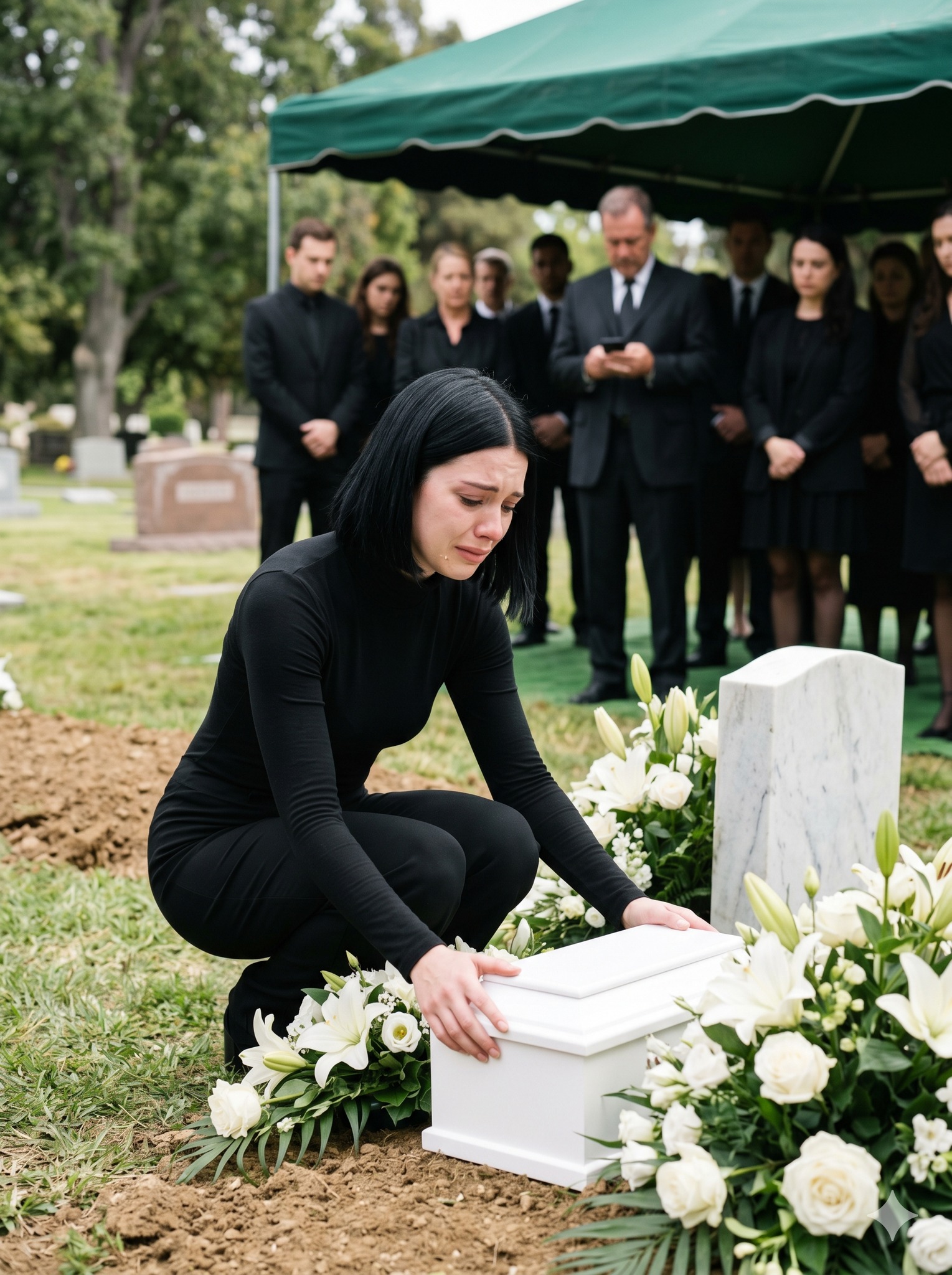
Inside, I stood beside her small white casket and spoke.
Not because I had the strength to, but because she deserved it. Even a life that brief leaves something real behind. I said her name. I made sure it was heard. That she was not reduced to silence simply because her time was short.
When it ended, I walked out the same way I had walked in.
Alone—but no longer uncertain.
Grief shows you what you’ve lost. But absence, especially at a moment like that, shows you something else entirely. It reveals the shape of what was never truly there.
That afternoon, something in me shifted—not outwardly, not in a way anyone could immediately see, but in a way that made certain things impossible to continue.
For years, I had supported my family quietly.
Paid debts. Solved problems. Stepped in before things collapsed. It had become a pattern—one I didn’t question too closely, because it felt easier to carry it than to examine it.
After the funeral, I stopped.
There was no announcement, no confrontation. I made the necessary calls—to my attorney, to the bank, to the offices where my name had been tied to obligations that were never fully mine. I withdrew my support and allowed things to return to their proper place.
Not as punishment.
As alignment.
The responses came quickly.
My mother called first, her voice firm, suggesting grief was clouding my judgment. That I was overreacting to what she described as a difficult scheduling decision.
My brother came by later, speaking in the same familiar tone—concern mixed with inconvenience, as if something had shifted in a system he had relied on without thinking about it.
I didn’t argue with either of them.
There was nothing left to explain.
Instead, I spoke plainly. Not with anger, but with clarity. I told them what their absence meant, not in accusation, but in truth. Then I let the conversation end where it needed to.
My father said little at first.
Later, he admitted something quietly—that he had chosen to keep things peaceful for years, even when it meant letting me carry more than I should have. Not out of cruelty, but out of avoidance.
It didn’t undo anything.
But it named it.
My mother responded differently. She stayed within her explanations, her reasons, her way of seeing things. I didn’t challenge them. Not because I agreed, but because I no longer needed her to see it my way in order to move forward.
Some things are understood only when a person is ready to face them.
And some may never be.
What I did next wasn’t dramatic.
I held my boundary.
Steady. Without raising it and without lowering it.
Letting go of that role—of being the one who absorbs, fixes, and carries—wasn’t an act of anger. It was a refusal to continue something that no longer had truth in it.
Losing Lily took more from me than I can fully describe.
But it also clarified something I had been overlooking for a long time: care cannot exist only in one direction. And presence, especially in moments of real loss, is not optional if something is meant to be called family.
When I buried my daughter, I didn’t become harder.
I became clearer.
And from that clarity, I chose a different way to live—one where what I give, and to whom I give it, is no longer shaped by habit, but by what is real.