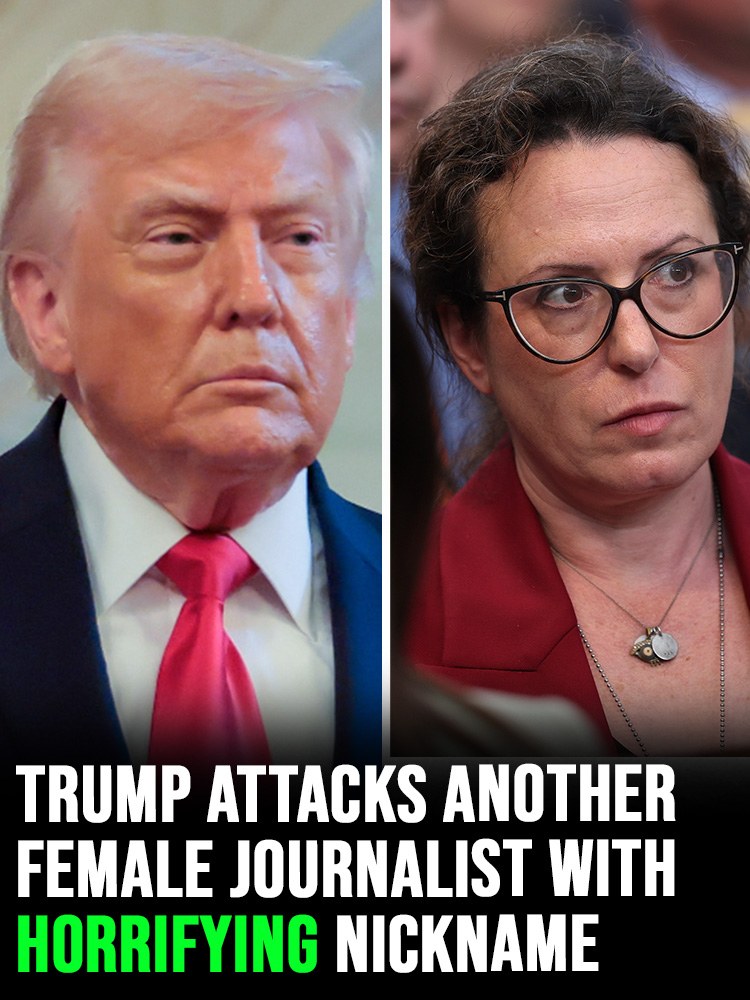
Donald Trump has once again turned his attention toward a prominent journalist, renewing a pattern that has defined much of his relationship with the media over the past decade. This time, the target is Maggie Haberman, a Pulitzer Prize-winning White House correspondent for The New York Times, whose reporting on Trump has long placed her at the center of both political scrutiny and public debate.
On March 6, 2026, Trump used his Truth Social platform to deliver a sharply worded post criticizing Haberman, referring to her in derogatory terms and suggesting that she could be included in an ongoing Florida-based lawsuit involving The New York Times. While the language of the post was consistent with Trump’s past rhetoric toward journalists he views as unfavorable, what stood out was not only the intensity of the attack, but the absence of a clearly defined trigger. Trump did not specify which article or report prompted his remarks, leaving observers to interpret the context rather than respond to a concrete dispute.
This lack of specificity is not unusual in Trump’s public criticism of the press. Throughout his presidency and post-presidency, he has frequently challenged journalists and media organizations in broad terms, often framing coverage as biased or inaccurate without engaging directly with individual claims. The New York Times, along with outlets such as CNN and The Washington Post, has repeatedly been positioned within his rhetoric as part of a media environment he considers hostile. Within that framework, figures like Haberman—whose reporting has consistently examined internal political dynamics, policy decisions, and controversies—have become recurring focal points.
Haberman’s career has been built on detailed investigative reporting, often involving extensive sourcing, document analysis, and insider accounts. Her work has covered a wide range of subjects, including Trump’s political strategy, internal White House operations, and connections between key advisors and broader policy decisions. In 2022, she published Confidence Man: The Making of Donald Trump and the Breaking of America, a biography that further cemented her role as one of the most closely associated journalists covering Trump’s public and private trajectory. Her reporting has been widely cited across major media platforms and remains influential in shaping public understanding of political developments.
At the same time, Trump’s criticism of Haberman fits into a broader pattern of confrontational interactions with journalists, particularly those who challenge his narratives or pursue investigative angles he disputes. In recent months, similar exchanges have occurred with reporters such as Kaitlan Collins of CNN and Natalie Allison of The Washington Post, both of whom faced public criticism from Trump during interviews or press interactions. These incidents, while varying in tone and setting, reflect a consistent dynamic in which journalistic inquiry is met with personal and institutional pushback.
Media analysts note that such interactions serve multiple functions. On one level, they reinforce Trump’s direct communication style, allowing him to bypass traditional media channels and speak directly to his audience. On another, they shape public perception by framing journalists and outlets within a narrative of opposition or bias. This approach can strengthen support among his base while simultaneously intensifying polarization within the broader media landscape.
Legal experts, meanwhile, emphasize that Trump’s references to potential lawsuits involve significant procedural and evidentiary hurdles. Defamation claims in the United States require a high standard of proof, particularly when public figures and established media organizations are involved. While Trump has previously pursued legal action against news outlets, many cases have faced dismissal or have not resulted in precedent-setting outcomes. As a result, public mentions of legal action are often interpreted as part of a broader communication strategy rather than an immediate legal trajectory.
The recurring tension between Trump and journalists like Haberman highlights a deeper structural reality within modern political life. The relationship between public figures and the press has always carried elements of conflict, particularly when reporting challenges official narratives or exposes internal dynamics. However, the scale, frequency, and tone of these exchanges in recent years reflect a shift in how that relationship is conducted—more public, more personal, and increasingly intertwined with social media platforms that amplify both message and reaction.
For journalists, this environment presents a dual challenge. It requires maintaining professional standards of verification, sourcing, and editorial oversight while operating under heightened public scrutiny and, at times, direct personal criticism. For audiences, it introduces an added layer of complexity in interpreting information, as reporting, reaction, and political messaging often unfold simultaneously and influence one another in real time.
Within this context, Haberman’s continued reporting represents a continuation of the traditional role of investigative journalism: to examine power, provide context, and document developments that may not be fully visible through official channels. Her work, along with that of other high-profile reporters, contributes to a broader record of political activity that extends beyond immediate headlines and into longer-term analysis and historical understanding.
Trump’s latest remarks, while consistent with his established approach to media criticism, serve as another example of how political communication, journalistic inquiry, and public perception intersect in the current landscape. The exchange itself may not resolve any underlying disputes, but it reinforces the ongoing tension between two institutions that operate with fundamentally different objectives—one seeking to shape narrative and maintain influence, the other to investigate, interpret, and inform.
In that sense, the significance of the moment lies less in the specific language of the criticism and more in what it represents: an continuation of a dynamic that continues to define the boundaries—and the friction—between political authority and the press in contemporary American life.