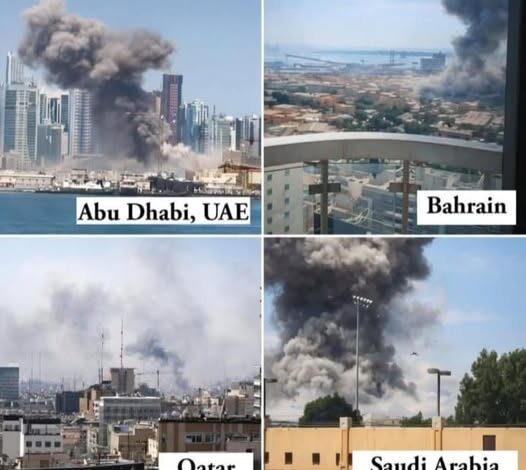
The strategic balance in the Persian Gulf has been jolted by a series of coordinated Iranian ballistic missile strikes, signaling one of the most serious escalations the region has faced in decades. In the early hours of March 1, 2026, Iranian state media confirmed that its military had authorized strikes against United States military installations across several Gulf nations. What had long simmered as indirect confrontation has now moved into open exchange, prompting airspace closures and emergency measures across multiple countries.
Coordinated Regional Strikes
Reports indicate that targets were struck in the United Arab Emirates, Bahrain, Qatar, and Kuwait. In Abu Dhabi, explosions were reported near Al Dhafra Air Base, a key hub for U.S. and allied air operations. The UAE responded by closing national airspace, grounding flights in one of the world’s busiest transit corridors — a decision reflecting both security concerns and precaution.
In Bahrain, facilities associated with the U.S. Navy’s Fifth Fleet in the Al Jufair district were reportedly impacted. Smoke rising over parts of Manama underscored the seriousness of the event. Authorities urged residents to avoid military zones and remain indoors as assessments continued.
Qatar reported missile defense engagements near Al Udeid Air Base, which hosts forward elements of U.S. Central Command. Officials stated that several incoming projectiles were intercepted, though civilian flights were suspended and residents were advised to shelter in place while security forces evaluated the situation.
In Kuwait, explosions were reportedly felt in areas surrounding the capital. Government directives instructed citizens to remain at home and avoid sensitive sites as the country raised its defense posture.
A Wider Strategic Message
The scale and synchronization of the strikes suggest deliberate planning. By targeting host nations of U.S. military bases, Tehran appears to be signaling that regional alignment carries tangible risk. This development follows months of rising tension, including prior U.S.–Israeli operations aimed at Iranian military assets.
Such actions reshape deterrence calculations. The move from indirect pressure to overt strikes narrows the margin for miscalculation — and increases the stakes for all parties involved.
Global Reaction and Economic Impact
International response has been swift. Several governments have called for immediate de-escalation, while discussions among allied nations regarding collective response are reportedly underway. Oil markets reacted sharply, with crude prices rising amid concerns about shipping lanes through the Strait of Hormuz — a corridor vital to global energy supply.
Airspace closures across multiple Gulf states have disrupted commercial travel, leaving thousands stranded. The economic ripple effects are already visible, from aviation to energy to regional trade.
Military Readiness and Civilian Risk
U.S. and regional forces have elevated alert levels at affected installations. Damage assessments are ongoing, and officials have not yet released comprehensive casualty figures. Military planners face the dual responsibility of protecting personnel while avoiding further civilian harm.
For civilians in cities such as Manama, Abu Dhabi, and Kuwait City, the crisis feels immediate. In densely developed Gulf capitals, military facilities often sit near residential and commercial areas. The call to avoid military zones is not abstract — it is practical guidance intended to minimize risk.
The Uncertain Hours Ahead
State media in Tehran has framed the strikes as defensive action. U.S. officials have stated that they are coordinating with regional partners and evaluating options. The coming hours will likely determine whether the situation stabilizes through restraint or intensifies through further retaliation.
Escalation carries consequences beyond strategy. Civilian life, regional economies, and global stability all hang in the balance. In moments like this, measured decision-making is not weakness — it is responsibility.
The situation remains fluid. What is clear is that choices made now will shape not only the immediate security environment, but the longer arc of regional order.