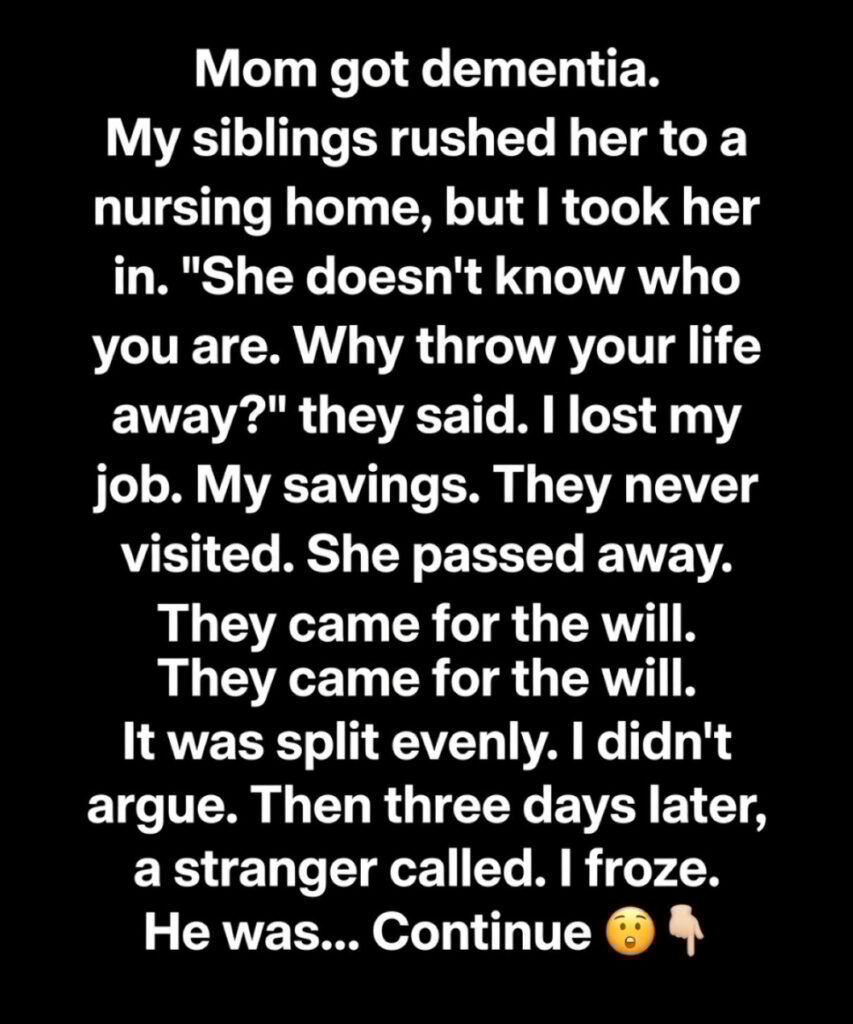
My mother’s memory left in small pieces.
First it was misplaced keys. Then forgotten appointments. Then stories told twice. Eventually, she no longer recognized my face.
When the doctors spoke of progression and uncertainty, their voices were careful. My siblings responded with practicality — discussing facilities, costs, schedules.
I listened.
And I knew I would not send her away.
Not because nursing care was wrong.
But because my mother was afraid of unfamiliar places.
Because comfort mattered more than efficiency.
So I brought her into my home.
Life changed slowly at first — then completely.
Work hours shortened. Savings disappeared into medication, safety rails, and doctor visits. My world narrowed to routines: meals, bathing, calming her when fear rose suddenly in her eyes.
My siblings visited rarely.
Some days were peaceful. She hummed old songs and smiled at nothing in particular. Other days were heavy with confusion and restlessness.
But I learned something important during those years.
Love does not require recognition.
It is enough to offer safety.
I reminded myself that caring for her was not about being remembered — it was about letting her feel secure in the moments she still had.
She passed just before dawn one morning, quietly, while I held her hand.
There was no struggle.
Just breath slowing into stillness.
Afterward, my siblings returned to handle paperwork and read the will. Everything was divided evenly, exactly as she had planned long ago.
I said nothing about the years I gave.
Nothing about the life I set aside.
Not because it didn’t matter — but because peace mattered more than explanation.
When they left, the house felt impossibly empty.
The purpose that had shaped my days was suddenly gone.
Three days later, the phone rang.
An old colleague of my mother’s called gently. He said she had asked him to keep something private while she still could.
There was a small account placed entirely in my name.
And a letter.
Written before her words slipped away.
In it, she thanked me for staying. For choosing patience. For making her feel safe when the world no longer made sense. She said she knew what I had given up, even when she could no longer say it out loud.
I held that letter for a long time.
And I understood something quietly powerful.
Memory may fade.
Names may disappear.
But love leaves a record deeper than recollection.
Not all gratitude is spoken in time.
Not all sacrifices are seen immediately.
But what is given with sincerity is never lost.
I didn’t care for my mother to be rewarded.
I cared for her because she was my mother.
The letter was not payment.
It was simply proof that love had been felt — even when words were gone.
And that, more than anything, made every difficult day worth it.