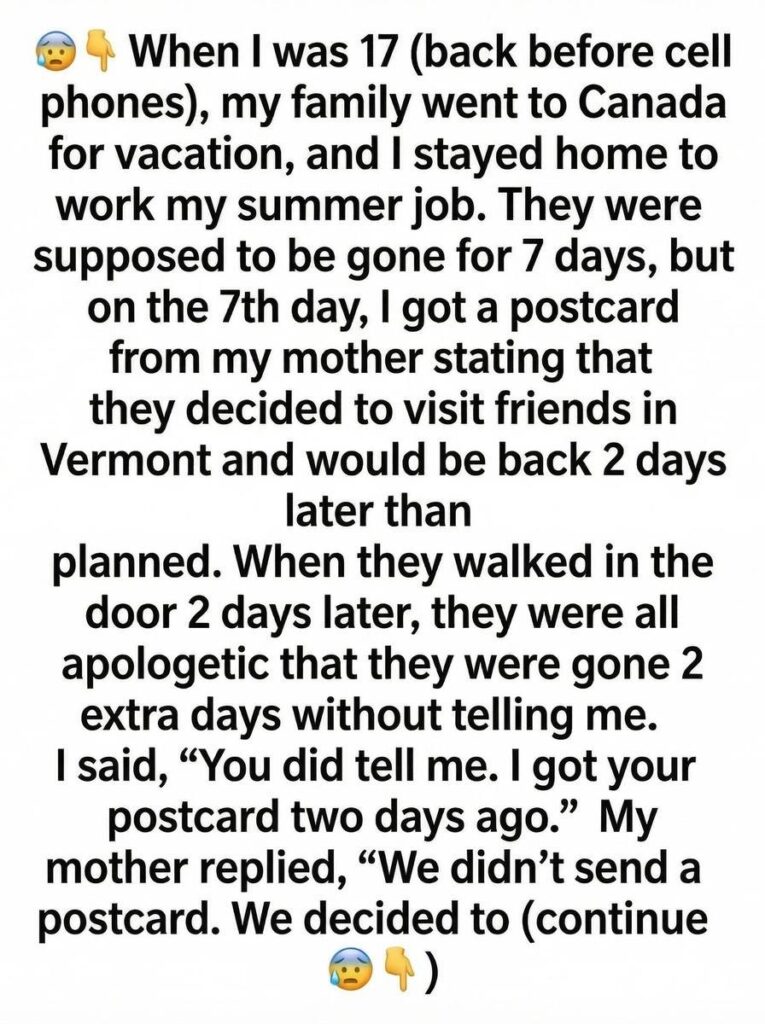
When I was seventeen, my family left for a summer trip to Canada and trusted me with the house. I told myself I was excited for the independence, but the first night made it clear how loud quiet can be. The rooms felt larger than they ever had, and time seemed to move by the sound of the clock rather than by moments. I ate alone, watched the same shows twice, and went to bed earlier than usual just to escape the stillness.
By the seventh day, the loneliness had settled deep enough that even small things felt heavy. That afternoon, a postcard slid through the mail slot.
It was from my mom.
Her looping handwriting filled the card with cheerful updates and a simple message: they had decided to take a quick two-day detour to Vermont before coming home. Nothing dramatic. Just a change of plans.
I remember the physical relief of it — like finally breathing out after holding air in too long. The house felt warmer. Safer. The quiet didn’t seem so endless anymore.
Two days later, they walked through the front door.
Happy. Tired. Sunburned.
When I joked about their surprise Vermont adventure and held up the postcard, the air in the room changed.
My mom stared at it slowly.
She told me she had never sent it.
They hadn’t gone to Vermont. They had driven straight back from Canada, exactly as planned.
We stood there reading it again. The handwriting was perfect. The stamp was real. The date matched.
But it wasn’t hers.
No one could explain how it got there.
There were no other strange letters. No missing mail. No clues. Just that one card — arriving precisely when I was most alone, saying exactly what would calm me.
That was what unsettled me most.
It wasn’t a threat.
It wasn’t a prank.
It was comfort.
Someone — or something — had noticed the gap and filled it with reassurance.
For nights afterward, I lay awake thinking about how easily I had trusted it. How quickly peace had come just because it looked familiar and sounded like love.
Over the years, I stopped searching for a concrete answer. There never was one.
What stayed with me was the quiet lesson hidden inside it.
When we’re uncertain, the mind reaches for safety wherever it appears. We accept what feels warm. We rest in what resembles care.
Sometimes comfort isn’t truth.
Sometimes it’s simply what we need in the moment.
That postcard never harmed me. It gave me two calm days in a lonely house.
Yet knowing it wasn’t real changed the way I understand reassurance.
Not everything that feels safe comes from where we think it does.
And sometimes the strangest moments in life aren’t about fear —
they’re about how deeply human it is to long for peace.
I never learned who sent that card.
But I learned something about vulnerability, trust, and how quietly the heart reaches for familiar light when the world feels too large and too still.