
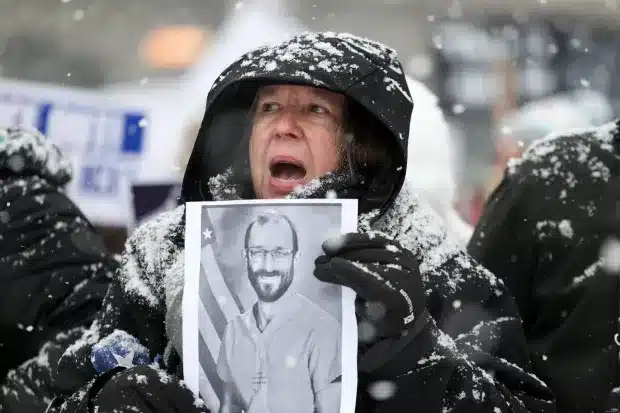
No One Was Prepared for This
“He Was Only 37…” — The Sentence a Mother Couldn’t Finish, and the Story That Asked America to Slow Down and Listen
No one was prepared for how this story would land.
Not a family grappling with sudden loss.
Not coworkers stunned to recognize a familiar name.
And not a public that encountered a headline before it ever heard a mother’s unfinished sentence.
“He was only 37…” she said — and then the words stopped.
Not because there was nothing more to say, but because grief often interrupts language itself. That pause — that break in a sentence — became the most human part of a story many first encountered only in fragments.
A Life Reduced to a Headline
To the public, Alex Pretti appeared briefly: a name, an age, a fatal moment captured in news coverage. The story moved quickly, as news cycles often do, leaving little space to understand who he was beyond the facts reported.
To his family, Alex was never a headline.

He was a son.
A colleague.
An intensive care nurse who chose a profession rooted in care, responsibility, and showing up for others when they were most vulnerable.
When his parents, Michael and Susan Pretti, spoke publicly, they did not offer polished statements or carefully shaped language. They spoke as parents in mourning — plainly, painfully, and without performance.
And people listened, not because the words were dramatic, but because they were real.
Grief Without Scripts
In their statements, the family described Alex as kind, thoughtful, and deeply committed to his work — especially to the people he cared for professionally. They also spoke about the disorientation of navigating private grief while a public narrative unfolded faster than they could process what had happened.
They did not ask for speculation.
They did not demand conclusions.
They asked for care, accuracy, and restraint.
Most of all, they asked that their son be remembered as a full human being — not a simplified version shaped by distance and haste.
Who Alex Was Beyond the Moment
Alex Pretti grew up in Wisconsin. He studied, worked, and built a life that rarely sought attention. Those who knew him describe someone engaged with the world around him — through his work, his interests, and his relationships — and someone who believed that showing up for others mattered.
He lived an ordinary life in the way most meaningful lives are lived: quietly, deliberately, and without expectation of recognition.
When Silence Carries Weight
As public attention shifted elsewhere, the family was left with a different kind of quiet — not resolution, but absence.
The silence did not answer questions or offer comfort. It simply marked the end of a cycle that had moved on.

For them, the story did not end when coverage slowed.
Loss does not follow timelines.
“He Was Only 37” Is Not a Conclusion
Thirty-seven years is not a statistic.
It is a life filled with choices, connections, and purpose.
The family’s message is not complicated — but it is heavy:
Slow down.
Be careful with narratives.
Remember the people behind the names.
Because every unfinished sentence belongs to someone who has to keep living after the story fades.
And that responsibility belongs to all of us who hear it.