Facebook Twitter Instagram
    Trending
    • Silence In The Skies, Tears On The Ground — Mystery Deepens As Authorities Struggle To Identify Remains From Doomed Maine Private Jet, Leaving Families Trapped In Agonizing Limbo And A Community Mourning Names Still Unknown
    • More than half a century later, Neil Diamond himself was left speechless when he heard his songs playing in Song Sung Blue. He entered the screening room simply to observe, but gradually began tapping his foot to the rhythm of each song, applauding after each performance, and finally shedding tears. The most shocking moment came when he turned and asked, “When will it be shown again?” It wasn’t a loud, boisterous compliment, but the genuine reaction of a legend realizing that the music he wrote was still alive. And that’s what silenced the entire room.
    • “THEY SHOUTED ‘HE’S GOT A GUN’ — AND THEN TWO FEDERAL GUNS EXPLODED IN THE STRUGGLE.” In a chilling flash on a Minneapolis street, what began as a confrontation quickly spiraled into a violent clash that left a man dead and the nation shaken. Two CBP agents fired their service weapons as bodies tangled and chaos unfolded, captured from multiple angles and now being replayed in gripping detail. Fear, confusion and desperation pulsed through every second — like a scene ripped from We Own This City colliding with real-world dread. Witnesses, videos, and official reports paint a haunting picture of a struggle that turned lethal in an instant, leaving questions burning hotter than the gunfire that echoed through the cold morning air. As investigations widen and narratives collide, no one can look away from what happened in those final, terrifying moments.
    • “THEY’RE STILL IN THERE.” Plunged Out Of The Sky And Into The Woods Of Maine, The Most Chilling Detail Remains Unchanged: All Six Victims Are Still Trapped Inside The Crushed Fuselage, Locked In A Wreck So Twisted Investigators Say It No Longer Resembles An Aircraft. Among The Dead Is The Attorney Wife Of A High-profile Lawyer, Turning What Should Have Been An Ordinary Flight Into A Slow-burn Tragedy With No Closure. A First Responder Spoke Quietly Of The Scene, Saying, “The Silence Hits You First — And It Never Really Leaves.” Officials Describe The Recovery As Painstaking And Emotionally Draining, With Unstable Terrain And Extreme Damage Forcing Delays As Families Wait In Suspended Grief. One Source Admitted Bluntly, “This Site Feels Less Like Debris And More Like A Place Time Stopped.” As Investigators Carefully Reconstruct The Jet’s Final Moments, Attention Is Now Fixed On The Flight Data, Radio Traces, And The Final Unexplained Actions Inside The Cabin — Details Expected To Surface Piece By Piece, And Quietly Change How This Crash Is Understood.
    • Luke Bryan Breaks Down In Tears After A Single Mother’s Voice Silences The American Idol Judges
    • “He Was 37.” — A Mother’s Grief That Turned Private Loss Into Public Questions. During a public appearance following her son’s death at age 37, a grieving mother struggled to complete her remarks, overcome by emotion as she spoke about a life cut short. Her visible anguish resonated widely, drawing attention not only to her family’s loss but also to unanswered questions surrounding the case. What began as a personal tragedy quickly became a broader conversation about accountability, due process, and how quickly narratives are formed. The moment did not rely on slogans or spectacle — it was the raw reality of grief that compelled people to pause and listen.
    • Power, Wealth, And A Winter Storm Collide In Shocking Maine Plane Crash That Left No Survivors
    • One Risky Song In 1999 Turned Faith Hill Into A Genre-Shattering Superstar
    Facebook Twitter Instagram
    Daily Stories
    • Home
    • News
    • Conservative
    • Magazine
    • Health
    • Animals
    • English
    Daily Stories
    Home » The Girl Who Remembered
    News

    The Girl Who Remembered

    Kelly WhitewoodBy Kelly WhitewoodSeptember 10, 20255 Mins Read
    Facebook Twitter Pinterest LinkedIn Tumblr Email
    Share
    Facebook Twitter LinkedIn Pinterest Email

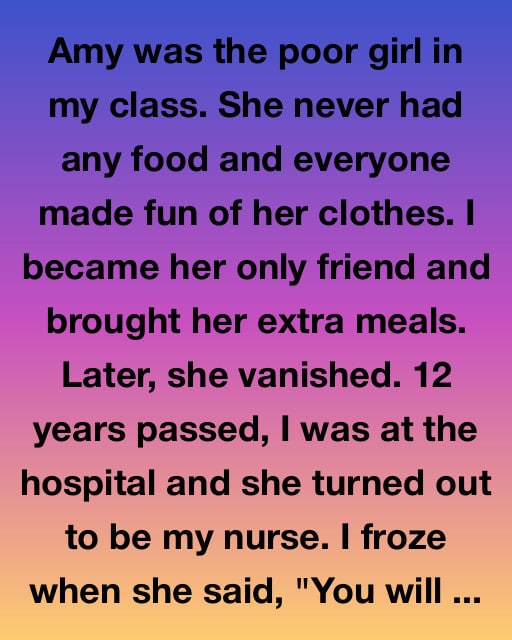
    In fifth grade, Amy was the kid everyone picked on. Too-short sleeves, taped-up shoes, nothing in her lunchbox. The first time I saw her pretend to chew during lunch, I packed an extra cheese sandwich the next day and slid it across the table. She said she wasn’t hungry; I said I wasn’t either. We both lied. After that, I started bringing more—half a PB&J, an apple, whatever I could smuggle past my mom. Kids snickered. I sat with Amy anyway. She was quiet until she wasn’t—funny, sharp, an artist with a pencil. She drew us on the playground swings once. I kept the sketch in my notebook like a treasure.

    One Monday she was just gone. Empty desk. Shrug from the teacher. I wrote letters and left them in the office. A few weeks later, an envelope came back with all my notes and a single line in her handwriting: “Thank you for seeing me when no one else did.” That was it. She vanished into the kind of silence that swallows childhood friends.

    Twelve years later I woke up in a hospital bed, fuzzy from anesthesia, IV tugging at my arm. A nurse walked in, hair scraped into a bun, badge swinging. She smiled and said, “You’ll be okay. You helped me once…I never forgot.”

    It took my brain a second to catch up. “Amy?”

    Her eyes went bright. “Yeah. It’s me.”

    She pulled up a chair and, just like that, the years fell away. They’d moved overnight, she said. New state, motel rooms, her mom working two jobs. High school had been a patchwork of part-time shifts for her, scholarship applications, and a single nurse who paid for her exam fees when money ran out. “Kindness comes back around,” she told me, and I felt that in my bones.

    We filled in the blanks while she checked my vitals. She remembered the cheese sandwich. I reminded her she once rescued me from a group project with a flawless poster drawn in pencil. When I was discharged, she handed me a folded paper—my old list of things she was good at, written in childish block letters: good at drawing, brave, fast on the swings, kind. She’d kept it all those years. “It told me I mattered,” she said.

    We got coffee. Coffee became dinner, then a walk in the park, then movie nights on my couch. One evening I blurted out, “You were my favorite person back then. I think you might still be.”

    “You were the first person who made me feel seen,” she said, and took my hand.

    Life settled into something simple and good. Amy worked nights at the hospital. I went back to my job. Weekends were ours. Then her mom got sick—late-stage pancreatic cancer that stole breath and time. Amy moved in with her to care for her. I brought groceries, changed lightbulbs, sat with them on the porch when the air was cooler and grief was less sharp. Amy did it all with this quiet, stubborn grace that broke me open in the best way. “I got love when I needed it most,” she said once, smoothing a blanket over her mom’s knees. “Now I’m giving it.”

    Her mom passed peacefully. At the funeral, Amy read a poem she’d written in high school, about invisible hands holding you up. No one left with dry eyes.

    Afterward, she asked me to move in. We found a small apartment with creaky floors, big windows, and a kitchen that smelled like coffee and soap. On Sundays we cooked with old music playing. On Thursdays we argued about crime documentaries and guessed the killer wrong most of the time.

    While cleaning one afternoon, she found a battered notebook full of sketches. “I always felt like I had to pick between art and survival,” she said. “You don’t anymore,” I told her, and signed her up—without permission—for a community art show. She swore at me, then paced, then showed up. She won first place with a pencil drawing of her mom’s hands holding a paper lunch bag. A local gallery asked to feature her work. Commissions trickled in. She picked up fewer hospital shifts and started teaching art therapy to kids. She bloomed and somehow bloomed me, too.

    I proposed on the same park swing she’d drawn when we were ten. She said yes with tears on her cheeks and graphite under her nails. At the wedding, I told our story—the cheese sandwich, the empty desk, the nurse who walked into my hospital room and never walked out of my life. “You saved me,” I said into the mic. “I didn’t even know it back then.” She leaned close and whispered, “You saved me first.”

    Now we run a tiny art café on a corner that gets good morning light. Amy paints in the back room; I pull espresso and learn people’s orders by heart. There’s a sign by the door that says, “If you’re hungry, don’t be shy. We’ve been there.” Every month we donate a portion of our profits to school lunch programs and art supplies. Some kids come in alone, all elbows and downcast eyes and secondhand jackets. Amy always sees them first. She brings hot cocoa and a napkin and that steady, quiet presence. When I ask what she said, she smiles and answers the same way every time: “I reminded them they matter.”

    Life isn’t fair. It will take without asking and leave without warning. But the small kindness you put into it doesn’t disappear. It waits—folded in a notebook, tucked in a memory, carried forward by someone who needed it—until the day it finds its way back to you. Sometimes as a nurse. Sometimes as a partner. Sometimes as a second chance you didn’t know you were owed.

    Be kind anyway. Especially when no one’s watching. It matters. It always has.

    Share. Facebook Twitter Pinterest LinkedIn Tumblr Email
    Previous ArticleFour CMA Nods Catapult Riley Green Into Country Music’s Biggest Spotlight Yet
    Next Article From sickly to stunning: The polio survivor who became a Hollywood icon

    Related Posts

    Silence In The Skies, Tears On The Ground — Mystery Deepens As Authorities Struggle To Identify Remains From Doomed Maine Private Jet, Leaving Families Trapped In Agonizing Limbo And A Community Mourning Names Still Unknown

    January 28, 2026

    More than half a century later, Neil Diamond himself was left speechless when he heard his songs playing in Song Sung Blue. He entered the screening room simply to observe, but gradually began tapping his foot to the rhythm of each song, applauding after each performance, and finally shedding tears. The most shocking moment came when he turned and asked, “When will it be shown again?” It wasn’t a loud, boisterous compliment, but the genuine reaction of a legend realizing that the music he wrote was still alive. And that’s what silenced the entire room.

    January 28, 2026

    “THEY SHOUTED ‘HE’S GOT A GUN’ — AND THEN TWO FEDERAL GUNS EXPLODED IN THE STRUGGLE.” In a chilling flash on a Minneapolis street, what began as a confrontation quickly spiraled into a violent clash that left a man dead and the nation shaken. Two CBP agents fired their service weapons as bodies tangled and chaos unfolded, captured from multiple angles and now being replayed in gripping detail. Fear, confusion and desperation pulsed through every second — like a scene ripped from We Own This City colliding with real-world dread. Witnesses, videos, and official reports paint a haunting picture of a struggle that turned lethal in an instant, leaving questions burning hotter than the gunfire that echoed through the cold morning air. As investigations widen and narratives collide, no one can look away from what happened in those final, terrifying moments.

    January 28, 2026
    Search
    Categories
    • News (4,891)
    Categories
    • News (4,891)
    • Contact Us
    • Privacy Policy
    • Terms of Service
    Copyright © 2026, News24. All Rights Reserved.

    Type above and press Enter to search. Press Esc to cancel.