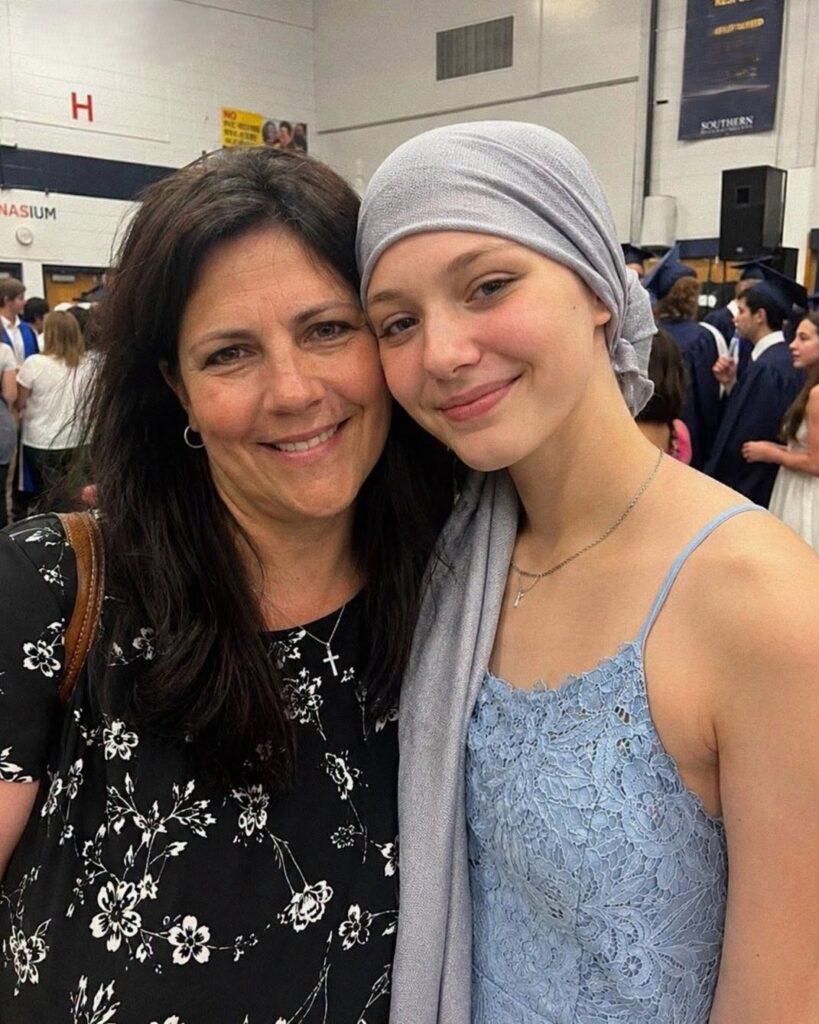
“Mom, does it look okay?” she asked. “Is it too shiny?”
“It looks perfect.”
“You have to say that. You’re my mother.”
I crossed the room and placed my hands gently on her shoulders.
Her collarbones were still sharper than they had been before the cancer. Her body had survived fourteen months of treatment, needles, scans, nausea, and nights when neither of us believed morning would come quickly enough.
“I’m your mother,” I said, “which means I don’t have to lie. The scarf is beautiful, and so are you.”
Her expression softened.
Then she turned and rested her forehead against my shoulder.
“I can’t believe this is really happening,” she whispered. “Graduation. An actual graduation.”
“You earned every second of it.”
“Dr. Patel said I’m in remission, but I still don’t know what to do with that word. It feels like I’ve been holding my breath for more than a year and someone finally told me I’m allowed to breathe again.”
I kissed the top of her covered head.
“Then breathe, sweetheart.”
She straightened and looked at herself again.
“I chose silver for a reason.”
“What reason?”
“Because silver looks like armor. If I have to cover my head, I want to look like a warrior.”
Something inside my chest ached and glowed at the same time.
“That may be the most beautiful thing you’ve ever said.”
Her smile faded slightly.
“Do you think people will stare?”
“Some might. But most of your classmates care about you. Chloe has texted you every day since treatment started.”
Lily laughed softly.
“She chose her graduation shoes because they matched my scarf.”
“See? You have people.”
“I have people,” she repeated, as though she was trying to believe it.
That afternoon, Lily left for graduation rehearsal with sunlight flashing across the silver fabric.
I watched her walk down the driveway feeling something close to peace.
I had no idea she would return home in tears.
The front door slammed open several hours later.
I heard the broken sound of her breathing before I saw her.
Lily stood in the hallway with the silver scarf crushed inside her fist. Her shoulders shook, and her eyes were red.
I hurried toward her.
“What happened?”
She looked at me, struggling to speak.
“Mrs. Hargrove said I can’t wear it.”
Mrs. Hargrove was the PTA president. She organized ceremonies, controlled committees, and behaved as if the school belonged to her.
I guided Lily to the couch.
“Tell me exactly what she said.”
Lily wiped her cheek.
“She waited until rehearsal ended. Everyone else was leaving, and she pulled me into the hallway near the trophy case.”
I kept my voice calm.
“Then what?”
“She smiled and said we needed to discuss the photographs. She said the regional newspaper would be there and the graduation pictures would hang in the front office for years.”
I felt anger begin to rise, hot and steady.
“She said my scarf would stand out. She said it might make people uncomfortable because parents wanted photographs of happy, healthy students.”
Lily’s voice cracked.
“She said my scarf would remind everyone of sickness.”
I closed my eyes for one second.
“She used that word?”
“She said they wanted joyful pictures, not reminders.”
“What did you say?”
“Nothing. I didn’t know what to say. She was smiling like she was helping me.”
Lily looked down at the scarf in her lap.
“She said I could sit in the back row behind the risers. Or I could wear a hat that matched the graduation gowns. She even suggested I attend a separate ceremony later.”
“A separate ceremony?”
“Like I’m contagious.”
I pulled her into my arms.
For fourteen months, Lily had endured hospital rooms without allowing herself to break down. She had smiled for nurses, comforted frightened children in treatment, and apologized when she was too sick to finish dinner.
Now she cried against my sweater.
“I fought so hard,” she whispered. “I fought so hard just to be there, and she wants me to hide.”
I lifted her chin.
“You are not hiding. Not on graduation day and not any day after that.”
“What if the principal agrees with her?”
“Then the principal will have a conversation with me too.”
Lily smoothed the scarf carefully.
“She made it sound reasonable. That’s what made me feel crazy. She smiled the entire time.”
“That is how people like her behave. They wrap cruelty in polite words and expect you to thank them.”
Lily gave a watery laugh.
“You sound like Grandma.”
“Good. Grandma was almost always right.”
Then her face became serious.
“Please don’t embarrass me, Mom. I don’t want a huge scene. I just want to walk across the stage like everybody else.”
I held her gaze.
“I promise I will not embarrass you. But I will not allow anyone to erase you. Those are not the same thing.”
She stared at me for a moment.
Then she nodded.
“I trust you.”
Those words settled inside me with the weight of a promise.
“Chloe saw me crying,” Lily added. “She said she was going to handle it.”
Chloe was Mrs. Hargrove’s daughter.
I did not doubt Chloe’s loyalty, but I doubted her mother would listen to her.
“Get some rest,” I told Lily. “On Saturday, we are walking into that auditorium with our heads high.”
“And the scarf?”
“The scarf stays.”
Graduation morning arrived bright and cold.
I zipped Lily into her pale blue dress and helped arrange the silver scarf around her head.
Then I fastened her grandmother’s pearl earrings.
She studied herself in the mirror.
“What if Mrs. Hargrove stops me at the door?”
“Then she’ll have to stop me first.”
The school parking lot was packed when we arrived. Families hurried toward the entrance carrying flowers, balloons, cameras, and carefully wrapped gifts.
Lily sat beside me, twisting her fingers together.
“Are you ready?” I asked.
“No.”
“Good. Brave people are rarely ready. They go anyway.”
We climbed out of the car and walked toward the auditorium.
Mrs. Hargrove stood beside the welcome table holding a clipboard and directing families toward their seats.
She noticed us immediately.
“Excuse me,” she called, stepping into our path. “We need to speak.”
“We’re going to our seats,” I said.
Her smile tightened.
“We had an understanding.”
“No. You made a demand. That is not the same thing.”
She glanced around to see who was listening, then lowered her voice.
“I spoke with the photographer. We have reserved a place for Lily in the back row behind the risers. She will still receive her diploma, but she will not appear in the class portrait.”
“You intend to hide her.”
“I intend to preserve the ceremony for everyone.”
“She is part of everyone.”
Mrs. Hargrove’s jaw stiffened.
“Then she can remove the scarf. Surely her hair has grown enough by now to look almost presentable.”
Lily flinched.
I felt my entire body go still.
“Her hair is not the issue,” I said. “My daughter is here to graduate.”
“I am the PTA president. I have the authority to organize the seating as I see fit.”
“Then organize it. Lily will sit exactly where her assigned name card says.”
I stepped around her.
She reached toward my arm, then stopped when another family walked past.
Mrs. Hargrove cared deeply about appearances.
She simply did not care how many people she hurt to protect them.
Lily and I walked down the aisle and found our seats.
“Mom,” she whispered, “please don’t make this worse.”
I squeezed her hand.
“I am not going to make it worse. I’m going to make it right.”
“What does that mean?”
“It means you fought for your place here. Now let me fight for you.”
The orchestra began warming up.
On the stage, Mrs. Hargrove approached the principal and spoke urgently while pointing toward our section.
The principal looked uncertain.
Then he nodded.
That was when I stood.
I walked down the center aisle.
Parents turned to watch. Whispers followed me toward the stage.
Mrs. Hargrove saw me approaching, and her expression hardened.
I climbed the three steps before anyone could stop me.
The microphone stood at the podium, already switched on for the opening speech.
I reached for it.
Mrs. Hargrove grabbed my shoulder.
“Don’t do this,” she hissed. “Don’t embarrass yourself or your daughter.”
I turned toward her.
“You told a child who survived fourteen months of cancer that her survival would ruin your photographs.”
The microphone carried every word through the auditorium.
Mrs. Hargrove’s hand slipped from my shoulder.
The room became silent.
I faced the audience.
“My daughter fought for her life so she could stand here today. Yesterday, she was told she needed to sit behind the risers, remove her headscarf, or attend a separate ceremony because her appearance might remind people of sickness.”
A murmur traveled across the room.
Mrs. Hargrove stepped closer.
“That is not what I meant.”
I continued.
“If surviving cancer makes someone unworthy of being seen, then what exactly are we teaching these children? Are we telling them that courage matters only when it photographs well?”
“I agree!”
The voice came from the student section.
Chloe rose from her seat.
She looked directly at her mother.
“You told Lily she would ruin the pictures.”
Mrs. Hargrove’s face went pale.
“Chloe, sit down.”
“No.”
The entire room watched her.
“Lily spent more than a year fighting to stay alive. The only thing that would ruin this graduation is pretending she doesn’t belong here.”
Then Chloe reached inside her gown.
She pulled out a folded silver scarf.
My breath caught.
Chloe tied it carefully around her head.
“Nobody graduates alone,” she said.
One by one, the other students began standing.
Each of them pulled a silver scarf from beneath a gown, inside a sleeve, or from a pocket.
They had planned it together.
Within moments, rows of silver scarves shimmered beneath the auditorium lights.
Lily covered her mouth with both hands.
Tears ran down my face.
Chloe had handled it after all.
The principal stepped toward the microphone.
He looked at Lily first.
Then he faced Mrs. Hargrove.
Finally, he looked across the crowd.
“Lily,” he said, “before this ceremony continues, I owe you an apology.”
The auditorium fell completely silent.
“No student who has fought as hard as you have should ever be made to feel unwelcome at her graduation.”
He turned toward Mrs. Hargrove.
“The comments made to Lily do not represent this school, our faculty, or the values we expect from our community.”
Mrs. Hargrove opened her mouth.
The principal raised his hand.
“No. This is not the moment to defend what happened. It is the moment to correct it.”
Then he looked back at Lily.
“Your place has always been with your classmates. We are proud that you are here.”
The room erupted in applause.
A short while later, Lily’s name was called.
She rose from her seat wearing her silver armor and walked toward the stage.
She passed Mrs. Hargrove without looking at her.
When the principal handed Lily her diploma, the entire graduating class stood.
Then the parents rose.
Within seconds, nearly everyone in the auditorium was on their feet.
Lily looked out at the crowd, tears shining in her eyes.
She had dreamed of one simple moment—walking across the stage beside her classmates.
She received something greater.
She was not hidden.
She was not placed in the back.
She was not treated like a reminder of sickness.
She stood in the center of the stage as proof of survival.
And when the photographer captured the graduation picture, Lily was exactly where she belonged.
In the front row.
Surrounded by silver.
Surrounded by people.