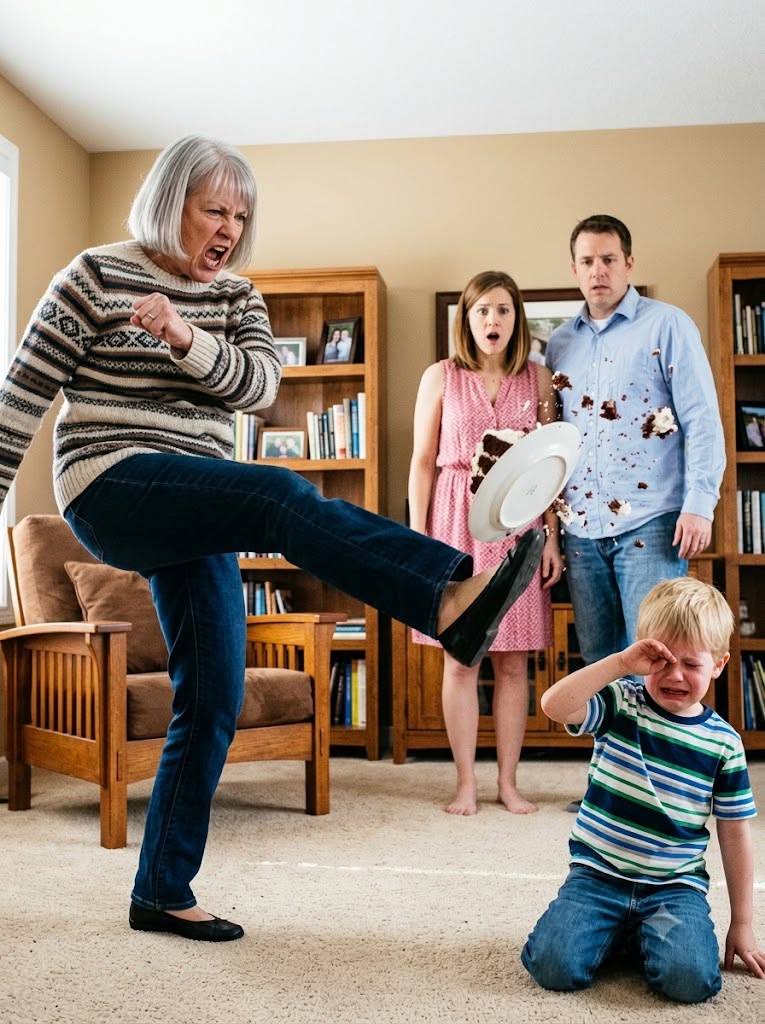
My four-year-old son, Luke, wanted to help. He carefully carried a small plate of cobbler toward her, both hands wrapped around it, his face full of the innocent seriousness children have when they want to do something kind.
Madeline looked at him.
Then, in front of everyone, she knocked the plate away.
The cobbler fell to the floor.
The room went silent.
“He is not a real member of this family,” she said.
For a moment, I could not breathe. The cruelty of it landed not on me, but on my child. Luke stood frozen, trying to understand why an act of kindness had been met with rejection.
Before anyone could fully respond, his face changed.
He bent forward, clutching his stomach.
At first, I thought he was crying from fear and humiliation. Then he gasped in pain. He had eaten a small bite of the dessert earlier, and within minutes, we were rushing him to the emergency room as his condition worsened.
To understand what happened that day, one has to understand the years that came before it.
Madeline had disliked me from the moment I met her son, Brandon. I came from a modest background, and that was enough for her to decide I was not suitable. She had imagined a different life for him — one involving Rachel, the daughter of a wealthy construction businessman.
Madeline did not hide her disappointment. She insulted me quietly at first, then openly. She questioned my upbringing, my manners, my worth. At one point, she even offered me money to leave Brandon.
When none of that worked, her anger shifted toward Luke.
From the day he was born, she treated him as if he were an outsider in his own family. Later, we learned she had gone so far as to create a false paternity document, trying to convince Brandon that Luke was not his biological son.
It was a lie.
Brandon had known it was a lie, and he had quietly carried that knowledge, thinking he was protecting me from more pain.
But silence, even when meant kindly, can sometimes allow cruelty to grow bolder.
At the hospital, doctors and nurses worked urgently to stabilize Luke. The waiting felt endless. Every minute seemed to ask the same question: how could a child become so sick from one bite of dessert?
Then the answer came.
Medical staff found signs that Luke had ingested a dangerous chemical substance.
Brandon stepped into the hallway and checked the security cameras from our home.
What he saw changed everything.
The footage showed Madeline entering the kitchen before the gathering. She moved carefully, looking over her shoulder, then poured a harsh liquid into the blackberry cobbler.
It was deliberate.
It was not a misunderstanding, not a family argument, not an accident made in anger. She had chosen to harm a child in order to create a story she could use against me.
Her plan had been to make Luke severely ill, blame me, and push Brandon toward Rachel.
We contacted the authorities immediately. As the investigation continued, messages were uncovered showing that Rachel had known about the plan and encouraged it.
The truth was no longer hidden behind manners, wealth, or family reputation.
Madeline and Rachel faced serious legal consequences for what they had done. Brandon cut ties with the relatives who had defended, excused, or minimized his mother’s cruelty.
There was grief in that decision, but also clarity.
A family name is not worth preserving when it is being used to protect harm.
The months that followed were quiet and difficult. Our focus became Luke. His body healed first, but his sense of safety took longer. For a while, he hesitated before eating food someone else had touched. He asked questions no four-year-old should have to ask.
“Is this safe?”
“Did you make it?”
“Can I eat it?”
Each time, I answered patiently.
“Yes, sweetheart. You are safe here.”
One year later, we celebrated the spring holiday in our own home.
No tense smiles. No cruel remarks. No child trying to earn love from someone determined not to give it.
I baked another blackberry cobbler.
When I placed it on the table, Luke looked at it for a moment. Then he picked up his spoon and took a bite.
No fear crossed his face.
Only sweetness.
I watched him eat and understood something I should have accepted long before: peace does not come from finally pleasing people committed to rejecting you. Peace comes from protecting what is entrusted to you, even if that means closing the door on those who confuse control with love.
True family is not proven by blood, wealth, or approval.
It is proven by protection.
By tenderness.
By the refusal to let cruelty sit at the table and call itself tradition.
That day, I stopped trying to earn Madeline’s acceptance.
I already had what mattered.
My husband beside me. My child safe. A quiet home. A table where love did not have to beg for permission to belong.