Then I heard my daughter crying in the background.
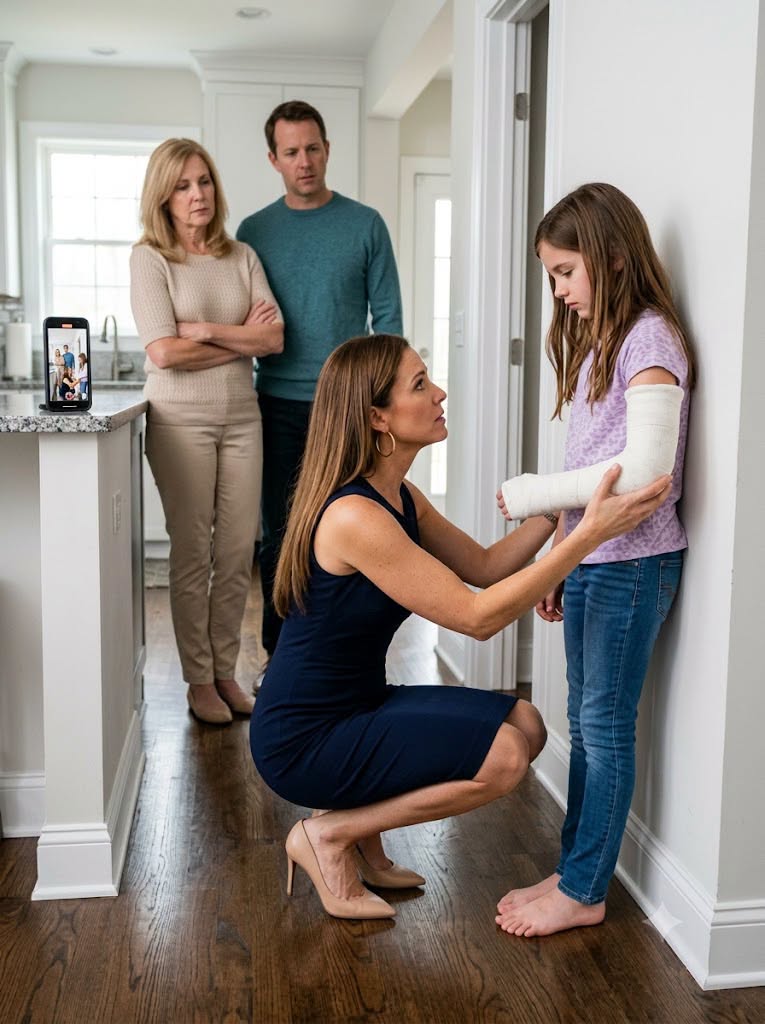
Her voice was small and shaken. She told me she had been locked in a bathroom after taking a piece of bread. She said her hands hurt.
Everything inside me went still.
I told Hailey to stay where she was, keep the phone close if she could, and remember that I was coming.
Then I dropped everything and drove straight to Derek and Miriam’s house in Scottsdale.
From the outside, the home looked perfect. Clean windows. Trimmed hedges. A quiet street. The kind of place people pass and assume peace lives inside.
But appearances can be very obedient. They often hide what a house has learned not to show.
Miriam opened the door, already prepared to explain herself.
I walked past her.
I found Hailey in the bathroom, frightened and in pain. When I saw her hands, the anger rose in me so quickly that I had to steady my voice before speaking.
Derek was there too.
Instead of protecting his daughter, he tried to soften what had happened.
“Mom was just trying to correct her,” he said. “Don’t overreact.”
I looked at him and understood something painful. He had lived so long under Miriam’s idea of discipline that he could no longer clearly see where correction ended and harm began.
But I could.
And I would not pretend otherwise.
I called the authorities.
Then I took Hailey directly to the emergency room. I wanted her treated, and I wanted everything documented properly. Medical staff examined her. Social workers took our statements. The truth was written down in places where Miriam’s explanations could not easily erase it.
Derek arrived later, anxious and defensive.
He kept saying we should handle it privately, as a family.
But some things cannot be hidden under the word family.
A child had been hurt.
A child had been made afraid of food.
There was nothing private about the responsibility to protect her.
As we prepared for family court, something unexpected happened.
Derek and his younger sister, Teresa, came to me with old documents from their childhood: school reports, notes, and records that revealed a long pattern of the same harsh methods in Miriam’s home.
Food had been used as control.
Pain had been called discipline.
Fear had been confused with respect.
Teresa’s hands trembled when she gave me the papers.
“She did it to us too,” she said.
In court, my lawyer presented the medical records, social worker reports, and the older documents showing that this was not an isolated mistake. It was a pattern that had been allowed to survive from one generation into the next.
Miriam tried to remain composed at first.
Then, under questioning, her control broke. Her words revealed more than she intended. She spoke of obedience, order, and children needing to learn their place. She spoke as if hunger, fear, and pain were acceptable tools for shaping a child.
And in that moment, even Derek looked shaken.
For the first time, he seemed to hear his mother’s voice from the outside.
The judge acted quickly.
I was awarded full custody. Derek was ordered into mandatory therapy. Miriam was barred from contact with Hailey, and a criminal investigation began.
It was not a victory that felt joyful.
No mother wants to win in court because her child has been harmed.
But it was protection.
And protection was what Hailey needed.
In the months that followed, our life became quieter, but not instantly easy.
Hailey had learned to ask permission for things no child should fear asking for. She hesitated before opening the refrigerator. She watched my face before reaching for snacks. Sometimes, even at dinner, she would ask if she had eaten too much.
Each time, I answered gently.
“You are allowed to eat.”
One afternoon, I brought home a large basket filled with fresh bread and rolls. I placed it on the kitchen counter where she could see it.
“This is for our home,” I told her. “You never have to be afraid of being hungry here.”
She stared at the basket for a long time.
Then she took one small roll.
No fear. No punishment. No locked door.
Just bread in her hands, and a mother beside her.
Miriam eventually lost much of the respect she had carefully built in the community. People began to understand that strictness is not the same as virtue, and control is not the same as care.
Derek began therapy. Slowly, painfully, he started facing the truth of his own childhood and the way silence had nearly allowed that pain to reach his daughter. I do not excuse what he failed to do. But I am grateful he finally began the work of breaking the cycle.
Today, Hailey knows our home is safe.
She knows food is not something to earn through fear.
She knows hunger is natural, and asking for what she needs is not a crime.
Most of all, she knows that love does not lock a child away.
Love protects.
Love provides.
Love corrects without cruelty.
And in this house, no child will ever be made to feel ashamed for needing bread.