First emotionally.
Then financially.
Then physically.
My father walked away chasing a business opportunity he never bothered explaining. My mother followed a new husband who apparently had no room in his life for two daughters.
Suddenly, everything they abandoned landed on my shoulders.
Especially Lily.
She was only eight years old.
Too young to understand why her parents stopped calling. Too young to understand why the person packing her lunches came home smelling like coffee, grease, and exhaustion after working double shifts.
I worked days at a roadside diner and attended classes at night. I learned how to braid hair from online tutorials at two in the morning. I signed permission slips, attended parent-teacher conferences, and pretended to know what I was doing.
Most days, I was terrified.
But Lily never needed to know that.
For years, it was just the two of us.
Birthdays.
School plays.
Late-night fevers.
Bills.
Tears.
Victories.
Every challenge was ours alone.
Somehow, we made it.
By the time Lily graduated high school, she had become everything I hoped she would be.
Strong.
Compassionate.
Brilliant.
Then she met Andrew Whitmore.
Andrew came from a world completely different from ours.
Old money.
Private schools.
Country clubs.
Generations of wealth.
His family carried themselves with the confidence of people who had never wondered whether rent would be paid on time.
Still, Andrew loved Lily completely.
When he proposed, I couldn’t have been happier.
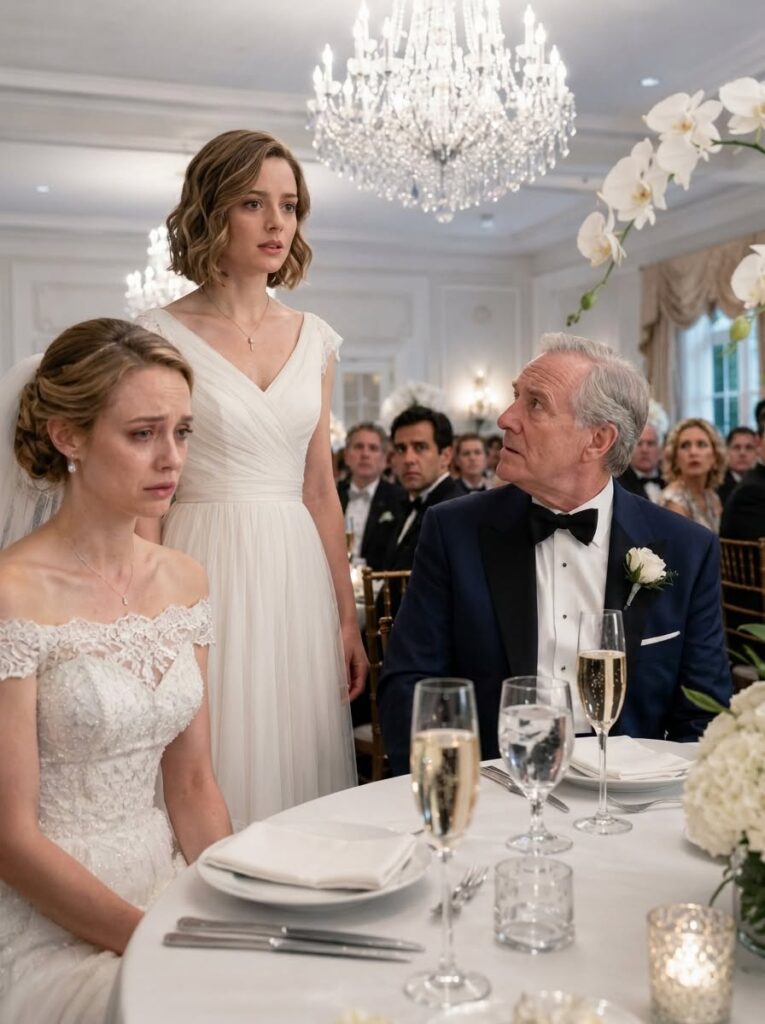
The wedding was held at one of Boston’s most prestigious country clubs.
Crystal chandeliers hung from the ceilings.
White orchids covered every table.
Champagne flowed freely.
Everything looked perfect.
But from the moment I arrived, I noticed Andrew’s father watching me.
Charles Whitmore had the kind of smile that never reached his eyes.
Throughout the evening, he barely acknowledged me. When he did, it felt more like an inspection than a conversation.
I ignored it.
This wasn’t my day.
It belonged to Lily.
During the reception, Charles stood to give a toast.
At first, everything sounded normal.
He praised his son.
Welcomed Lily into the family.
Thanked the guests.
Then his attention shifted toward me.
“And of course,” he said, raising his glass, “we should acknowledge Rebecca, the sister who raised our beautiful bride. Quite a remarkable story. Very humble beginnings.”
A few uncomfortable laughs drifted through the room.
I felt Lily stiffen beside Andrew.
Charles continued.
“I suppose every family needs someone to keep things grounded,” he said. “Even if refinement wasn’t exactly part of their upbringing.”
The room grew noticeably quieter.
Guests exchanged nervous glances.
Charles smiled wider.
Then he delivered the line that changed everything.
“Rebecca,” he said, staring directly at me, “forgive my curiosity, but when Andrew described you, I expected someone less… noticeable. So you’re the charity case who raised the bride?”
The ballroom fell silent.
No music.
No conversations.
Nothing.
Lily’s face turned white.
Andrew looked horrified.
Every eye in the room landed on me.
Slowly, I placed my napkin on the table.
Then I stood.
Charles still wore that smug smile.
I met his gaze and asked calmly, “Do you even know who I am?”
For the first time all evening, uncertainty crossed his face.
“What exactly is that supposed to mean?” he asked.
Before I could answer, the club’s general manager appeared near our table.
His expression was tense.
“Mr. Whitmore,” he said carefully, “perhaps you should sit down.”
Charles frowned.
“Why?”
The manager swallowed.
“Because Ms. Hayes owns this property.”
The silence became absolute.
A wine glass slipped from someone’s hand and shattered across the floor.
Charles stared.
“What?”
The manager cleared his throat.
“Hayes Hospitality Group acquired this country club last year. Ms. Rebecca Hayes is the principal owner.”
Every trace of color vanished from Charles’s face.
Lily covered her mouth.
Andrew actually laughed once in disbelief.
Charles looked from the manager to me.
“That’s impossible.”
I smiled.
“No,” I said. “It’s just information you never thought was worth learning.”
His wife, Margaret, quietly whispered, “Charles, stop.”
But he couldn’t.
People like Charles rarely stop until they realize they’ve lost.
“You may own the building,” he said, “but that doesn’t erase where you came from.”
“No,” I replied. “It doesn’t.”
I took a step closer.
“Where I came from taught me how to work. It taught me how to sacrifice. It taught me how to raise a child who wasn’t even mine because the people responsible for her walked away.”
Murmurs spread across the ballroom.
I turned toward Lily.
Tears filled her eyes.
“I never wanted this at your wedding,” I said softly.
She stood immediately and grabbed my hand.
“Don’t apologize,” she whispered. “You didn’t do anything wrong.”
Andrew rose beside her.
“Dad did.”
Charles glared at his son.
Andrew didn’t back down.
“You insulted the woman who sacrificed her entire life so Lily could have one.”
Charles looked around the room for support.
He found none.
Even Margaret stepped away from him.
Then Charles made one final attempt.
“You’ll never truly belong in rooms like this.”
I looked around the ballroom.
The chandeliers.
The expensive flowers.
The guests.
Then I looked back at him.
“Charles,” I said calmly, “I didn’t come here because I wanted to belong in your room.”
I placed my hand on Lily’s shoulder.
“I came because my sister wanted me in hers.”
The room erupted into applause.
Not loud at first.
Then stronger.
Guests stood.
Andrew embraced Lily.
Margaret wiped tears from her eyes.
And Charles Whitmore stood completely alone.
For a moment, I almost felt sorry for him.
Almost.
Because while he spent his life measuring people by status and money, he failed to understand something far more valuable.
The proudest accomplishment of my life wasn’t owning a country club.
It wasn’t building a successful hospitality company.
It wasn’t the wealth.
It was standing beside the little girl I raised and watching her begin a beautiful new chapter.
That night, Charles left the reception alone.
The celebration continued without him.
And as I watched Lily and Andrew share their first dance, I realized something.
For years, I had worried whether I had done enough.
Whether I had been a good parent.
Whether Lily had missed too much growing up.
But looking at the woman she had become, I finally had my answer.
I had never been a charity case.
I had been her family.
And in the end, that mattered more than anything Charles Whitmore could ever own.