Then I saw her.
At first, it was only the familiar denim jacket that caught my attention.
Faded.
Wrinkled.
Completely out of place among designer luggage and tailored coats.
Then I saw the woman wearing it.
“Elena?”
My voice came out sharper than I intended.
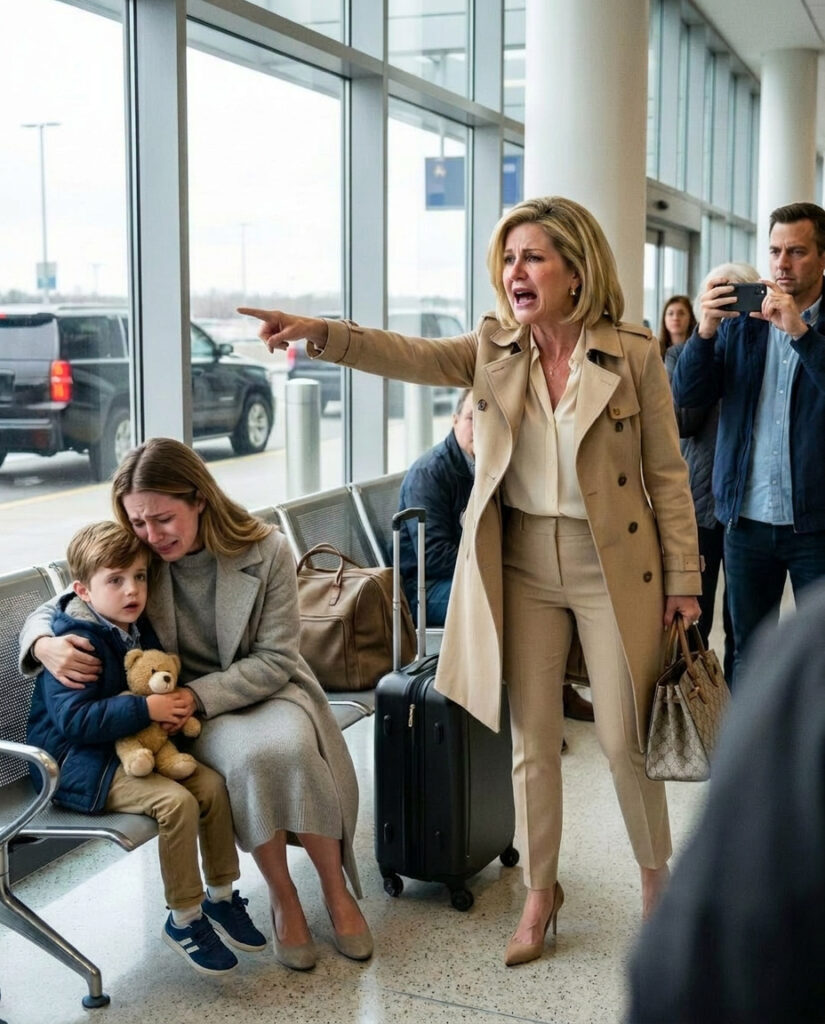
She sat hunched on a cold metal bench beside three worn suitcases. My grandson Leo was asleep in her arms, his small face pressed against her shoulder, cheeks streaked with dried tears.
Elena looked up at me in panic.
For one terrible second, fear flashed across her face before recognition settled in.
Then she started crying.
Not loudly.
Not dramatically.
The silent kind of crying people do when they are already exhausted from hurting.
“Raymond,” she whispered shakily. “You weren’t supposed to be back until tomorrow.”
I dropped my briefcase immediately and rushed toward her.
“What happened?” I asked, kneeling in front of her. “Why are you here? Why do you have luggage?”
Leo stirred slightly against her chest. I brushed his soft hair back gently while Elena tried unsuccessfully to stop trembling.
Then she handed me a crumpled envelope.
“Your sister came to the guest house this morning,” she whispered. “With two security guards.”
A cold feeling slid through my chest.
“She said my things were already packed. She bought me a one-way ticket back to Ohio.”
My jaw tightened immediately.
“She told me…” Elena swallowed hard. “She told me that now that Liam is gone, I don’t belong in your family anymore.”
For a moment, the noise of the airport disappeared entirely.
My son had been dead for one year.
One year since the military training accident that shattered our family.
One year since Elena buried her husband while holding their crying child in her arms.
And during that year, I made one promise to myself:
I would protect them.
No matter what.
“She said I was embarrassing the family,” Elena continued weakly. “She said Leo deserved to grow up around people with class instead of my ‘lower-class influence.’”
My vision went cold.
Not blurry.
Not emotional.
Cold.
Beatrice had always been cruel in the polished, elegant way wealthy people sometimes mistake for sophistication. She spent her life believing status mattered more than kindness. But using my son’s death to exile his widow and child?
That crossed into something unforgivable.
I stood slowly and picked up the heaviest suitcase myself.
Then I looked directly into Elena’s tear-filled eyes.
“Get in the car,” I said quietly.
She blinked at me.
“Raymond…”
“Get in the car, Elena.”
My voice hardened.
“It’s time my sister learns who actually holds power in this family.”
The drive back to Long Island passed beneath complete silence.
Elena sat in the back seat beside Leo, staring out the window at the skyline while he slept against her shoulder.
I sat in front beside Arthur, making phone calls.
Not angry ones.
Precise ones.
By the time we crossed the bridge toward the estate, my legal team had already been summoned. I instructed them to bring every document connected to the Caldwell Family Trust.
Beatrice had spent her entire life misunderstanding one very important fact.
She believed access was ownership.
Because she sat on charity boards and hosted expensive luncheons, she thought she controlled the family.
But the truth was simpler.
Everything she had existed because I allowed it.
The mansion.
The cars.
The foundation stipend.
The staff.
The lifestyle.
Every piece of it flowed through me.
“Raymond,” Elena said softly from the back seat as we approached the estate gates. “I don’t want to start a war.”
I turned toward her immediately.
“This isn’t a war.”
The gates opened slowly before us.
“It’s a correction.”
The car rolled up the long gravel driveway toward the stone manor. Through the massive dining room windows, I could already see guests gathered inside.
Beatrice was hosting one of her ridiculous charity luncheons.
Perfect timing.
Arthur opened my door first.
I stepped out and turned toward Elena.
“Stay beside me,” I told her gently. “And hold Leo tightly.”
The moment we entered the foyer, laughter drifted toward us from the dining room.
Crystal glasses clinked.
Women in designer dresses smiled over champagne.
Then Beatrice saw me.
The crystal glass slipped from her hand instantly and shattered across the marble floor.
The entire room went silent.
“Raymond!” she stammered, hurrying toward us in panic. “You’re back early.”
Then her eyes shifted toward Elena.
“What is she doing here?” she hissed. “I thought this had already been handled.”
I looked at her calmly.
“The only thing being handled today,” I said evenly, “is your removal from this house.”
The room froze.
Beatrice stared at me like she genuinely thought she misheard.
“What?”
Behind me, David Thorne — my chief legal counsel — stepped into the foyer carrying a leather folio.
Beatrice’s face lost all color.
“You can’t speak to me like this,” she whispered harshly. “This is our family home.”
“No,” I corrected. “This estate belongs to the Caldwell Trust. And I am the sole trustee.”
The socialites around her started whispering nervously.
I continued calmly.
“For years, I allowed you to live here because you are my sister. I allowed you to oversee our social affairs because I believed family deserved loyalty.”
I glanced toward Elena beside me.
“But today you used my son’s death to throw his widow and child out of their home.”
David opened the folio and handed Beatrice several documents.
“As of ten minutes ago,” he said professionally, “your executive stipend from the Caldwell Foundation has been suspended indefinitely. Your residency rights on this estate have also been terminated. You have seventy-two hours to vacate the property.”
Beatrice looked like she might collapse.
“Raymond, please,” she whispered desperately. “You can’t do this to me.”
I studied her for a long moment.
For the first time in her life, she looked afraid instead of superior.
“Where am I supposed to go?” she cried.
I answered calmly.
“There’s a two-bedroom apartment owned by the foundation in Queens. It’s already prepared for you.”
The horror on her face almost made several guests look away.
But I wasn’t finished.
“And starting Monday morning,” I continued, “you’ll report to our inner-city youth shelter five days a week.”
She blinked rapidly.
“What?”
“You’re going to serve meals there.”
The room went completely still.
“You’re going to meet families who have actually suffered. You’re going to learn that kindness matters more than pedigree. And maybe, for the first time in your life, you’ll discover what being part of a family is actually supposed to mean.”
Beatrice looked down at the papers in her hands.
Then she looked toward Elena.
Elena didn’t look triumphant.
That was the difference between them.
There was only sadness in her eyes.
That finally broke something inside my sister.
She sat down heavily in a dining chair and started crying.
Not angry tears.
Not manipulative tears.
Real ones.
For the first time in her life, she saw herself clearly.
Five years later, our family looked very different.
To everyone’s surprise — including mine — Beatrice stayed at the shelter.
At first, she complained constantly.
Then slowly, something changed.
She started listening to people.
Helping.
Learning names.
Showing up even on days nobody expected her to.
The woman who once judged everyone by wealth eventually became the aunt who baked cookies with Leo every Sunday afternoon and volunteered at the shelter without cameras nearby.
Losing Liam nearly destroyed all of us.
But in the end, it forced us to understand something more important than status, money, or reputation.
Family is not the people who share your name.
It’s the people you choose to protect when everything else falls apart.
{"post":102586,"page":2,"next":[{"id":102583,"title":"My Kids Thought I Was Asleep When They Started Arguing About Who Would Get My House When I Was Gone \u2013 So I Taught Them a Lesson They Never Expected","url":"https:\/\/new24.info\/102583"},{"id":102580,"title":"Everyone in Class Laughed at My Boyfriend Because of His Height \u2013 But at Graduation, Our Teacher Invited Us on Stage and Said Words That Left Everyone Speechless","url":"https:\/\/new24.info\/102580"},{"id":102576,"title":"Heart surgeon warns everyone about eating food that \u2018destroys your heart\u2019 daily","url":"https:\/\/new24.info\/102576"},{"id":102571,"title":"Texas just got its answer","url":"https:\/\/new24.info\/102571"},{"id":102566,"title":"\u2018No vaccine\u2026 no treatment\u2019: Experts raise alarm over rare strain of Ebola spreading through Africa as WHO declares global health emergency","url":"https:\/\/new24.info\/102566"},{"id":102561,"title":"Mother In Law Installs A Hilarious Steering Wheel Lock To Punish Her Cruel Son","url":"https:\/\/new24.info\/102561"},{"id":102557,"title":"BREAKING: Veteran Actress Dead at 66 After Ca*cer Battle","url":"https:\/\/new24.info\/102557"},{"id":102553,"title":"US Citizen Diagnosed with Ebola as WHO Declares Emergency \u2013 What We Know About the Virus","url":"https:\/\/new24.info\/102553"},{"id":102550,"title":"The entertainment world is mourning the sudden loss of a beloved television personality","url":"https:\/\/new24.info\/102550"},{"id":102544,"title":"The Terrifying Discovery in My Child\u2019s Hair That Saved Her Life \u2013 The Hidden Medical Nightmare Every Parent Needs to Know About","url":"https:\/\/new24.info\/102544"},{"id":102540,"title":"My ex-husband left me because I \u201ccouldn\u2019t give him a child,\u201d then had the nerve to invite me to his wedding just to humiliate me. \u201cYou have to come,\u201d he sneered. \u201cShe\u2019s already pregnant. She\u2019s not like you.\u201d","url":"https:\/\/new24.info\/102540"},{"id":102535,"title":"Jennifer Lopez slammed after revealing her pubic area during concert","url":"https:\/\/new24.info\/102535"},{"id":102531,"title":"When My Mother Canceled My Wedding She Exposed Her Own Shocking Crimes","url":"https:\/\/new24.info\/102531"},{"id":102524,"title":"If you have these lines on your nails after 40, it is a clear sign that..","url":"https:\/\/new24.info\/102524"},{"id":102520,"title":"Heartwarming Business Class Journey Reunites An Elderly Mother With Her Pilot Son","url":"https:\/\/new24.info\/102520"},{"id":102516,"title":"My Son Sold My Apartment So I Crashed His Lavish Wedding","url":"https:\/\/new24.info\/102516"},{"id":102510,"title":"My Little Girl Was Locked in a Bu:rning-Hot Hotel Room Without Food or Water While My Family Took the Other Kids on a Luxury Boat Ride\u2026\u2026","url":"https:\/\/new24.info\/102510"},{"id":102506,"title":"My new wife\u2019s seven-year-old daughter burst into tears every time we were left alone together. Whenever I gently asked her what was wrong, she would only shake her head silently. My wife would just laugh it off and say, \u201cShe simply doesn\u2019t like you.\u201d","url":"https:\/\/new24.info\/102506"},{"id":102501,"title":"If you notice ridges on your nails, this could indicate that you are suffering from this","url":"https:\/\/new24.info\/102501"},{"id":102487,"title":"Texas just got its answer \u2014 and the Democrats who fled won\u2019t like it one bit\u2026See more","url":"https:\/\/new24.info\/102487"}]}