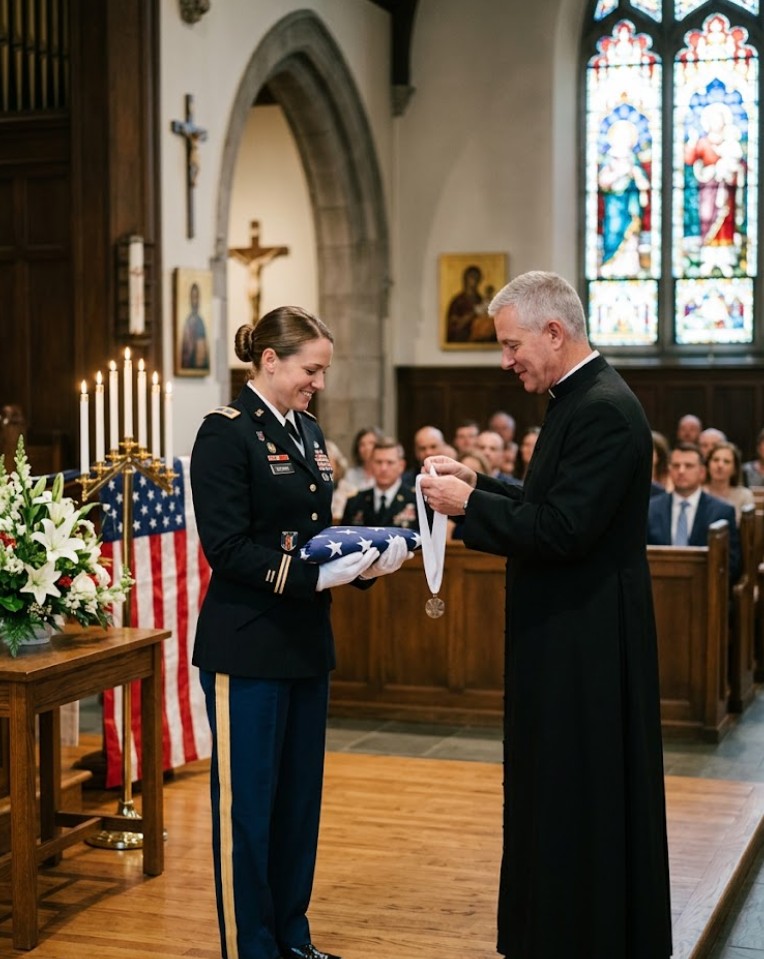
“Daniel Mercer.”
Before I could ask questions, he simply nodded once, as though honoring a promise made long ago.
Outside the church, my stepfather Thomas waited beside his car with a carefully arranged smile that unsettled me more than open hostility would have. Something inside me had already shifted. Grief was no longer standing alone. Doubt had entered beside it.
Instead of returning home after the funeral, I drove to a storage facility on the outskirts of town called Fairview Storage. The brass key opened a narrow unit covered in dust and silence. There was no hidden fortune waiting inside. No dramatic evidence of violence. Only a plastic storage bin and a thick manila envelope left behind by someone who understood that truth sometimes survives quietly, on paper, long after people are gone.
I sat on the concrete floor and began reading.
The documents revealed that my biological father, Daniel Mercer, had not simply disappeared from our lives after a tragic boating accident, as I had been told since childhood. The deeper truth was slower, colder, and far more deliberate. My stepfather had spent years systematically removing him from records, property rights, legal claims, and eventually even memory itself.
There were forged signatures. Altered transfers. Financial records. Custody documents reshaped to create the appearance of abandonment. It became painfully clear that Thomas had not merely replaced my father within the household — he had attempted to erase him completely.
Some forms of cruelty are loud and reckless. Others are patient. Administrative. Built through years of quiet manipulation that eventually hardens into accepted history.
As I read through the files, my phone vibrated repeatedly with messages from Thomas demanding I come home immediately. The urgency in his words no longer sounded parental. It sounded fearful.
Among the papers was an old photograph of my father in military uniform. He stood upright with the same posture people had often told me I carried naturally without understanding why. Beside the photograph were his military dog tags, worn smooth with age.
I held them for a long time before placing them around my neck.
What I felt in that moment was not hatred toward Thomas, though anger certainly existed. It was something steadier than that: the quiet realization that identity can be buried, distorted, or hidden, but not fully destroyed forever. Truth has a way of surviving in fragments until someone is finally ready to face it.
The legal battle that followed lasted months. Fraud investigations moved slowly, requiring patience and evidence rather than emotion. Piece by piece, records were corrected and false claims unraveled. My father’s name was restored where it belonged. So was mine.
My mother’s role in the story remained more difficult to hold. I came to understand that fear can trap people inside silence for years. That understanding did not erase the pain her silence caused, but it softened the temptation to reduce her entirely to weakness. Human beings often endure complicated loyalties badly, especially when fear and dependence become intertwined.
When everything finally ended, I left Savannah carrying far less certainty about family than I once had. But I also carried something more honest.
Not every inheritance comes through money or property. Sometimes what is passed down is a name, a truth, or the chance to stop living inside someone else’s version of your life.
And sometimes peace begins the moment you no longer agree to disappear.