I came home from my grandson’s funeral expecting silence.
At eighty-one, I thought I had already buried everyone I loved. First my husband, Walter. Then my daughter, Eileen. And now Calvin, my grandson, the last bright piece of my family.
For years, Calvin had come to my house every Sunday at noon. I always knew it was him before he knocked because he never really knocked. He just opened the screen door and called, “Grandma, I’m here.”
He was seventeen, tall, strong, always moving. Captain of his basketball team. Popular, but never cruel. He’d kiss my cheek, head straight for the kitchen, lift every pot lid, and ask if there was peach pie.
We ate together. Played cards. Argued about basketball. Then he fixed whatever I had been ignoring that week—the porch light, the sticky window, the loose hinge.
Sometimes he took extra food when he left.
“For the team?” I asked once.
He smiled. “Something like that.”
Then he died.
Collapsed during a game.
Seventeen years old.
At the funeral, people I didn’t know stood up and spoke about him like he had saved parts of their lives. One teammate said Calvin never let anyone sit alone. A teacher said he always found the kids everyone else had given up on.
One boy in the back said, “He made me believe I could still be decent.”
That sentence followed me home.
When I got back from the funeral, I dragged my suitcase up the walk and stopped.
My front door frame was cracked near the lock.
Fresh wood dust covered the step.
I pushed the door open carefully.
Then I smelled garlic. Onion. Pot roast.
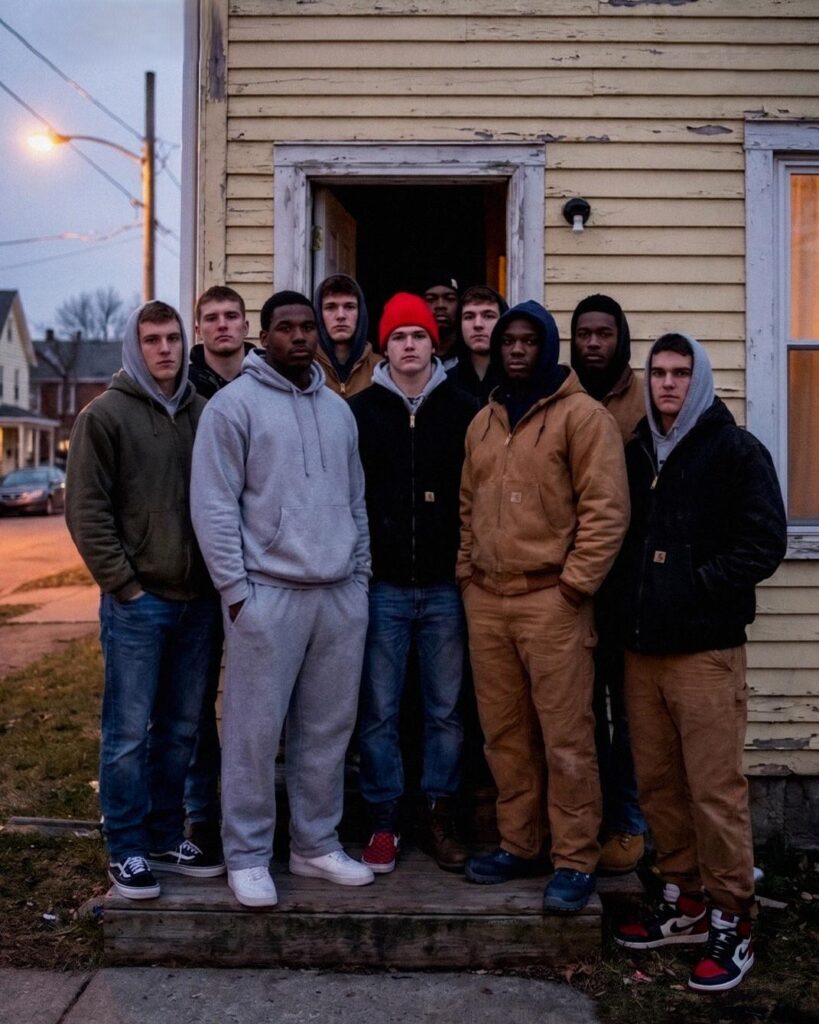
There were ten boys in my living room.
One was painting over the water stain near the hallway. One was repairing my shelf. One was scrubbing the floor. Two were carrying groceries into the kitchen. Tools were spread across the table, and my curtains were folded neatly, waiting to be rehung.
For a second, nobody moved.
Then I said, “What are you doing in my house?”
A tall boy with paint on his hands set down his brush.
“Ma’am,” he said carefully, “please don’t panic.”
“That depends entirely on what happens next.”
His name was Andre. He told me they knew Calvin. He told me Calvin had given him my address months ago and said that if anything ever happened, someone needed to check on me.
“He made me write it down,” Andre said. “I thought he was joking.”
A younger boy near the stove muttered, “He was not joking about you.”
They had come by after hearing about the funeral and found the damaged door. They thought someone had tried to break in while I was gone. So they checked the house, fixed what they could, brought food, and started cleaning.
It wasn’t perfect.
The paint line wobbled. The shelf wasn’t stained. One curtain rod still leaned against the wall. Calvin’s chair had new fabric on the seat, but one arm still showed the old worn patch.
It looked unfinished.
It also looked loved.
Andre explained that Calvin knew them from the courts by Mercer. Some had bad reputations. Some were close to becoming what people already assumed they were. But Calvin had stayed with them. Helped them. Fed them. Tutored them. Dragged them away from trouble more than once.
One said Calvin helped him through algebra.
Another said Calvin brought groceries when his mother got sick.
A third said Calvin drove his little brother to urgent care.
Then the youngest boy looked at me with red eyes and said, “He talked about you all the time. Your pie. Your rules. Your Sunday dinners. He said you were his favorite person on earth.”
That broke something open in me.
Andre said, softer now, “He said if anything ever happened to him, somebody had to make sure his Nana wasn’t alone.”
My knees gave out, and I sat down.
No one rushed me. They just stood there awkwardly, ten boys who could patch walls and fix locks but had no idea what to do with an old woman crying.
Then one of them said, “The roast is gonna dry out.”
I covered my face.
“Then somebody baste it.”
That should have been the end of it.
One strange afternoon. One meal. One thank-you.
But they kept coming back.
Andre finished the door frame and put in a stronger lock. Mateo fixed the leak under the sink. Rico cut the grass. Dev, the youngest, sat at my kitchen table and ate like he was afraid the food might disappear.
Soon, I knew all their names.
Andre. Mateo. Rico. Dev. Jamal. Luis. Benji. Trey. Noah. Omar.
I learned they weren’t a gang as much as boys who had learned to stand close because no one else stood with them. Some had mothers. Some had only old phone numbers they no longer called. Some had beds. Some slept wherever they could.
And I started cooking too much food again.
By the third Sunday, there were rules.
No swearing at my table.
No fighting on my porch.
Shoes off at the door.
And nobody was allowed to say they weren’t hungry if I could hear their stomach from across the room.
Rico pointed at me once and said, “That’s something Calvin would say.”
I told him, “Then he learned from the best.”
Then came the night it almost all fell apart.
Someone pounded on my door after eleven.
I opened it and saw Andre and Jamal carrying Dev between them. Blood soaked one side of his shirt.
I didn’t waste time.
“Lay him on the sofa,” I said. “Mateo, call 911. Now.”
Dev had been jumped two blocks over by people he had been trying to get away from. Andre was furious. Rico was worse.
“We’re not letting this go,” Rico said, heading for the door.
Andre grabbed his keys.
I stepped in front of them.
“Move, Nana,” Andre said.
It was the first time he called me that.
“No.”
“They hurt him.”
“And if you leave angry, they’ll hurt more than him.”
Rico slammed his hand against the wall. “So we do nothing?”
“Calling an ambulance is not nothing,” I said. “Keeping him alive is not nothing.”
They tried to move around me.
I planted my feet.
“You want to honor Calvin?” I said. “Then don’t walk out that door and become the thing he was trying to save you from.”
Nobody moved.
I pointed toward Dev, pale and shaking on my sofa.
“He needs you alive. Not arrested. Not bleeding. Not dead.”
Andre looked away first.
I kept going because once I started, I couldn’t stop.
“I buried my husband. I buried my daughter. I buried Calvin. I will not stand in this house and watch another child throw his life away because rage feels easier than grief.”
The room went silent.
Rico whispered, “We ain’t children.”
I looked him straight in the face.
“You are to me.”
That ended it.
Not forever. Not magically. But it ended that night.
The ambulance came. Dev got stitches and a cracked rib instead of a funeral. Statements were taken. A coach Calvin trusted came to the hospital. So did a counselor from an outreach center Calvin had once dragged Andre to.
Piece by piece, they chose help over revenge.
Now Sundays are loud again.
There are too many shoes by my door, too many elbows on my table, too many arguments about basketball in my living room.
Sometimes I still turn when the screen door opens, expecting Calvin’s voice.
“Grandma, I’m here.”
Sometimes I still cry after they leave.
But last Sunday, Dev held up a biscuit and asked, “Nana, are these for everybody or just the people you love?”
I looked around my table.
Andre pretending not to smile. Rico reaching for thirds. Mateo fixing my salt shaker because he can’t sit still. All those boys the world had already decided were trouble.
And I said, “Same thing.”
I thought I had buried everyone I ever loved.
Turns out Calvin had been leaving people behind for me.