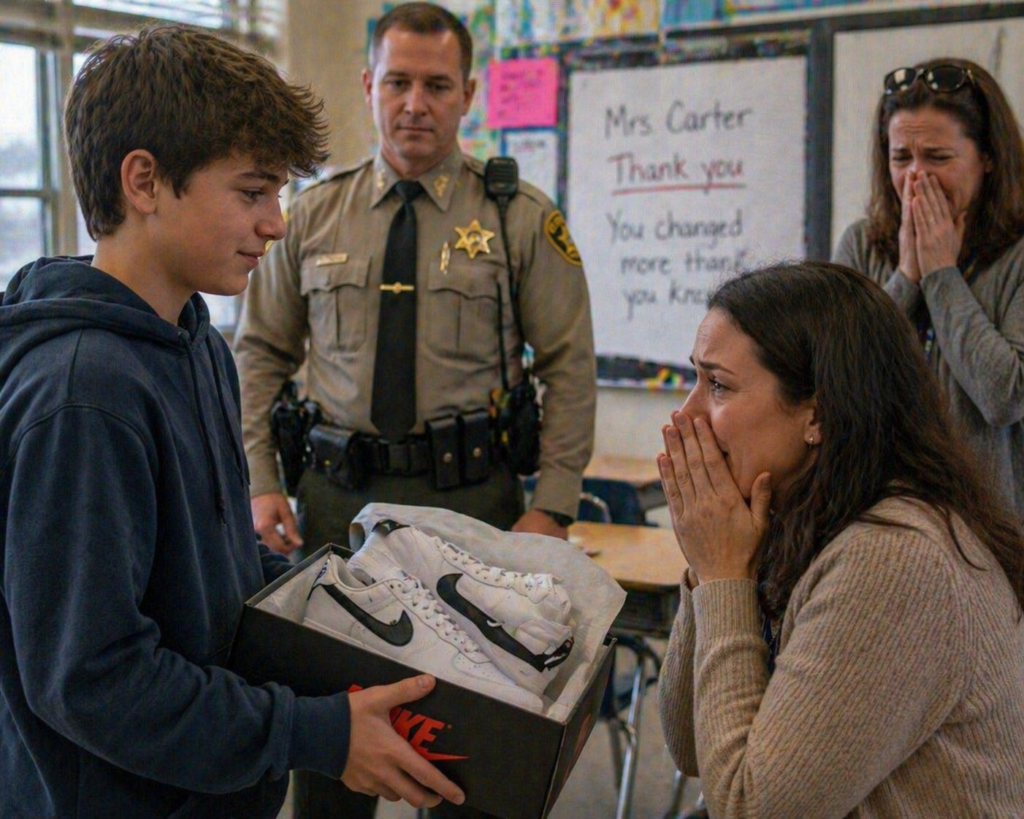
I didn’t think anything about that afternoon would stay with me beyond a quiet sense of pride.
Dilan came home looking like he’d wrestled the day and barely won—mud on his jeans, hair windblown, voice a little too flat. He said he needed a shower before dinner, and I let him go, assuming it was just another long school day.
Then I picked up his lunch box, and a receipt slipped out.
Men’s sneakers. Size 11. Paid in cash.
That was the moment the day tilted.
Dilan didn’t even wear that size. And when I checked the jar beneath his father’s photo—the one he’d been filling for months with small, hard-earned money—it was empty.
He didn’t lie when I asked. He just hesitated long enough for me to understand it mattered.
“It was for Mr. Wallace,” he said finally. “His shoes were bad.”
I knew the teacher. I knew what he meant to my son. A quiet man who had noticed Dilan when others overlooked him, who had given him space to exist without being singled out or pitied.
So I hugged my boy and told him he’d done something good.
And for a few hours, I thought that was the whole story.
Then the phone calls started.
First, the sheriff’s office asking if Dilan was home and safe.
Then a stranger blessing him before hanging up.
No explanations. Just fragments that made no sense on their own.
By morning, fear had filled in the blanks with things I didn’t want to imagine.
When I saw the patrol car in my driveway and the sheriff holding a plastic bag with Dilan’s torn white hoodie inside, my heart dropped into a place I couldn’t reach.
Because suddenly, it wasn’t about kindness anymore.
It was about consequences.
At the station, everything finally came into focus.
Dilan had taken Mr. Wallace to buy the shoes. Insisted on it, even when the man tried to refuse. He’d emptied his pockets at the register, determined to do something that mattered.
And on the way out, three men tried to rob them.
They grabbed the teacher’s briefcase.
And my son—my fourteen-year-old son—didn’t let go.
He held on.
Hard enough for his sleeve to tear. Long enough for the men to give up and run when a patrol car pulled in.
When I heard that part, my chest tightened in a way that pride couldn’t soften. Because bravery sounds noble until you picture your child standing in the middle of danger without hesitation.
“I didn’t want them taking it,” Dilan said, like that explained everything.
It didn’t. Not yet.
Then Mr. Wallace told us what was inside the briefcase.
An urn.
His daughter’s ashes.
He had been on his way to bring them to his mother so they could finally lay her to rest beside family.
If Dilan had let go, that would have been gone.
Not replaced. Not recovered.
Gone.
That was the moment everything shifted.
Not just the fear.
The understanding.
Because my son hadn’t just held onto a bag.
He had held onto something sacred.
And he didn’t even know it.
When I asked him why he hadn’t told me, his answer came quietly.
“You looked tired. I didn’t want to make it worse.”
That hurt more than anything else that day.
Because while I was trying to raise him, he had already learned how to carry things on his own.
Outside, there was a bicycle waiting.
New. Solid. Beautiful in a way that made it hard to look at directly.
Mr. Wallace had bought it after finding the paper in Dilan’s pocket—the one with bike listings and careful price comparisons.
It wasn’t a replacement.
It was recognition.
Dilan stood there staring at it like it might disappear if he blinked.
And for the first time since the sheriff showed up at my door, I saw something settle in him.
Not pride.
Something steadier.
Like the world had answered back.
On the ride home, he asked if I was mad.
I looked at him—really looked at him—and realized something I hadn’t been ready to admit before.
Raising a child is not about keeping them safe from everything.
Sometimes, it’s about watching them step into something bigger than your fear.
“No,” I told him. “I’m not mad.”
And I meant it.
Because somewhere between the empty savings jar, the torn hoodie, and that briefcase, my son had become the kind of person you don’t teach with words.
Only with example.
Only with time.
Only with love that doesn’t ask for anything back.
And somehow, without me realizing it…
he had already learned.