
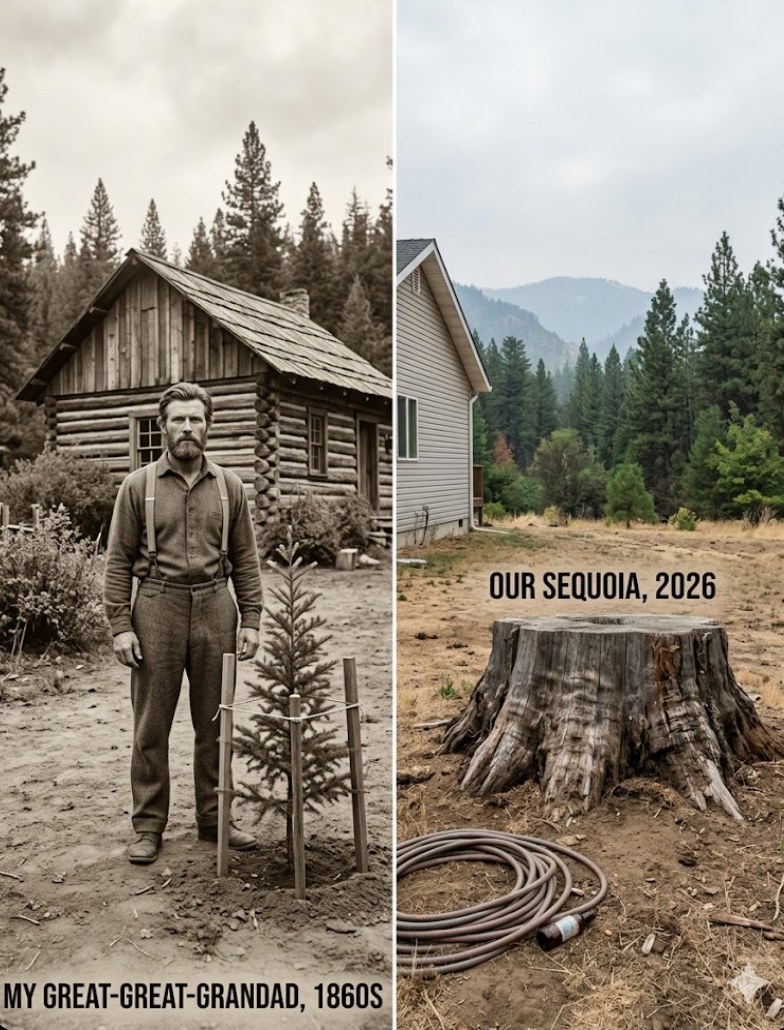
What Remains After the Tree Is Gone
I grew up believing the sequoia in our yard would outlast all of us. It had been planted generations ago by my great-great grandfather, when he arrived with little more than hope and the intention to stay. Every family photo, every milestone, somehow included that tree. It wasn’t just part of the yard—it was part of how we understood ourselves.
My neighbor, Roger, saw it differently.
To him, it was a problem—roots crossing into his yard, shade where he wanted light. I tried to meet him halfway. Trimmed branches, paid for maintenance, adjusted where I could. But his requests didn’t settle. Eventually, he wanted the tree gone entirely.
We left for a week. When we came back, it was already done.
The space where the tree stood felt wrong—too open, too quiet. Just a stump, deep tire marks, and sawdust where something steady used to be. My daughters stood beside me, trying to understand what had happened.
Roger came over shortly after, holding a cane made from that same wood. He didn’t deny it. He explained it as if it were a conclusion we had forced.
There wasn’t much to say in that moment. Anger wouldn’t restore anything.
So I chose something else.
Letting the Story Be Seen
The next day, I brought him a small package. Inside was a frame holding photographs—generations of my family standing beside that tree. The frame itself was made from what remained of the stump.
I didn’t accuse him. I didn’t argue.
I simply let the history sit where it could be seen.
Over the following days, I shared those photos with others in the neighborhood. Not as a campaign, just as part of remembering what had been there. People understood without needing much explanation.
Something shifted—not loudly, but clearly. The way Roger was met changed. Conversations shortened. Doors closed a little quicker.
Not punishment. Just distance.
When Understanding Arrives Late
A few days later, at a small neighborhood gathering, I spoke briefly about what it means to plant something that won’t be for you alone. Something that carries forward, even when you don’t see the end of it.
I didn’t mention Roger directly.
I didn’t need to.
The next morning, he came to my door. This time, there was no explanation—just an apology. Not perfect, but honest enough to recognize that something had been taken that couldn’t be replaced.
What Can Be Replanted
I handed him a pair of work gloves.
Not as forgiveness in words, but as an invitation to take part in what comes next.
That weekend, we planted a new sapling. The neighbors came. Not because it fixed what had been lost, but because it marked a decision—to build something again, together, even if it would take years to grow.
Roger worked quietly. No need to speak much.
Final Reflection
The old tree is gone. Nothing will make it the same again.
But something else remains.
Not just the memory of what stood there, but the choice that followed its loss.
Some things are taken in a moment. What replaces them is slower.
And sometimes, that slower work is what holds longer in the end.