Teachers rarely measure their impact in test scores alone. What they leave behind often lives in small, quiet moments—gestures that shape how a child feels about themselves long after the school day ends.
That’s what made one simple interaction at WG Nunn Elementary School resonate far beyond its setting.
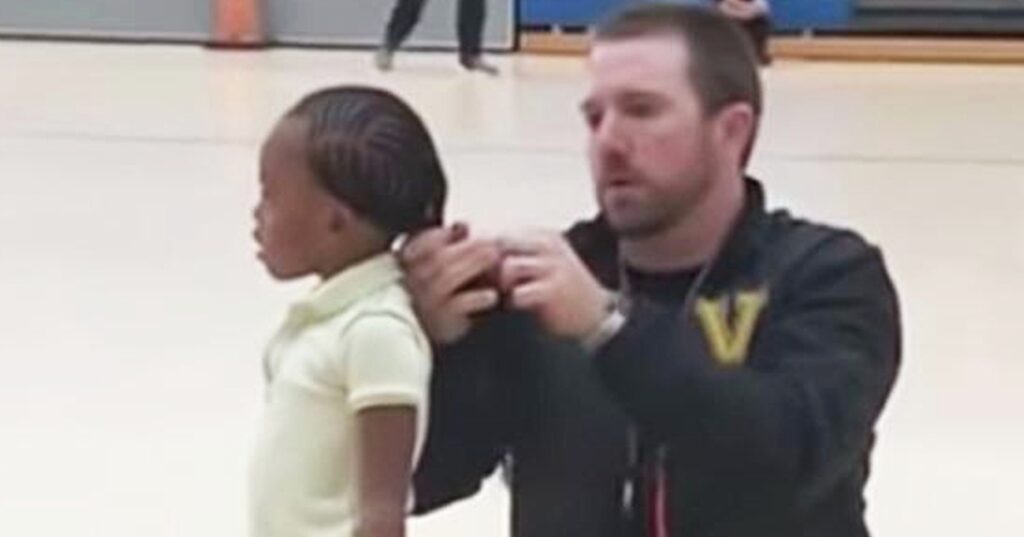
Jonathan Oliver, a P.E. teacher and youth basketball coach, was in the middle of a game when one of his kindergarten players approached him with a practical problem. Kristen Paulk just wanted to keep playing—but her hair kept falling into her face. She needed a ponytail.
It was a small request. The kind that could easily be brushed aside in a busy gym.
Instead, Oliver paused, knelt down, and—balancing himself on a basketball to meet her at eye level—carefully gathered her braids and tied them back. His movements were steady and focused, the kind of attention that quietly says: you matter.
He didn’t know anyone was watching.
But Kandice Anderson did. She recorded the moment and later shared it online with a simple caption: “When your job goes beyond teaching!”
What followed was something Oliver never expected. The video spread quickly, reaching thousands, then millions. Eventually, it caught the attention of Good Morning America, which invited him to speak about the moment that had struck such a chord.
His reaction remained grounded.
“It was shocking to me that it got that much attention because we all do it,”
he said, almost brushing off what others saw as remarkable.
To him, it wasn’t a viral moment. It was routine.
“We want to make them feel like they’re at home and that they enjoy being here. We try to love on them as much as possible. To me, it was just a ponytail.”
There’s something revealing in that response. For educators, acts of care are often woven so naturally into the day that they don’t register as extraordinary. But to those outside that daily rhythm, they stand out.
Oliver added humor to the moment too, acknowledging the limits of his hairstyling skills.
“It was a good thing she asked for a ponytail. Anything else, I’d say, ‘You better ask your mom.’”
For Miyah Cleckley, Kristen’s mother, the video carried a deeper reassurance. Watching someone treat her child with that level of care confirmed something every parent hopes for but doesn’t always see.
“I always know that Kristen is in very good hands with him,”
she said, noting that in her own home, hair care is often a shared responsibility.
“We have five girls and one son, so when I’m working, their father has to step in too.”
Her words reflect a broader truth: children flourish when the adults around them—at home and at school—form a network of support rather than separate worlds.
What makes this moment meaningful is not that it is rare, but that it represents something quietly universal. Across classrooms and playgrounds, teachers tie shoelaces, settle disagreements, notice changes in mood, and offer encouragement in ways that often go unseen.
They meet children where they are—sometimes literally, as Oliver did when he knelt down to Kristen’s level.
The act itself was simple. But the message behind it was not.
It was about dignity. About attention. About ensuring that even in a crowded gym, a small child didn’t feel overlooked.
In the end, the lesson wasn’t about basketball or even about helping with a hairstyle. It was about kindness expressed without hesitation.
And those are the moments children remember—not because they are dramatic, but because they are human.
Long after the game is forgotten, that feeling stays.