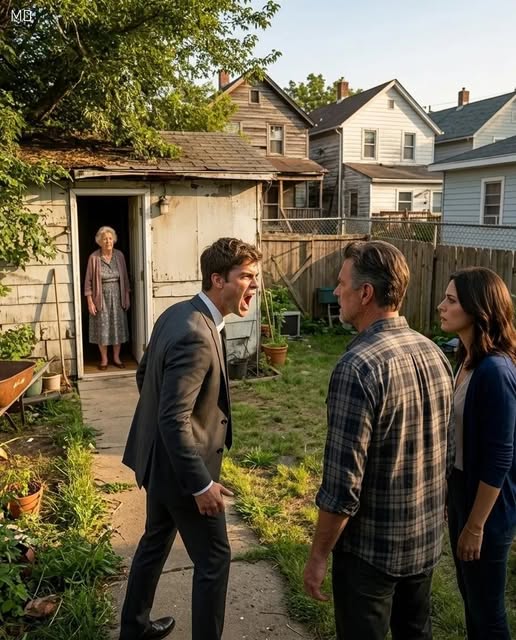
The rain hitting the metal roof had become something I stopped noticing after a while. At first, it felt loud and intrusive, like a reminder of where I was. But over time, it blended into the background, just another part of the space I had learned to accept. The shed behind Brian’s house was never meant for living. It was built for tools, for storage, for things that didn’t quite belong anywhere else. Yet somehow, it had become my place.
Brian always described it differently. He called it my “private space,” said I needed peace and quiet, that the house was too busy for me. And for a long time, I repeated those words to myself, trying to believe them. It’s easier to accept a smaller life when it’s presented as care. But deep down, I knew the truth was simpler than that—I had been moved out of sight because it made things easier.
The day Ethan arrived changed everything.
He wasn’t expected. When he opened the door and stepped inside, calling “Grandma?” in that familiar, gentle way, I felt something shift immediately. It wasn’t just surprise. It was the sudden awareness of how things looked to someone who hadn’t slowly adjusted to them. When he hugged me, I felt safe in a way I hadn’t allowed myself to feel for a long time. But when he pulled back and really looked around, I saw his expression change.
He noticed everything I had learned to minimize—the peeling paint, the exposed pipes, the lack of a real kitchen, the absence of a bathroom. To me, these had become inconveniences I worked around. To him, they were signs that something was wrong.
Brian came out quickly, speaking before silence could take hold. He explained things the way he always did, confidently and without pause, framing the situation as thoughtful and necessary. He talked about space, about noise, about how this was all for my comfort. But Ethan didn’t react the way I expected. He didn’t argue, didn’t raise his voice. He simply listened, then looked at his father and asked, “Why is she really living back here?”
It was such a simple question, but it carried more weight than any confrontation could have. For the first time, Brian didn’t have an immediate answer that sounded convincing.
Later, when we were alone, Ethan sat with me and didn’t rush me. That mattered more than anything. He didn’t try to fill the silence or guide the conversation. He just waited. And eventually, I told him what I had never fully admitted out loud.
After my husband died, everything felt unclear. Grief has a way of making decisions feel distant, like they belong to someone else. That was when Brian brought the paperwork. He spoke quickly, confidently, telling me it was for my protection, that it would make things easier. I trusted him, because he was my son and because I didn’t have the strength to question every detail.
Looking back, nothing happened all at once. That’s what made it so easy to accept. First, there were small changes—less control over finances, decisions made on my behalf. Then came suggestions about moving into a smaller space inside the house. Eventually, the idea of having my own “quiet area” outside was introduced, and by then, I was already used to adapting.
By the time I realized how much had changed, it felt too late to resist.
Ethan didn’t respond with anger. Instead, he became focused in a way that felt steady and reassuring. He found someone who understood situations like mine, someone who could look at the documents and explain what had really happened. We went through everything together—bank statements, papers I had signed, details I had overlooked. With each step, things became clearer. For the first time, I understood that what had been done wasn’t beyond repair.
The process of fixing it wasn’t quick or easy. It required patience, and there were moments when it felt overwhelming. But having someone beside me who wasn’t trying to manage the situation, but truly support me, made all the difference. Slowly, I began to reclaim what I had lost—not just financially, but personally.
Moving into my own apartment was a quiet milestone. It wasn’t large or luxurious, but it was mine in a way that nothing had felt in years. There was something deeply grounding about having real walls, a proper kitchen, and a door I could close knowing that my space was respected.
My relationship with Brian changed in ways that are hard to fully explain. There is distance now, and a kind of careful politeness where there used to be familiarity. That loss is still there, but so is something else—the realization that I no longer need to accept things just to keep peace.
Ethan visits often. He brings energy into the space, laughter that feels natural, not forced. He doesn’t treat me like someone who needs to be managed. He treats me like someone who matters.
When people hear my story, they often expect a dramatic turning point—a confrontation, a legal battle, something loud and decisive. But the truth is much quieter than that. Everything changed because someone noticed what didn’t make sense and cared enough to ask about it.
Sometimes, the most powerful thing you can do for someone isn’t to fix their situation immediately. It’s to see it clearly, without accepting the version that’s been normalized, and to stay long enough for the truth to come out.
That’s what brought me back—not just to a better living situation, but to a sense of dignity I didn’t realize I had been losing.
And it all started with one simple question.