Hospital Security Footage Reveals the Truth Behind a Child’s Broken Leg—and a Parent’s Cover-Up
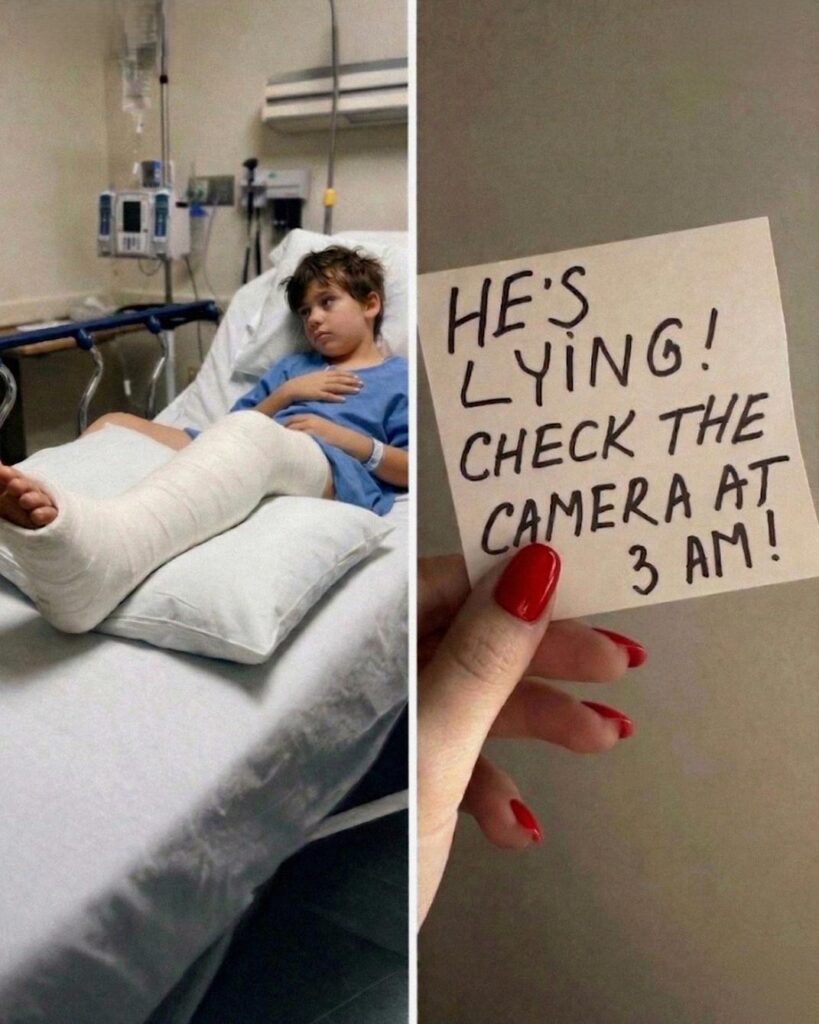
The hospital corridor felt longer than it really was, stretched by worry and the kind of silence that settles when something isn’t right. I sat beside my ten-year-old son, Howard, watching him try to be brave under the weight of a thick blue cast that looked too heavy for his small frame. He wasn’t crying, he wasn’t complaining—but his eyes were tired, and there was a quiet tension in him that didn’t belong to a simple accident.
Across the room, my ex-husband Jasper leaned back in his chair, repeating the same explanation he had given me earlier. Howard had fallen off his scooter. Just a normal accident. Nothing unusual. It was the kind of story that makes sense on the surface, the kind people accept without asking too many questions.
But something about it didn’t sit right.
Howard wouldn’t look at me. And every time I asked him what happened, Jasper answered for him—quickly, smoothly, as if he was trying to keep the story intact before it could unravel. That alone might have been enough to raise concern, but it was the moment the nurse came in that changed everything.
She moved through the room with quiet attention, checking vitals, adjusting small details. When Jasper reached over to fix Howard’s blanket, my son flinched. Not dramatically, not loudly—but instinctively. The kind of reaction you don’t fake.
The nurse saw it.
As she finished and passed by me, she slipped something into my hand so quickly it barely registered. A folded note. No eye contact, no explanation. Just a small gesture that carried weight.
When Jasper stepped out of the room, I opened it.
He is lying. Check the camera at 3 AM.
For a moment, I didn’t want to believe it. Not because it was impossible—but because believing it meant everything would change. Still, when behavior and words don’t match, ignoring it isn’t protection. It’s avoidance.
That night, just before three, I walked down to the security office. The building was quiet in a way hospitals rarely are during the day. The guard didn’t ask many questions—just pulled up the footage from Howard’s room and let the recording run.
At exactly 3:00 a.m., the door opened.
Jasper walked in.
But he wasn’t alone.
A woman followed him inside, someone I had never seen before. The way she closed the door behind her felt practiced, familiar. This wasn’t the first time she had been there.
Howard was asleep.
Jasper wasn’t checking on him.
He was talking to him.
The audio was clear enough to remove any doubt. He told Howard to repeat the scooter story. He told him not to mention that he hadn’t been there. He made it sound like telling the truth would create problems, like silence was the safer choice.
That was the moment everything shifted.
The injury hadn’t been a simple accident under supervision. Howard had been left with someone else—someone distracted enough that a child could get seriously hurt. And instead of taking responsibility, Jasper had chosen something else. He tried to place that responsibility onto our son.
Hearing Howard agree, quietly, reluctantly, was harder than seeing the footage itself. A child trying to protect a parent, even when it doesn’t feel right—that kind of pressure leaves a mark that isn’t visible.
I asked the guard to save the recording. When I walked out, it felt like I was carrying something heavy, not just evidence, but a truth I could no longer set aside.
Back on the pediatric floor, the nurse was waiting. She didn’t need details. A single look was enough. Within minutes, the hospital social worker was involved, and by morning, the situation was no longer something we could handle privately.
Jasper tried to continue as if nothing had changed. He spoke casually, asked routine questions, acted like the story was still intact. But when I told him what I had seen, the certainty left him. In its place came explanations, smaller versions of the truth, attempts to minimize what had happened.
“It was only ten minutes,” he said.
But time wasn’t the issue.
The issue was trust—and what happens when it’s broken in a way that involves a child.
He was taken aside for a formal discussion. Not as punishment, but as accountability. Because when a child is involved, the standard has to be higher than convenience.
Howard’s leg healed over time, as bones tend to do. But what stayed longer was the memory of being asked to hold a secret that didn’t belong to him. That part required care of a different kind. Therapy gave him a place to speak freely, without worrying about consequences or protecting anyone else.
One afternoon, after his final check-up, we walked slowly to the car. He was steadier now, more like himself. As we reached the parking lot, he looked up at me and said something simple.
“I don’t like keeping secrets.”
I stopped for a moment, realizing how much weight that sentence carried for him.
“You don’t have to,” I told him. “Not for anyone.”
That was the promise I should have made sooner.
The truth didn’t make things easier. It didn’t restore what had already been damaged. But it gave Howard something back that mattered more than comfort.
It gave him his voice.
And sometimes, that’s where real healing begins.