What Was Taken — And What Was Quietly Restored
It started with a phone call that didn’t match the day.
My sister’s voice carried urgency, the kind that tells you something has already gone too far. By the time I reached our family property on Pine Hollow Road, I understood why.
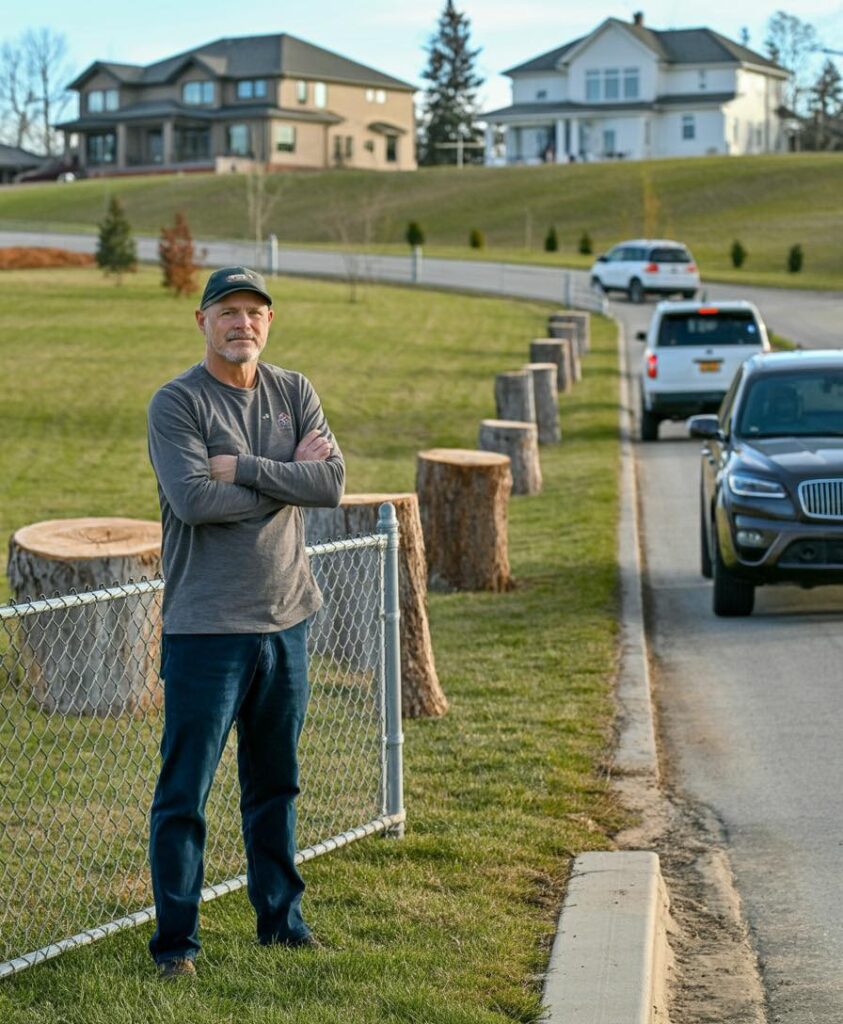
The trees were gone.
Not one or two—but six of them. Old sycamores that had stood longer than most things in my life. My father had planted some of them when I was young. The others had been there even before that, part of the land in a way that didn’t need explanation.
Now there were only stumps.
When Something Is Treated as Disposable
The clearing crew hadn’t acted randomly.
They had been sent.
From Cedar Ridge Estates, the development just east of our property. Their homeowners association had decided the trees were in the way of a better view.
That was the reasoning.
Simple. Efficient. Detached.
When I spoke to their president, Gordon Hale, he didn’t deny it. He leaned on a survey he claimed gave them the right to clear the boundary.
But I knew something he hadn’t accounted for.
What Was Already Decided Long Ago
Our land wasn’t undefined.
My grandfather had formalized an easement decades earlier. It allowed access across our property—nothing more.
No alterations. No removal. No expansion.
Just passage.
That distinction matters.
Because when something is written clearly, it doesn’t change just because someone finds it inconvenient later.
Responding Without Escalating
I didn’t argue at length.
I confirmed what I already understood with my attorney.
Trespass. Violation of easement terms. Property damage.
Then I took a step that didn’t raise voices, but made the situation clear.
I secured the road.
A chain across Pine Hollow Road—not to provoke, but to establish a boundary that had already been crossed.
Access is a privilege when it’s granted through agreement.
And agreements require respect.
When Reality Becomes Unavoidable
The reaction was immediate.
Frustration. Complaints. Pressure.
But none of that changes what is verifiable.
An independent county survey confirmed it plainly: every tree had been on our land.
There was no overlap. No ambiguity.
Just a decision made without regard for what was already in place.
What Resolution Actually Looks Like
Once that was established, the direction became clear.
Not through confrontation—but through consequence.
The homeowners association agreed to settle.
Not just financially—but physically.
Twelve mature sycamores were planted along the boundary. Not as decoration, but as restoration—and a reminder.
The line that had been ignored was now impossible to overlook.
What Remains
When the last tree was in place, I removed the chain.
Access was restored.
Not because nothing had happened—but because what needed to be addressed had been addressed.
The view they had tried to open will, over time, close again.
Quietly. Naturally.
Final Thought
Not every response needs to be loud to be effective.
Sometimes, it’s enough to understand what is yours, to stand by it without excess, and to allow things to return to balance through steady action.
Because boundaries don’t exist to create conflict.
They exist to preserve what matters.
💬 Do you think people respect boundaries more after they’ve been enforced—or understood beforehand?