The $600,000 Coat: What Was Hidden in Plain Sight
Family relationships are rarely straightforward. What appears distant or difficult on the surface can hold meaning that only becomes clear later. For one young man, that understanding came through something easily dismissed—a worn, moth-eaten coat.
Growing up, he knew his uncle as a demanding and critical figure. Conversations felt heavy, and gatherings often left others uneasy. Over time, distance replaced effort. When news of his uncle’s terminal illness reached the family, the response was quiet. Few chose to engage.
At his mother’s insistence, he visited. The hospital room held no resolution—only a shared silence between two people who had never learned how to speak openly to each other. His uncle, weakened, held a photograph and spoke little. The visit felt incomplete. When his uncle passed shortly after, the sense of loss remained distant, more reflective than emotional.
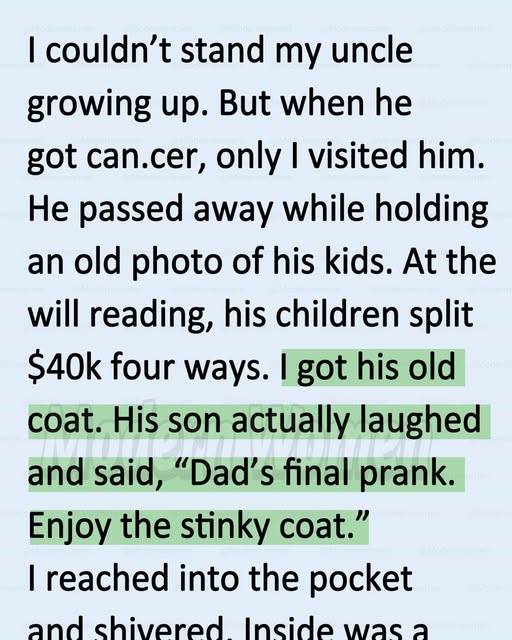
At the reading of the will, expectations followed familiar lines. The uncle’s children received their share. When it came to the nephew, he was given a coat—old, worn, and carrying no visible value. The reaction in the room was immediate. It was seen as a final gesture of disregard. He left without argument, carrying something that seemed to confirm what he had always believed.
For a time, the coat remained untouched. Then curiosity led him to check its pockets. Inside, he found a letter. The handwriting was the same, but the tone was not.
The message was simple. The coat had been chosen because it would be overlooked. It would not attract attention or conflict. It also explained something more difficult—that his uncle had noticed who came without expectation. The visit that felt insignificant had not been dismissed.
Along with the letter was a key.
At the bank, the contents of the safety deposit box were clear—documents, properly prepared, and a property of substantial value transferred to his name. Nothing hidden, only delayed in how it was revealed.
The coat remained.
Not as a symbol of the inheritance, but as a reminder of something quieter—
that presence, even when unnoticed, is rarely without meaning,
and that what holds value is not always placed where others are looking.