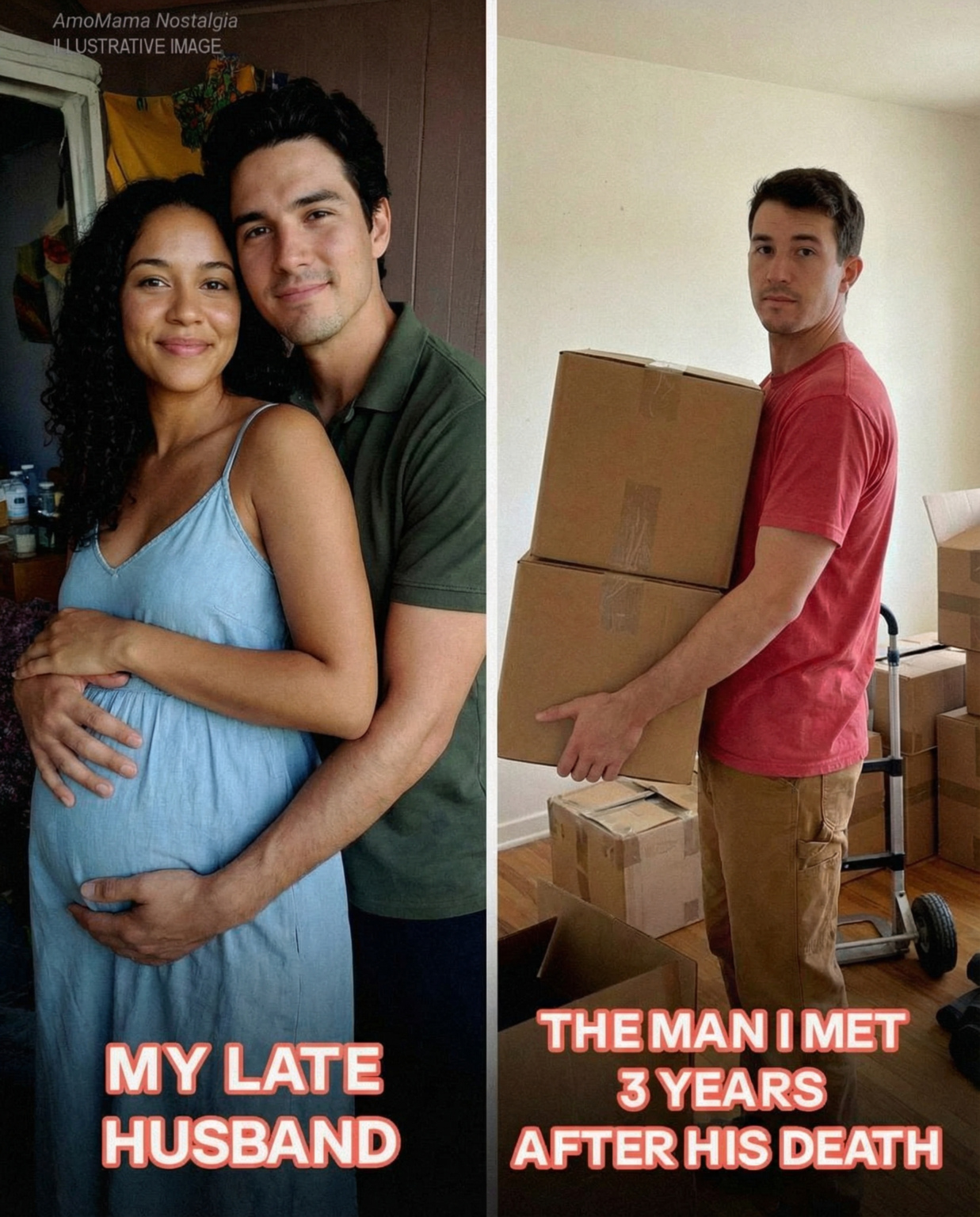
He froze.
For a moment, the hallway seemed to shrink, like the walls themselves were holding their breath. The little girl clung to his neck, sensing something was wrong, her small fingers tightening against his shirt.
“Katie…” he said quietly.
That one word broke something open inside me.
Not just because he said my name—but because of how he said it. The same way he used to when he wanted me to calm down. Soft. Careful. Almost afraid of hurting me with the truth.
My knees nearly gave out.
“It is you,” I whispered, my voice trembling. “You’re alive. You’re… alive.”
The woman behind him stepped forward, her face tense, protective. “What’s going on?” she asked, glancing between us.
He didn’t answer her.
He was still looking at me.
And in his eyes, I saw something I hadn’t expected.
Not relief.
Not joy.
But guilt.
Deep, suffocating guilt.
“I thought you were dead,” I said, my voice rising now, years of buried grief breaking through. “They told me you died. They buried you, Ron. I buried you!”
The little girl started to cry.
He gently put her down. “Go inside, sweetheart,” he said softly.
“But—”
“Go. It’s okay.”
She hesitated, then slipped past the woman and into the apartment.
Now it was just the three of us.
Three lives standing at the edge of a truth that couldn’t stay hidden any longer.
He ran a hand over his face.
“I never wanted you to find out like this,” he said.
My chest tightened.
“Find out what?” I demanded. “That my husband faked his death? That he left me alone—pregnant—to bury him and our child? What exactly was I supposed to find out, Ron?!”
The woman stepped back slightly, her expression shifting from confusion to something more fragile—fear, maybe, or realization.
He looked at her briefly, then back at me.
And then, finally, he said it.
“I didn’t fake it.”
Silence.
The kind that feels heavy, like it’s pressing down on your lungs.
“What?” I said, barely audible.
“I didn’t fake my death,” he repeated. “I was supposed to die that night.”
My mind struggled to follow.
“That doesn’t make any sense,” I said. “People don’t just accidentally get buried alive and come back three years later with a new family.”
His jaw tightened.
“I was in that crash,” he said slowly. “The car went off the road. Everything after that… is a blur. But I remember waking up. Not in a hospital. Not with doctors.”
He paused.
“With people I didn’t know.”
A chill ran through me.
“They told me I had been found unconscious. No ID. No memory. Severe head trauma. They said I was lucky to be alive.”
“But—your name, your records—” I started.
“They were gone,” he said. “The car was burned. No documents. No way to identify me. And I…” he swallowed, his voice cracking slightly, “I didn’t remember anything. Not you. Not our life. Nothing.”
The words hit me like waves, one after another, pulling me under.
Amnesia.
A part of me wanted to reject it, to call it a lie, to scream that it was too convenient.
But another part… the quieter part… felt something else.
Not relief.
But understanding.
Because life doesn’t always break cleanly. Sometimes it fractures in ways no one can predict.
“What about the funeral?” I asked weakly.
“They found a body in the car,” he said. “Badly burned. They assumed it was me.”
My stomach twisted.
A stranger had been buried in his place.
And I had mourned a man who wasn’t there.
“I tried to remember,” he continued. “For months. But nothing came back. They gave me a new identity. A chance to start over.”
“And you just… took it?” I asked, disbelief creeping into my voice.
He looked at the floor.
“What else was I supposed to do?” he said quietly. “I didn’t know who I was. I didn’t know where I belonged. I had no one.”
The woman stepped forward then, her voice gentle but firm.
“He told me everything,” she said. “From the beginning. I knew he didn’t remember his past.”
I looked at her.
Really looked.
She wasn’t the enemy I had imagined in the split second I saw them together.
She looked… human. Tired. Real.
“And the child?” I asked, my voice barely holding together.
“Our daughter,” she said softly.
The words landed like a quiet storm.
Not loud.
But devastating all the same.
For a moment, anger surged again.
Three years.
Three years of silence.
Three years of me learning how to breathe again without him.
And he had built another life.
Another family.
But then something unexpected happened.
The anger… didn’t stay.
It softened.
Because beneath it, there was something deeper.
Grief, yes.
But also a strange, reluctant clarity.
Life had moved forward.
For both of us.
Just not in the same direction.
“Do you remember now?” I asked him.
He hesitated.
“Not everything,” he admitted. “But when I saw you just now… something came back. Pieces. Your face. Your voice.”
Tears filled my eyes.
“So I wasn’t completely gone,” I said.
“Never,” he whispered.
There it was.
The truth that didn’t need shouting.
Love doesn’t always disappear.
Sometimes it just… changes form.
Becomes something quieter. Something less demanding.
Something that doesn’t try to claim what no longer belongs to it.
I wiped my tears, taking a slow breath.
“I lost our baby,” I said.
His face crumpled.
“I know,” he said softly. “I… felt it. Even before I remembered. Like something was missing.”
We stood there, connected by something invisible but undeniable.
Not as husband and wife anymore.
But as two people who had once shared a life—and a loss.
“I hated you,” I admitted. “For three years, I hated you for leaving me.”
“I know,” he said.
“But now…” I looked at the door behind him, where a child waited. A life he had built without knowing me. “Now I see… you didn’t leave. You were taken.”
He nodded, his eyes heavy.
“And you?” he asked. “Did you… find happiness again?”
I thought about it.
About the quiet apartment.
The small routines.
The slow rebuilding of a life that didn’t depend on anyone else.
“I found peace,” I said.
And in that moment, I realized something deeper.
Sometimes, closure doesn’t come as a neat ending.
Sometimes, it arrives in fragments.
In unexpected meetings.
In truths that hurt—but also heal.
“I think we should keep some distance,” I added gently. “For her sake. And for mine.”
He understood immediately.
“Of course.”
I turned to leave, then paused.
“Take care of your family,” I said.
“I will.”
As I walked back into my apartment, closing the door behind me, I expected to feel broken again.
But I didn’t.
There was pain, yes.
But also something else.
A quiet acceptance.
A knowing that what was meant for me had not been taken—it had simply taken another path.
And perhaps, in ways I couldn’t yet see, it had led me exactly where I needed to be.
{"post":98145,"page":1,"next":[{"id":98118,"title":"Retired Military Pilot Rescues Commercial Flight From A Midair Hijacking","url":"https:\/\/new24.info\/98118"},{"id":98115,"title":"My Daughter Vanished, and Years Later a Package Uncovered My Husband\u2019s Secret","url":"https:\/\/new24.info\/98115"},{"id":98112,"title":"ICON DEAD With heavy hearts, we announce the passing. When you find out who he is, you will cry: Check the first comment","url":"https:\/\/new24.info\/98112"},{"id":98109,"title":"From a Difficult Childhood to Worldwide Recognition: The Early Life Journey of Alain Delon","url":"https:\/\/new24.info\/98109"},{"id":98106,"title":"The Father Who Returned After Fifteen Years\u2014Only to Find His Daughter Living as a Servant in the Mansion He Bought for Her","url":"https:\/\/new24.info\/98106"},{"id":98103,"title":"Retired aircraft accident investigator issues chilling theory on New York plane crash","url":"https:\/\/new24.info\/98103"},{"id":98100,"title":"I Sewed My Daughter a Dress for Her Kindergarten Graduation from My Late Wifes Silk Handkerchiefs","url":"https:\/\/new24.info\/98100"},{"id":98097,"title":"BREAKING: Karoline Leavitt confirms President\u2019s new health battle\u2026","url":"https:\/\/new24.info\/98097"},{"id":98092,"title":"Comforting A Crying Pregnant Neighbor Revealed My Husbands Truly Darkest Secret","url":"https:\/\/new24.info\/98092"},{"id":98089,"title":"I Raised My Best Friends Son And A Secret Hidden In A Stuffed Bunny Changed What We Thought We Knew","url":"https:\/\/new24.info\/98089"},{"id":98086,"title":"One Elderly Mother Forces A Department Store To Remember Forgotten Seamstresses","url":"https:\/\/new24.info\/98086"},{"id":98083,"title":"Discovering The Hidden Family Connection Behind A Very Unique Childhood Birthmark","url":"https:\/\/new24.info\/98083"},{"id":98080,"title":"She Stayed Composed at the Funeral\u2014Her Reason Surprised Everyone","url":"https:\/\/new24.info\/98080"},{"id":98077,"title":"BREAKING NEWS!!! TRUMP just confirmed the passing! See it!","url":"https:\/\/new24.info\/98077"}]}