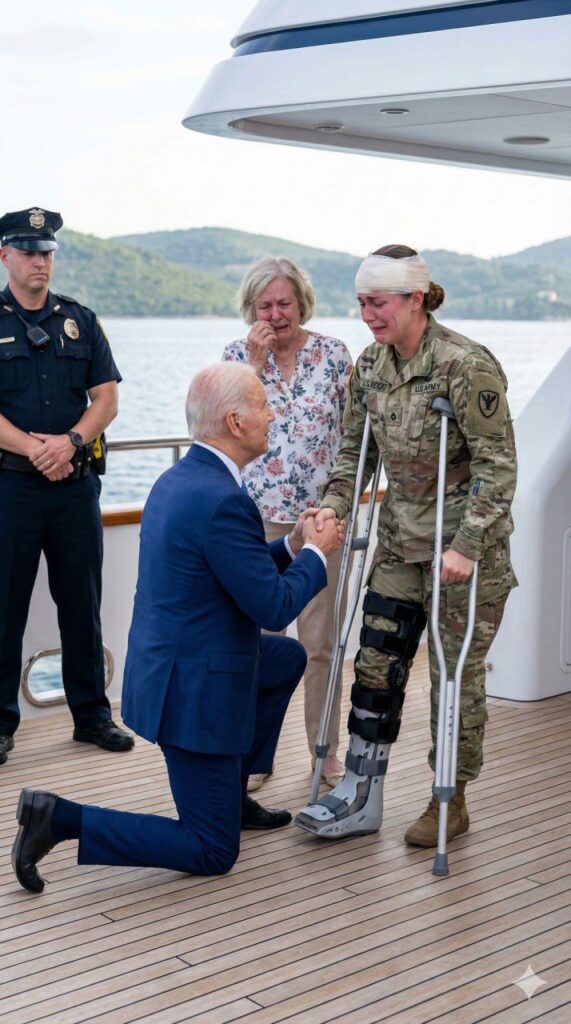
The lawyer didn’t ask me twice.
Within days, the quiet machinery of truth began to turn—documents pulled, accounts traced, signatures examined like fingerprints left behind in a life I thought I knew. While I lay recovering, learning to trust my leg again step by careful step, another kind of healing began—one that peeled back illusions I had carried since childhood.
What they found wasn’t just neglect. It was a pattern.
My parents weren’t struggling. They weren’t forced to choose between my health and survival. They had savings. Investments. Even a secondary account my mother had never mentioned, quietly growing over years. The boat hadn’t been a sacrifice—it had been a preference.
And I… had simply not been chosen.
The realization didn’t come like a storm. It settled slowly, like dust in a silent room. There was no shouting in my heart, no dramatic breaking point. Just a quiet, steady understanding: love that depends on convenience is not love you can lean on.
A week later, I walked—slowly but firmly—into their home.
The boat keys were on the table, glinting in the sunlight that poured through the wide windows. My mother was arranging flowers. My father was scrolling through something on his tablet. My sister sat curled on the couch, as if nothing in the world had ever asked anything difficult of her.
They looked up, surprised.
“You’re walking better,” my father said, almost impressed.
“I am,” I replied calmly.
No one asked how. No one asked what it cost.
For a moment, I studied them—not with anger, but with clarity. These were the people who raised me, yes. But they were also people who had drawn a line when it mattered most—and placed me on the wrong side of it.
“I know about the accounts,” I said quietly.
The room shifted. Subtle, but undeniable.
My mother’s hands paused mid-arrangement. My father’s eyes narrowed just slightly.
“I don’t know what you think you’re implying,” he began.
“I’m not implying anything,” I said. “I know.”
Silence stretched between us.
Then came the justifications—soft at first, then sharper. Timing. Priorities. Lessons. Responsibility. Words dressed up to look wise, but empty at their core.
I listened. Not to argue, but to understand fully.
And when they were done, I nodded.
“You didn’t have to choose me,” I said. “That was always your right.”
They seemed relieved for a second—thinking, perhaps, that I had come to forgive without cost.
“But I also don’t have to choose you anymore.”
That landed differently.
My sister scoffed, muttering something about drama. My mother looked hurt—genuinely, perhaps for the first time. My father said nothing, but his silence felt heavier now.
I didn’t raise my voice. I didn’t accuse. I didn’t insult.
Because the truth doesn’t need to shout.
“I’m not here to punish you,” I continued. “I’m here to be honest. What happened showed me something I can’t unsee. And I won’t pretend it didn’t matter.”
I placed an envelope on the table.
Inside was a simple document—nothing aggressive, nothing cruel. Just a formal notice that I had legally separated my financial ties, declined any future inheritance, and established independent protections around my assets.
Not revenge. Boundaries.
My mother picked it up with trembling hands.
“You’d really cut us off like this?” she whispered.
I met her eyes—not cold, not bitter, just clear.
“No,” I said gently. “You already showed me what I meant to you. I’m just accepting it.”
And in that moment, something shifted—not in them, but in me.
There was no triumph in it. No satisfaction. Just a quiet release.
Because sometimes the hardest truth isn’t that others fail you—it’s that you must stop asking them to be who they’ve shown they are not.
As I turned to leave, my brother’s name crossed my mind.
Later that day, I went to see him.
He was in a small rented garage, trying to work with borrowed tools, doing what he could to rebuild what he had sacrificed without hesitation.
When he saw me walk in—steady, upright—his face lit up.
“You did it,” he said, smiling wide.
“We did it,” I replied.
I handed him a box.
Inside was a full set of brand-new tools—better than the ones he had sold.
He stared at them, then at me.
“You didn’t have to—”
“I know,” I said. “But I wanted to.”
Because real love doesn’t calculate. It doesn’t wait for convenience. It shows up when it costs something.
That’s the difference.
And as I walked out of that garage, the weight I had carried for years felt lighter—not because everything was fixed, but because something inside me had finally aligned.
Mercy doesn’t always mean staying. Forgiveness doesn’t always mean returning. Sometimes it means stepping away without hatred, without revenge—just truth, and a quiet dignity that no one can take from you.
And in that space, something stronger than anger begins to grow.
Peace.
{"post":98036,"page":1,"next":[{"id":98014,"title":"Faith on Two Wheels: Breaking the Walls of Tradition at First Baptist","url":"https:\/\/new24.info\/98014"},{"id":98009,"title":"When I Hid Two Hundred Million And Asked For Help I Learned Who Loved Me Without A Price","url":"https:\/\/new24.info\/98009"},{"id":98005,"title":"Dem Senator Killed In Motor Vehicle Accident Over Thanksgiving","url":"https:\/\/new24.info\/98005"},{"id":98002,"title":"Police find girl missing since 2022: \u2018She was n\u2026 See more","url":"https:\/\/new24.info\/98002"},{"id":97999,"title":"If You Own Any of These Plastic Bowls, Doctors Say You Need to Throw Them Away","url":"https:\/\/new24.info\/97999"},{"id":97995,"title":"12 Signs a Woman Feels Comfortable and Happy in a Healthy Relationship","url":"https:\/\/new24.info\/97995"},{"id":97991,"title":"Public Reaction to Remarks by Elon Musk\u2019s Daughter on Donald Trump","url":"https:\/\/new24.info\/97991"},{"id":97988,"title":"A School Rivalry Took a Turn When One Student Kept Putting Another Down","url":"https:\/\/new24.info\/97988"},{"id":97985,"title":"I Didn\u2019t Realize What the Oil Cap Was For Until Someone Explained It","url":"https:\/\/new24.info\/97985"},{"id":97982,"title":"Experts Suggest Keeping an Important Emergency Item at Home for Preparedness","url":"https:\/\/new24.info\/97982"},{"id":97979,"title":"My Husband Died, Leaving Me With Six Children","url":"https:\/\/new24.info\/97979"},{"id":97976,"title":"Why Common Relationship Assumptions Don\u2019t Always Reflect Real Emotional Growth","url":"https:\/\/new24.info\/97976"},{"id":97966,"title":"\u2018New Nostradamus\u2019 who foresaw Iran war makes chilling prediction about Trump","url":"https:\/\/new24.info\/97966"},{"id":97970,"title":"In the Middle of a Freezing Blizzard Night, a 5-Year-Old Girl Refused to Let Go of a Terrifying Scarred Stray Dog Everyone Else Was Afraid Of","url":"https:\/\/new24.info\/97970"}]}