
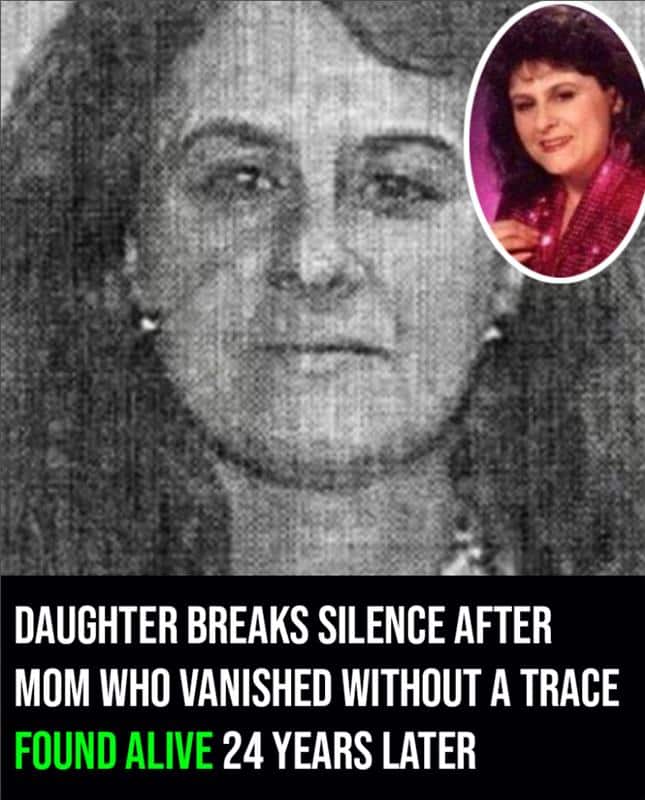
After more than two decades of unanswered questions, Amanda Smith is speaking about the moment she learned that her mother, Michele Hundley Smith, is alive.
Michele disappeared on December 9, 2001, from Eden, North Carolina. At the time, her absence set off an extensive search involving multiple law enforcement agencies, including federal authorities. Her children were 19, 14, and 7 when she vanished — old enough to remember, young enough to still need her.
For 24 years, there were no clear answers.
Earlier this month, the Rockingham County Sheriff’s Office confirmed that Michele had been located within North Carolina. Officials stated she was “alive and well.” At her request, her location has not been disclosed.
The announcement closed one long chapter. It opened another.
Amanda has shared her reaction openly — not with dramatic declarations, but with honest complexity.
“I am ecstatic, I am angry, I am heartbroken — I am all over the map,” she wrote.
Relief and grief rarely travel separately in moments like this. To learn that a missing parent is alive is a kind of miracle. To realize those years were lived apart by choice is something heavier.
Amanda has said she does not yet know whether she will rebuild a relationship with her mother.
“My initial reaction would be yes,” she admitted. “But then I think of all the hurt.”
Her words do not rush toward forgiveness, nor do they close the door. They sit where many real emotions sit — in the middle, where love and pain coexist without neat resolution.
She has also acknowledged something quieter: that people sometimes run from circumstances they cannot face. That understanding does not erase accountability. It simply resists turning a person into only their worst decision.
Forgiveness, she says, may come. Or it may not. And each sibling must choose their own path forward.
What remains undeniable is the cost of absence. Twenty-four years cannot be restored. Childhood milestones cannot be replayed. Time, once lost, does not return.
Yet knowing the truth — even a difficult truth — is different from living in uncertainty. Closure does not mean peace, but it does mean clarity.
This case is a reminder that life rarely resolves itself in simple terms. Relief can stand beside resentment. Hope can coexist with boundaries. And healing, when it comes, tends to move slowly and privately.
For Amanda and her family, the discovery that Michele is alive answers one question. What comes next will require patience, honesty, and the courage to face whatever truth unfolds — without denying the years that shaped them.
Sometimes closure is not an ending.
It is the beginning of a harder, but more honest, conversation.