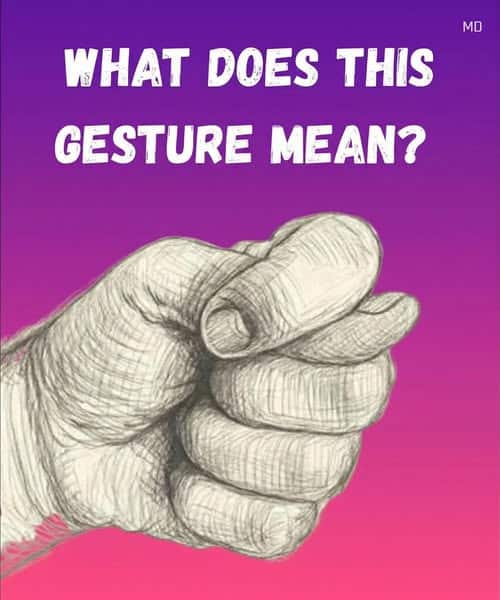
The human hand has always spoken before the mouth learned how to explain. Long before writing, before carefully chosen words, people shaped meaning through movement — offering comfort, warning, welcome, and refusal with nothing more than fingers and intention. Among these quiet languages, few gestures have traveled as far or changed as much as the small clenched fist with the thumb tucked between two fingers, often called the “fig.”
At first glance it looks almost awkward, even childish. Yet for centuries it carried weight far beyond its size.
In the ancient world, where unseen forces were believed to move through daily life, the fig gesture was not a joke or a habit. It was protection. People feared harm that came not only from swords and illness, but from envy, curses, and ill will. The gesture’s shape — echoing symbols of life and fertility — was thought to push back against destructive energy. It wasn’t aggressive. It was a quiet act of self-preservation, a way of saying: I will not receive what you wish to send.
Later, as societies hardened into strict hierarchies, the gesture took on a different role.
In villages where speaking openly could bring punishment, people learned to resist without noise. The fig became a discreet refusal — a way to say no when no could not be spoken aloud. It allowed dignity without confrontation, boundary without chaos. Not rebellion that burned everything down, but steadiness that protected the self.
Across cultures, its meaning drifted.
In some places it softened into a charm for luck and well-being, worn close to the body as a reminder of protection. In others it stayed sharp, a mocking sign that meant “nothing for you,” used to puncture pride or unreasonable demand. One simple shape, carrying both blessing and boundary, depending on the heart behind it.
And then, slowly, it became gentle.
For many families it transformed into a playful trick — the pretend stolen nose of a laughing child, a moment of harmless surprise and closeness. What once guarded against danger and injustice found a home in affection. The same fingers that had once pushed back against harm now created joy.
There is something quietly beautiful in that evolution.
As fears changed, so did the gesture. Yet its core remained the same: a small movement standing in for something larger — protection, refusal, connection.
Today, the world is louder. Disagreements are announced, argued, broadcast. Silence often feels like weakness. But the fig gesture comes from a time when restraint was strength, when presence mattered, when people understood that not every boundary needs a battle.
It reminds us that firmness does not require cruelty.
That resistance does not need rage.
That dignity can live in stillness.
There is wisdom in that.
Sometimes the strongest response is not escalation but clarity. Not shouting but choosing where your energy goes. The old gesture carried this lesson long before anyone put it into words: you can stand your ground without hardening your heart.
In its long journey — from spiritual shield, to quiet protest, to playful memory — the fig reflects something deeply human. We seek safety, we crave respect, and we long for connection. We learn, over time, that power handled gently lasts longer than power thrown like a weapon.
The hand has always known this.
And perhaps that is the quiet gift of remembering such gestures: they remind us that steadiness often outlives force, and that sometimes the most meaningful communication is the one that refuses harm without becoming harmful in return.
A small movement.
A firm boundary.
A calm heart.
Not loud — but enduring.
{"post":96087,"page":1,"next":[{"id":96064,"title":"The Biker Who Wept for His Dying Dog And The Subway That Learned Compassion","url":"https:\/\/new24.info\/96064"},{"id":96061,"title":"The Dad Who Rewrote His Identity for His Daughter A Story of Pain Love and Becoming Someone New","url":"https:\/\/new24.info\/96061"},{"id":96058,"title":"UNSENT MESSAGE \u2013 Police have found a seven-word message on Savannah Guthrie mother phone","url":"https:\/\/new24.info\/96058"},{"id":96055,"title":"Why Are Tree Trunks Painted White?","url":"https:\/\/new24.info\/96055"},{"id":96052,"title":"The Anniversary Dinner Joke That Backfired And The Party That Taught Him A Lesson In Respect","url":"https:\/\/new24.info\/96052"},{"id":96049,"title":"The 3 AM Rescue: How a Group of Bikers Saved a Dog Shelter From a Silent Killer","url":"https:\/\/new24.info\/96049"},{"id":96046,"title":"The Restaurant Snob\u2019s Costly Mistake: How a Mother\u2019s Frugal Attire Exposed Her Son\u2019s Manipulative Fianc\u00e9e","url":"https:\/\/new24.info\/96046"},{"id":96042,"title":"Curious Objects Found by Children During a Day at the Beach","url":"https:\/\/new24.info\/96042"},{"id":96039,"title":"How a Brief Moment Turned Into a Widely Shared Digital Story","url":"https:\/\/new24.info\/96039"},{"id":96036,"title":"The Real Reason Public Bathroom Doors Stop Short And What They Are Quietly Designed To Do","url":"https:\/\/new24.info\/96036"},{"id":96032,"title":"The Neon Retribution: A Lesson in Boundaries and Bridal Shine-","url":"https:\/\/new24.info\/96032"},{"id":96029,"title":"The Hidden Guardian: A Stepson\u2019s Secret Legacy","url":"https:\/\/new24.info\/96029"},{"id":96026,"title":"The Invisible Draft: 5 Signs Your Body Rejects Sleeping with a Fan","url":"https:\/\/new24.info\/96026"},{"id":96023,"title":"The $75 Million Inheritance and the Divorce Clause That Backfired","url":"https:\/\/new24.info\/96023"}]}